Case Study: Hard Engineering (AQA A-Level Geography): Revision Notes
📚Revision Notes
Case Study: Hard Engineering
Introduction to Heysham and Morecambe
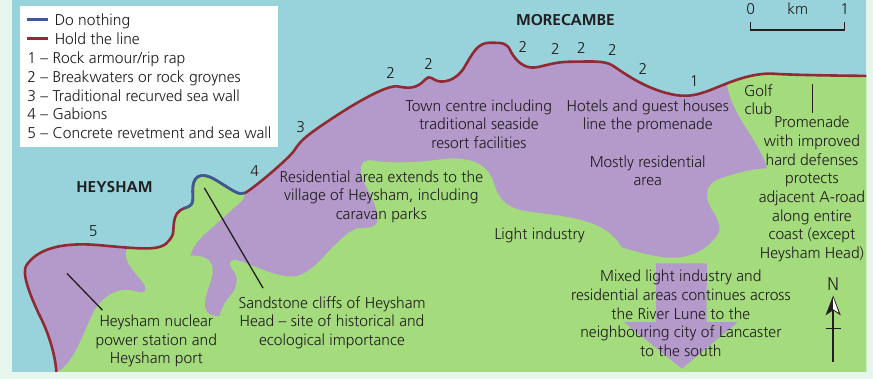
Morecambe in Lancashire provides a detailed example of how hard engineering strategies are used to protect coastal settlements. The local authority, Lancashire County Council, has implemented a range of coastal defence techniques along this 8.5 km stretch of coastline. This case study demonstrates the practical application of different hard engineering methods and how they can be combined to create an effective coastal management scheme.
Note
Coastal Management Options
Local authorities in the UK have four main strategic approaches when deciding how to manage their coastline, each with distinct implications for coastal communities and the environment.
-
Hold the line means maintaining the current position of the coastline by keeping existing defences in good condition or constructing new structures where the old ones are no longer effective enough
-
Do nothing but monitor is chosen for stretches where building or maintaining defences is not practical, either because the cost is too high or because there are few properties or important features to protect
-
Retreat the line involves allowing the coast to erode in a controlled and managed way, rather than trying to stop it completely
-
Advance the line means constructing new defences further out to sea than the existing coastline, effectively pushing the defensive boundary seaward
Background to the coastal defence scheme
The current protection along Morecambe's coastline resulted from a major improvement programme that took place between 1989 and 2018. This comprehensive scheme cost £30 million and transformed the coastal defences through a multi-phase approach. The project combined traditional hard engineering methods with more contemporary techniques, creating a sustainable management solution that would last for many years.
The scheme was carefully designed to balance the need for strong coastal protection with environmental concerns and aesthetic considerations. As the area includes important natural habitats, the engineers had to ensure that the defences would not damage the local ecosystem.
Strategy 1 – Rock armour/rip rap to enhance and protect the existing sea wall
This strategy involved placing large boulders of locally sourced limestone along the majority of the promenade and sea walls. The placement extended from the western end of the promenade to approximately one kilometre east of the town centre, creating a robust barrier against wave action.
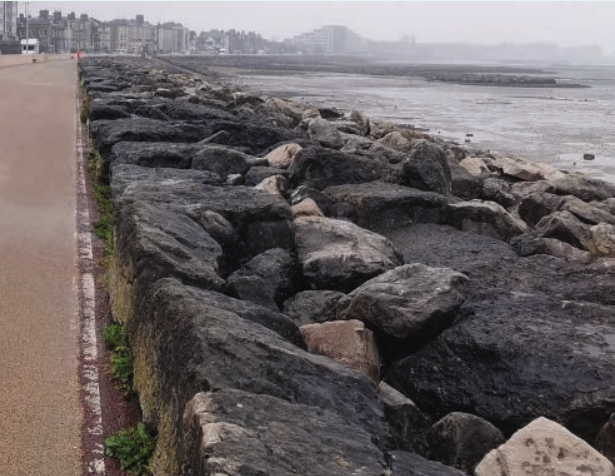
The individual stones used in this rock armour varied considerably in size, ranging from 0.77 tonnes to 7 tonnes, with an average weight of 3.5 tonnes. In total, an enormous 436,000 tonnes of rock armour was installed along this section of coast. This massive quantity of material provides substantial protection by absorbing and dissipating wave energy before it can reach the sea wall behind. The irregular shape and size of the boulders means that waves break up as they pass through the rock armour, significantly reducing their erosive power.
Note
How Rock Armour Works
The effectiveness of rock armour lies in its ability to dissipate wave energy. As waves crash against the irregular surface of the boulders, their energy is broken up and absorbed rather than being reflected back or transmitted through to the structure behind. The spaces between the rocks also allow water to drain through, reducing the pressure build-up that could destabilize the defence.
Strategy 2 – Breakwaters or rock groynes
Around ten breakwaters were constructed at regular intervals along the coastline in front of the town. These structures included several fish-tail shaped breakwaters, which have a distinctive curved design. Just under 1 million tonnes of locally sourced limestone boulders were used to build these offshore structures.
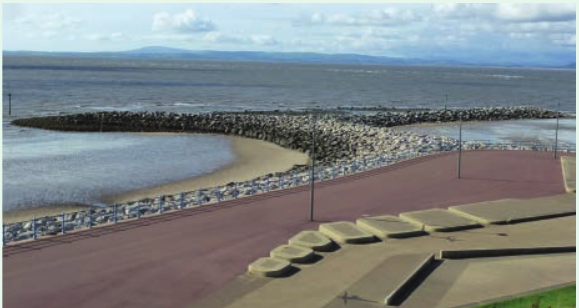
Breakwaters are built perpendicular to the coastline and extend out into the sea. Their purpose is to reduce wave energy before waves reach the shore, creating a calmer area of water between the breakwater and the beach. This reduction in wave energy helps to protect the shoreline from erosion and encourages sediment deposition in the sheltered areas. The fish-tail design is particularly effective at dissipating wave energy while also helping to trap sediment and build up the beach.
Note
Breakwater Positioning and Effect
The strategic placement of breakwaters creates sheltered zones behind each structure. These protected areas experience significantly reduced wave action, which allows suspended sediment to settle and gradually build up the beach. This demonstrates how hard engineering can create conditions that support natural coastal processes.
Strategy 3 – Repaired and replaced sea walls
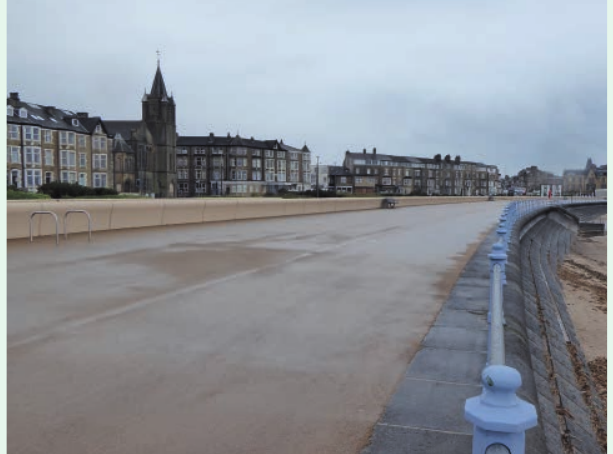
The traditional recurved sea wall that runs along the promenade received significant attention during the improvement programme. Between 2015 and 2018, four kilometres of 30-year-old sea wall that ran along the promenade was completely replaced with a modern, state-of-the-art design featuring a decorative wave reflection wall and flood wall.
Important
A recurved sea wall is a wall with a curved top section that deflects wave energy back out to sea rather than allowing it to overtop the structure.
This major replacement project cost £11 million and provides protection for 11,400 homes and 2,246 commercial properties in the area. The new wall was designed with a lifespan of 100 years, ensuring long-term protection for the community. The wave reflection feature at the top of the wall helps to throw wave energy back towards the sea, reducing the amount of water that can overtop the defences during storms.
Strategy 4 – Gabions
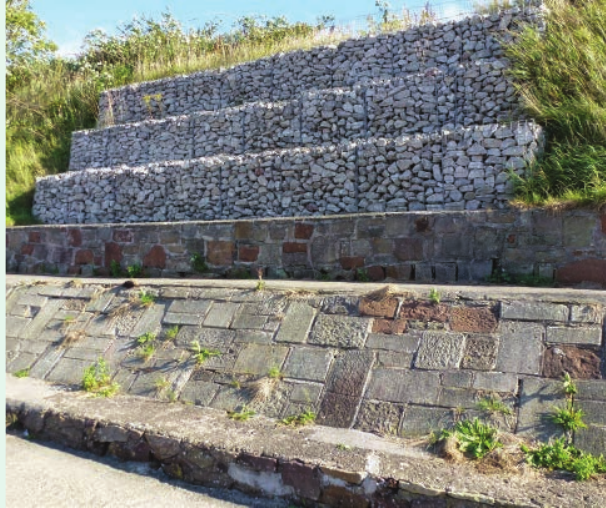
More than 500 gabion cages were installed at various locations along the coast to reinforce the defences. Each cage measured 2 metres × 1 metre × 1 metre and was filled with small limestone boulders.
Important
Gabions are wire mesh cages filled with rocks or stones. They are used in coastal defence because they are flexible, allowing them to settle and adjust to ground movement, while still providing substantial protection against erosion.
Gabions are particularly useful in coastal defence because they are permeable, allowing water to drain through them, which reduces the build-up of pressure behind the structure. They are also relatively quick and easy to install compared to solid concrete structures, and they can be stacked to create walls of different heights depending on the level of protection required.
Strategy 5 – Concrete revetment and sea wall
To the west of Heysham Head, extending towards the port and power station, the existing sea wall and large concrete revetments were carefully repaired and kept in place rather than being replaced.
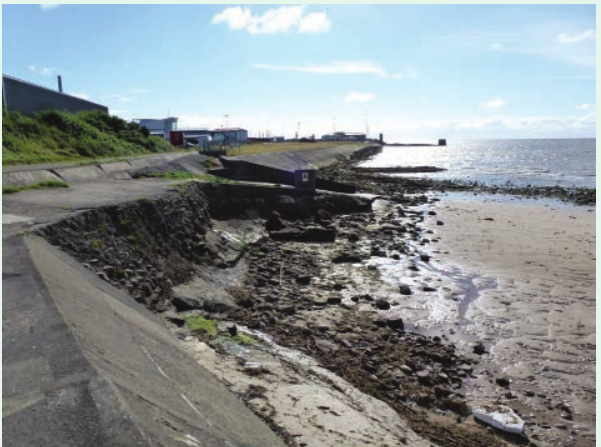
Revetments are sloping structures built on the face of a cliff or embankment to protect it from erosion. Concrete revetments are particularly durable and can withstand significant wave energy over many years. By repairing rather than replacing these structures, the project saved money while still maintaining effective coastal protection in this area.
Summary and additional features
Although the scheme relied heavily on traditional hard engineering strategies, the designers made sure that the work was carried out in a way that respected the environmental importance of Morecambe Bay. The bay is classified as both a Site of Special Scientific Interest (SSSI) and a Special Area of Conservation (SAC), which means it contains rare habitats and species that need protection.
Important
A Site of Special Scientific Interest (SSSI) is an area that is legally protected in the UK because of its wildlife or geological features. A Special Area of Conservation (SAC) is a European designation that protects important habitats and species.
Several sustainable practices were incorporated into the design. For example, sourcing the limestone locally for the rock armour and rock groynes meant that the material came from the same geological origin as the rocks forming the natural coastline. This created a more natural appearance and reduced environmental impact. Most of the quarries used were located less than 10 km away, which significantly reduced the carbon footprint associated with transporting the materials.
Note
Integration with Natural Processes
The positioning of the breakwaters was particularly clever. By spacing them at intervals along the coast, the engineers created a series of small sheltered bays between the structures. These bays encouraged natural beach formation, which acts as a form of soft engineering. The beach provides additional protection by absorbing wave energy before it reaches the hard engineering structures behind.
To further enhance this natural protection, the project included a substantial beach nourishment programme. Between Heysham and the eastern end of the promenade, 89,000 tonnes of sand and 19,000 tonnes of shingle were added to the beach. This increased the beach volume, providing a natural buffer against wave action and complementing the hard engineering defences.
Important
Beach nourishment is the process of adding sand and shingle to a beach to increase its size and volume, providing natural protection against coastal erosion and flooding.
The entire project was designed not just for protection, but also to improve the area for residents and visitors. The scheme includes combined cycle and walking paths along the promenade, playgrounds, and various artistic elements that make the seafront more attractive and enjoyable. This demonstrates how coastal management schemes can serve multiple purposes, providing both defence and social benefits.
Summary
Key Points to Remember
-
Morecambe and Heysham's coastal defence scheme cost £30 million (1989-2018) and protects 11,400 homes and 2,246 commercial properties along an 8.5 km stretch of coastline
-
Five main hard engineering strategies were used: rock armour (436,000 tonnes), breakwaters (just under 1 million tonnes of limestone), replaced sea walls (£11 million, 100-year design life), gabions (over 500 cages), and concrete revetments
-
The scheme was designed to be environmentally sensitive because Morecambe Bay is both an SSSI and SAC, with materials locally sourced to reduce carbon footprint and maintain geological consistency
-
Hard engineering was combined with soft engineering through beach nourishment (89,000 tonnes of sand and 19,000 tonnes of shingle), demonstrating an integrated coastal management approach
-
The breakwaters created small sheltered bays that encouraged natural beach formation, showing how hard engineering can work alongside natural processes to provide enhanced protection