Geology (AQA A-Level Geography): Revision Notes
📚Revision Notes
Geology
Geology plays a crucial role in determining how coastal areas respond to erosion. The type and structure of rocks along a coastline significantly influence the rate at which erosion occurs and the landforms that develop. Understanding geology helps explain why some coastlines have dramatic cliffs whilst others feature gentle slopes and sandy bays.
Note
The geological composition of a coastline is one of the most important factors determining its vulnerability to erosion and the distinctive features it develops over time.
Lithology
Lithology describes the physical and chemical properties of rocks, particularly their resistance to erosion and permeability.
Different rock types erode at vastly different rates. Harder rocks like granite offer the greatest resistance to erosional forces, while chalk provides moderate resistance. In contrast, weaker materials such as clay and sand erode much more quickly when exposed to wave action.
Permeability refers to how easily water can pass through rock. Rocks containing joints or cracks are particularly vulnerable because seawater can force its way through these weak points. Once water penetrates these lines of weakness, it makes the rock more susceptible to erosion from within.
Example
Rock Resistance Comparison:
Most Resistant:
- Granite - Very hard igneous rock, erodes extremely slowly
- Chalk - Moderately resistant sedimentary rock
Least Resistant:
- Clay - Soft sedimentary material, erodes rapidly
- Sand - Loose material with minimal cohesion
This variation in erosion rates between different rock types is known as differential erosion. When harder and softer rocks exist alongside each other, the softer rocks wear away faster, creating an uneven coastline with distinctive features like headlands and bays.
Important
Differential erosion occurs when rocks of varying resistance erode at different rates, producing a varied and distinctive coastline. This is a key process in creating the dramatic coastal features we observe today.
Rock structure and orientation
Beyond the rock type itself, the arrangement and orientation of rock layers dramatically affects coastal landforms.
Concordant coastlines
When rock layers run parallel to the coastline, this creates a concordant coastline. Here, the more resistant rocks (such as Portland limestone) act as a protective barrier, forming cliffs that shield the coast from erosion. The sea can only break through in a few places where weaknesses exist.
At a concordant coastline, you typically find:
- Long stretches of relatively straight cliffs
- Limited variation in coastal features
- Occasional breakthrough points where the sea has penetrated the resistant layer
- Weaker rocks protected behind the resistant outer layer
Note
Memory Aid: Think "Con-CORD-ant" - the rocks run in ACCORD (parallel) with the coast, creating harmonious, straight coastlines.
Discordant coastlines
In contrast, a discordant coastline forms when rock layers lie at right angles (perpendicular) to the coast. This orientation allows the sea to exploit differences in rock resistance more easily.
The sea attacks the weaker rocks preferentially, eroding them back to form bays. The harder, more resistant rocks remain protruding as headlands. This creates a much more varied and indented coastline.
At a discordant coastline, you find:
- Alternating headlands and bays
- Dramatic variation in coastal features
- Headlands made of resistant rock
- Bays carved into weaker rock layers
Note
Memory Aid: Think "Dis-CORD-ant" - the rocks are in DISCORD (at angles) with the coast, creating dramatic variations in coastal features.
Rock dip
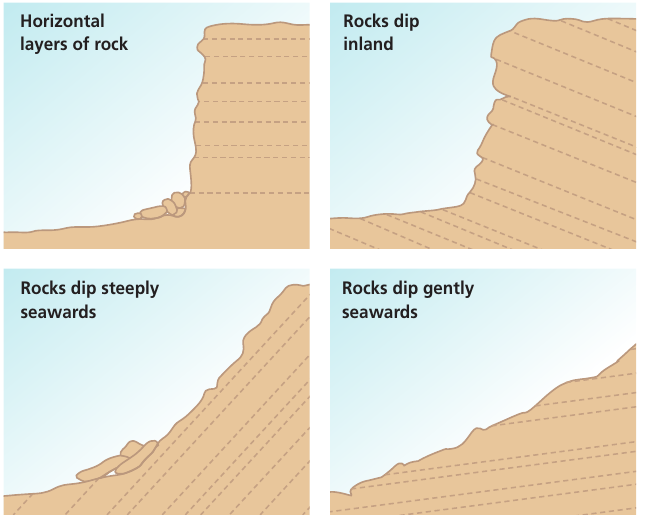
The angle at which rock layers are tilted - called the dip - also significantly influences cliff profiles and coastal features.
There are four main dip scenarios:
Horizontal strata: When rock layers lie flat and horizontal, they tend to produce steep, vertical cliff faces.
Rocks dipping inland: Where rock layers angle away from the sea towards the land, they create the steepest and most dramatic cliffs. The structure provides stability and strength.
Rocks dipping steeply seaward: When layers angle sharply down towards the sea, they still form relatively steep cliffs, though the rock structure may be less stable.
Rocks dipping gently seaward: Where layers slope gradually down towards the ocean, they produce much gentler, sloping coastal features rather than vertical cliffs.
Note
Memory Aid: Remember "Dip Direction Determines Design" - whether rocks dip inland or seaward fundamentally affects the cliff shape and steepness.
Case study: The Purbeck Coast
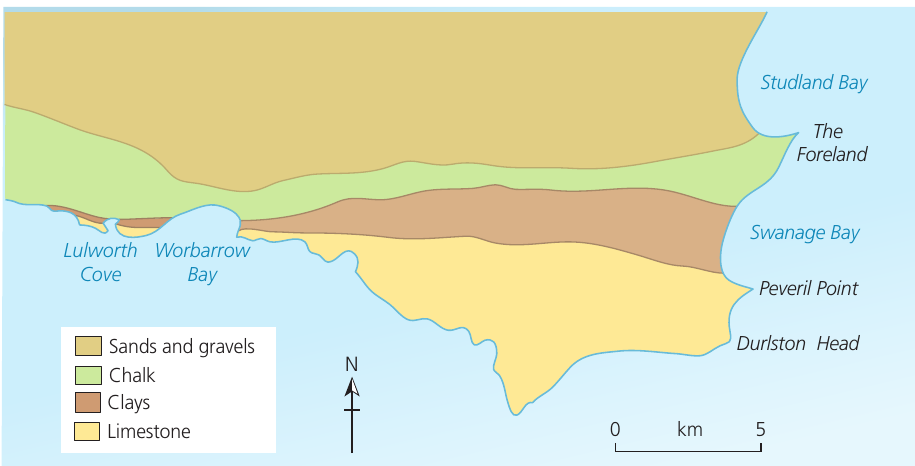
The Purbeck Coast in southern England provides an excellent example of how geology shapes coastlines, demonstrating both concordant and discordant features within a small area.
Southern section - concordant coastline
The southern portion of the Purbeck Coast shows a classic concordant arrangement. The resistant Portland limestone runs parallel to the coastline, forming protective cliffs. This barrier has largely prevented erosion, with only a few breakthrough points:
- Worbarrow Bay - a large area where the sea has broken through
- Lulworth Cove - a smaller breach in the limestone
Behind the limestone barrier lie weaker clay deposits, which the sea has eroded once it penetrated the outer defence.
Eastern section - discordant coastline
Moving east, the rocks run at right angles to the coast, creating a discordant coastline. Here, the sea has exploited the varying rock resistance to create a dramatic alternating pattern:
- Swanage Bay - a large bay carved into weaker clays and gravels
- The Foreland and Peveril Point - prominent headlands formed from resistant chalk and limestone
- Durlston Head - another resistant headland
- Studland Bay - formed in less resistant sands and gravels
This geological arrangement perfectly demonstrates how rock type and orientation work together to create distinctive coastal landforms.
Example
Purbeck Coast Analysis:
The Purbeck Coast demonstrates both types of rock orientation:
Concordant (Southern):
- Portland limestone barrier runs parallel to coast
- Protects weaker rocks behind
- Few breakthrough points (Worbarrow Bay, Lulworth Cove)
Discordant (Eastern):
- Rocks run perpendicular to coast
- Creates alternating pattern of bays and headlands
- Bays form in weak rocks (clays, gravels)
- Headlands form in resistant rocks (chalk, limestone)
Summary
Key Points to Remember:
-
Lithology (rock type) determines how quickly different parts of the coast erode, with granite being most resistant and clay eroding most rapidly
-
Differential erosion occurs when rocks of varying hardness erode at different rates, creating varied coastlines
-
Concordant coastlines have rocks parallel to the coast, forming protective barriers with few breakthrough points
-
Discordant coastlines have rocks perpendicular to the coast, allowing the sea to create alternating headlands and bays
-
Rock dip (the angle of rock layers) influences cliff steepness - inland dipping rocks form the steepest cliffs, whilst seaward dipping rocks create gentler slopes
-
The Purbeck Coast provides an excellent real-world example demonstrating both concordant and discordant features in close proximity