Hard Engineering (AQA A-Level Geography): Revision Notes
📚Revision Notes
Hard engineering
What is hard engineering?
Hard engineering involves making deliberate physical changes to the coastal landscape to protect it from erosion and flooding. This approach uses strong, resistant materials to create structures that can withstand the power of waves and tides.
Note
Hard engineering – Making a physical change to the coastal landscape using resistant materials, like concrete, boulders, wood and metal.
Unlike soft engineering (which works with natural processes like beaches and dunes to absorb wave energy), hard engineering works against nature by building defensive barriers. Each type of structure is typically constructed on a large scale and requires significant financial investment.
Types of hard engineering structures
There are several different approaches to hard engineering, each designed with a specific purpose. These methods can be used individually or in combination to protect different parts of the coastline.
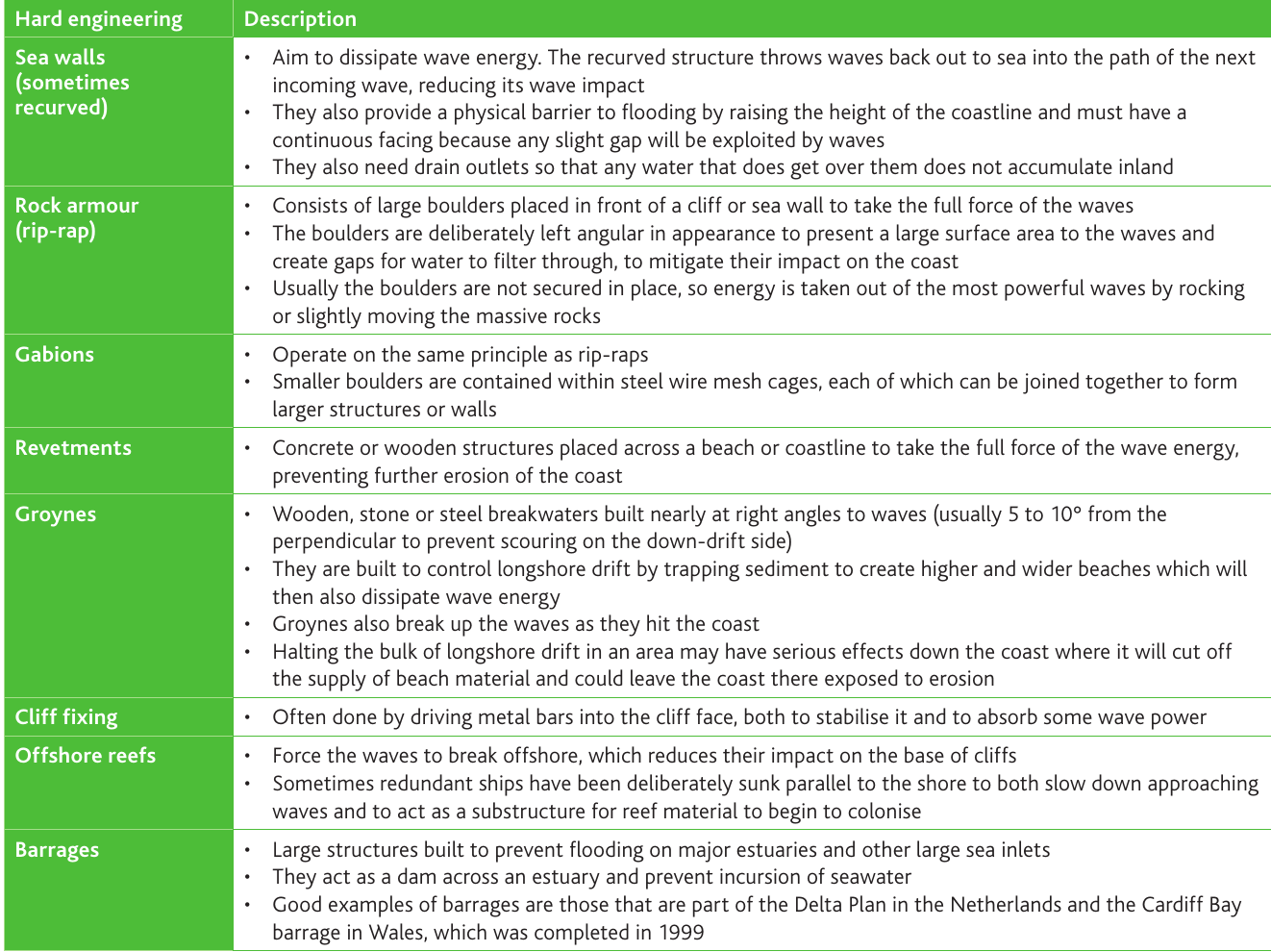
Sea walls (recurved)
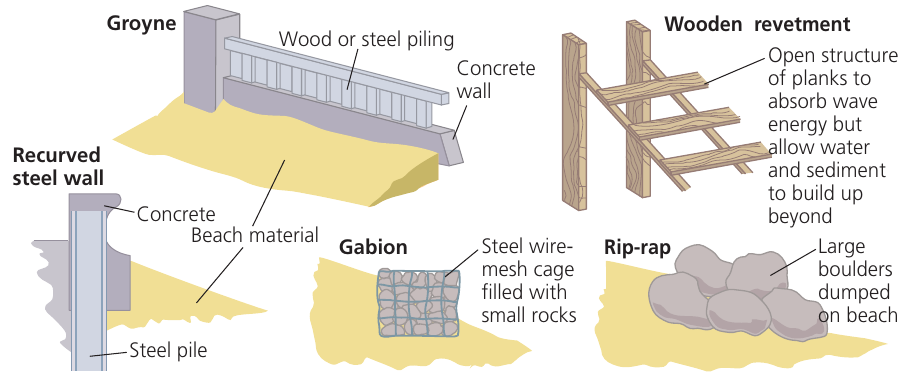
Sea walls are among the most recognisable forms of coastal defence. These structures are designed with a curved top section that redirects incoming waves back towards the sea. This recurved shape is crucial because it reduces the wave's impact by throwing it back into the path of the next approaching wave.
Note
The recurved design is what makes sea walls particularly effective – by throwing waves back, they create interference patterns that reduce the energy of subsequent waves approaching the coast.
Key features of sea walls:
- Provide a physical barrier against flooding by raising the height of the coastline
- Must have a continuous facing to prevent any gaps where waves could breach
- Require drainage outlets to prevent water accumulation on the landward side
- Can be extremely expensive to construct (over \£7,000 per metre)
Rock armour (rip-rap)
Rock armour uses nature's own materials - large boulders - to create an effective coastal defence. These massive rocks are deliberately placed in front of vulnerable cliffs or sea walls to take the full force of incoming waves.
How rock armour works:
- Large boulders are positioned with irregular, angular shapes
- This creates gaps between the rocks where water can flow through
- As waves crash against the rocks, their energy is absorbed and dissipated through movement and friction
- The boulders either remain stationary or move slightly, which further reduces wave power
- Presents a large surface area to incoming waves, spreading the impact
Gabions
Gabions operate on similar principles to rock armour but use smaller rocks contained within steel wire mesh cages. These cages can be joined together to form larger defensive structures or walls along the coastline.
The advantage of gabions is their flexibility - they can be constructed in various sizes and shapes to fit specific coastal features, while still providing effective wave energy absorption.
Revetments
Revetments are sloping structures made from concrete or wood that are placed across a beach or along the coastline. Their purpose is to absorb the full force of wave energy before it can cause further erosion.
The key characteristic of revetments is their positioning - they're built directly in the path of approaching waves, creating a barrier that prevents the coast behind them from being eroded.
Groynes
Groynes are one of the most distinctive coastal management features. These structures are built extending out from the beach into the sea at specific angles.
How groynes function:
- Constructed from wood, stone or steel as breakwaters
- Built nearly perpendicular to the coastline (typically 5 to 10° from the perpendicular)
- Designed to trap sediment moving along the coast through longshore drift
- Create wider, higher beaches on the updrift side, which then dissipate wave energy naturally
- Also break up incoming waves as they approach the shore
Important
Critical consideration with groynes:
While they build up beaches in one location, they can starve areas further down the coast of sediment. This can leave downdrift areas more exposed to erosion as their natural beach protection is cut off. The effects can extend considerable distances along the coastline.
Cliff fixing
This technique involves driving metal bars directly into unstable cliff faces. The bars help to stabilise the cliff structure and can also absorb some wave power as waves strike the coast.
Cliff fixing is often used in combination with other hard engineering approaches to provide comprehensive protection.
Offshore reefs
These structures are designed to break wave energy before it reaches the shore, reducing the impact on the base of cliffs and coastal defences.
Note
Offshore reefs can be purpose-built structures, but in some cases, redundant ships have been deliberately sunk parallel to the shoreline. These vessels act as artificial reefs, slowing approaching waves and providing a substructure where new reef material can naturally accumulate.
Barrages
Barrages are major engineering projects - large dam-like structures built to prevent flooding in estuaries and other significant sea inlets. They work by acting as a barrier across an estuary, preventing seawater from advancing inland during high tides or storm surges.
Notable examples include:
- The Netherlands Delta Plan - a comprehensive system of barriers protecting low-lying areas
- Cardiff Bay barrage in Wales (completed in 1999) - prevents flooding in Cardiff's historic bay area
Evaluating hard engineering
Advantages
Hard engineering structures offer several important benefits:
- Longevity: When properly maintained, these structures are effective throughout their designed lifespan
- Reliability: They provide consistent, predictable protection against wave action and flooding
- Asset protection: They justify their expense by protecting valuable buildings and infrastructure that would be far more expensive to replace
Disadvantages
However, hard engineering approaches have significant drawbacks:
High costs: Construction and ongoing maintenance require substantial financial investment. For example, building a sea wall can cost over \£7,000 per metre, and these structures need regular maintenance to remain effective.
Important
Knock-on effects: Defending one section of coastline can create serious problems elsewhere. Structures that interrupt natural processes (like groynes blocking longshore drift) can leave adjacent areas more vulnerable to erosion.
Visual impact: Many hard engineering structures are considered eyesores. They can be visually intrusive and change the character of natural coastal landscapes.
Habitat disruption: These structures physically alter the natural coastal environment, which can disrupt or destroy habitats that wildlife depend on. The presence of artificial barriers can prevent natural coastal processes from functioning properly.
Remember!
Summary
Key Points to Remember:
- Hard engineering uses resistant materials (concrete, boulders, wood, metal) to make physical changes to the coastline for protection against erosion and flooding
- The eight main types are: sea walls, rock armour, gabions, revetments, groynes, cliff fixing, offshore reefs, and barrages
- Hard engineering structures are typically large-scale, long-lasting, and expensive (sea walls can cost over \£7,000/m)
- While effective at protecting specific locations, these approaches can cause erosion problems elsewhere on the coast and may damage natural habitats
- Each type of structure works in a specific way:
- Some dissipate wave energy (sea walls, rock armour)
- Others trap sediment (groynes)
- Others prevent flooding (barrages)