Mass Movement (AQA A-Level Geography): Revision Notes
📚Revision Notes
Mass movement
What is mass movement?
Mass movement refers to the downslope movement of material under the influence of gravity. It is a frequent occurrence on coastlines, particularly along steep slopes. The specific type of mass movement that occurs at any given location depends on several important factors.
Factors affecting mass movement
Four key factors influence the nature and type of mass movement at a coastline:
- Cohesion within the sediment - how well the particles stick together
- Slope angle - steeper slopes are more prone to movement
- Grain size - the size of particles in the sediment affects how easily they move
- Temperature and saturation levels - the amount of water present and temperature conditions
Note
Understanding these four factors is essential for predicting where and when mass movement is likely to occur along a coastline. They work together to determine the stability of coastal slopes and the type of movement that will take place.
Types of mass movement
Mass movements can be classified into two broad categories: those that happen suddenly and rapidly, or those that develop gradually over an extended period. Here are the main types you need to understand:
Landslides
Important
Landslides occur when material composed of softer rocks or deposited sediment slips due to internal failure when the material becomes lubricated. This typically happens following periods of heavy rainfall.
When slopes contain softer rocks or loose deposited material, water can infiltrate and act as a lubricant. This reduces friction between particles, causing the material to fail internally and slide downslope. Heavy rainfall is the most common trigger for landslides in coastal areas.
Rock falls
These happen when cliffs are undercut by wave action at their base, or when slopes experience mechanical weathering processes such as frost action. As the cliff face becomes unstable due to undercutting or weathering, blocks of rock detach and fall to the base of the slope.
Mudflows
Important
Mudflows are rapid flows of fine material down a slope, triggered by heavy rainfall that saturates the soil beyond its capacity to absorb water.
During intense rainfall, fine-grained material becomes saturated with water. When excess water cannot percolate deeper into the ground because lower layers are already saturated, the surface layers become very fluid and flow downhill. The characteristics of the mudflow depend on:
- The level of saturation in the soil
- The type of sediment present
- The angle of the slope
On gentler slopes, these flows are sometimes called 'solifluction', which creates distinctive lobe-shaped features as material accumulates at the base of the slope.
Rotational slip or slumping
Important
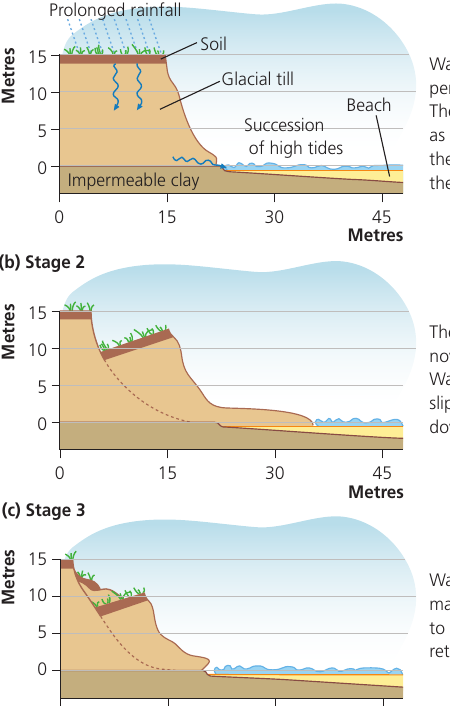
Rotational slip (or slumping) occurs where softer material sits on top of much more resistant materials. With excessive lubrication from water, entire sections of the cliff face move downwards along a curved (concave) slide plane, creating a rotation movement.
This type of mass movement is particularly common along the British coast where glacial deposits overlie impermeable clay layers. Good examples can be found in east Yorkshire and north Norfolk. The process creates distinctive slump features in the coastal landscape.
Note
British Coast Examples: Rotational slumping is especially prevalent where glacial deposits sit on top of impermeable clay layers. The east Yorkshire and north Norfolk coastlines provide excellent case studies of this process in action, where the geological structure creates ideal conditions for rotational slip to occur.
Example
Worked Example: The Three Stages of Rotational Slumping
The diagram above illustrates how rotational slumping develops through three distinct stages:
Stage 1 - Saturation and Weakening: Prolonged rainfall infiltrates the soil and glacial till. Water percolates into the permeable sand-and-gravel-rich glacial till but cannot penetrate the impermeable clay beneath. The upper layers become saturated as water accumulates, weakening the base of the cliff. Successive high tides also contribute to instability.
Stage 2 - Rotational Movement: The upper layers, now significantly heavier due to water content, lose stability. Water acts as a lubricant, creating a concave slip plane along which the cliff slides down in a rotational movement.
Stage 3 - Removal and Repetition: Wave action removes the slumped material at the cliff base, allowing the erosion process to repeat. The cliff potentially retreats further inland over time.
Soil creep
Important
Soil creep is the very slow, almost imperceptible, but continuous downslope movement of individual soil particles.
This is the slowest type of mass movement. While the exact causes are not fully understood, most geographers agree that soil moisture plays a crucial role, working alongside various weathering processes to cause the gradual particle-by-particle movement. Although slow, over long periods this can move significant amounts of material.
Run-off
Run-off is another significant process operating on coastlines and is closely linked to mass movement. It takes several forms:
- Stream emergence - a stream flowing out onto a beach in a bay, carrying large quantities of sediment (load) during flood events
- Cliff cascades - streams flowing over cliff edges, carving V-shaped grooves into the cliff face as they do so
- Surface flow - water simply flowing over the ground surface to reach the coastline
Note
Run-off assists and triggers many of the mass movement processes described above by adding water to slopes, increasing saturation levels and reducing stability. This demonstrates the interconnected nature of coastal processes.
Remember!
Summary
Key Points to Remember:
- Mass movement is the downslope transfer of material under gravity, common on steep coastlines
- Four key factors control mass movement: cohesion, slope angle, grain size, and saturation levels
- Landslides, rock falls, and mudflows are rapid forms of mass movement triggered by heavy rainfall, wave action, or weathering
- Rotational slumping occurs where soft material overlies resistant layers, common where glacial deposits sit on impermeable clay (e.g. east Yorkshire and north Norfolk)
- Soil creep is extremely slow but continuous, while run-off provides water that triggers and supports mass movement processes