Sediment Sources, Cells and Budgets (AQA A-Level Geography): Revision Notes
📚Revision Notes
Sediment Sources, Cells and Budgets
Introduction to sediment in coastal systems
Sediment plays a vital role in coastal systems, functioning as a key input alongside energy. Understanding where sediment comes from, how it moves, and where it accumulates helps us comprehend how coastlines develop and change over time. The balance of sediment within a coastal area determines whether beaches grow or shrink, and whether the shoreline advances seaward or retreats inland.
Note
The sediment balance concept is fundamental to understanding coastal dynamics. Just as a system needs energy to function, it needs sediment as the raw material that shapes and reshapes coastal features over time.
Sources of coastal sediment
Coastal sediment originates from multiple sources, each contributing different types and quantities of material to the coastal system:
- Rivers and streams: Transport sediment from inland areas and deposit it where they meet the sea
- Estuaries: Act as temporary storage areas where river sediment accumulates before being redistributed by tides and waves
- Cliff erosion: Provides material directly from the land as waves attack and break down coastal cliffs
- Offshore sand banks: Supply sediment that waves and currents push towards the shore
- Biological sources: Include shells, coral fragments, and skeletons of marine organisms that break down into sediment
Note
The relative importance of each source varies along different stretches of coast. Some beaches rely heavily on river inputs, whilst others are built primarily from eroded cliff material. This variability means that coastal management strategies must be adapted to local sediment sources.
Sediment cells
Coastlines can be divided into manageable sections for study and management purposes. These divisions recognise that sediment movement patterns are not uniform along an entire coast.
Important
Sediment cells are distinct stretches of coastline separated from neighbouring areas by well-defined boundaries, such as prominent headlands and areas of deep water.
Along the coastline of England and Wales, researchers have identified 11 major sediment cells (also called littoral cells). In theory, these cells function as closed systems where sediment inputs balance outputs, with little exchange between adjacent cells. However, the reality is more complex – sediment can and does move around headlands and into neighbouring cells, particularly during storms.
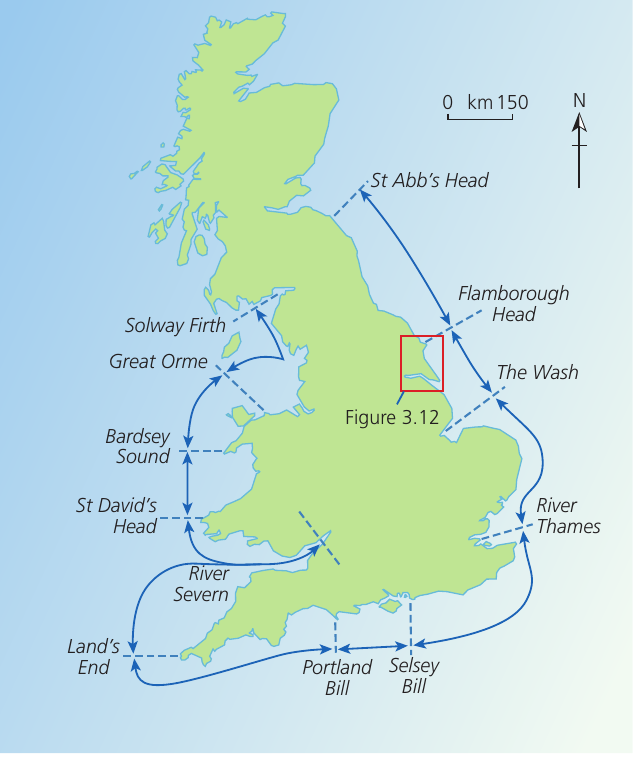
The boundaries between cells typically occur at:
- Major headlands that interrupt longshore drift
- Stretches of deep water where sediment cannot easily move along the coast
- Estuaries that act as sediment sinks
Sub-cells
Large sediment cells are often subdivided into smaller units called sub-cells. This subdivision allows for more detailed study and more targeted coastal management strategies.
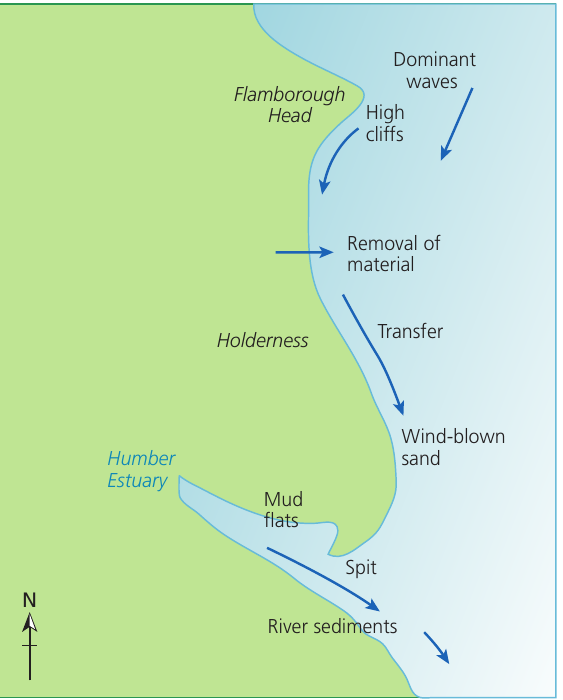
A well-documented example is the sub-cell between Flamborough Head and the Humber Estuary on England's east coast. This area demonstrates how sediment moves through a coastal system:
Example
Worked Example: Sediment Movement in the Flamborough Head to Humber Estuary Sub-cell
This sub-cell demonstrates a complete sediment pathway from source through transport to sink:
Source (Input):
- Dominant waves from the northeast approach Flamborough Head
- High cliffs are eroded, releasing material into the coastal system
- The River Humber contributes additional sediment
Transport (Movement):
- Sediment is removed from the base of the cliffs
- Longshore drift transfers material southward along the Holderness coast
- Wind blows sand inland from the beach
Sink (Output/Storage):
- Material accumulates in mud flats within the estuary
- A spit forms where sediment is deposited
This illustrates the complete sediment pathway from source (cliff erosion) through transport (longshore drift) to sink (estuary deposition).
Coastal sediment budgets
Sandy beaches and muddy shorelines exist because sediment has accumulated there over time. For these features to persist, the combination of wave, current, and tide action must be sufficient to keep the material in place rather than removing it.
Important
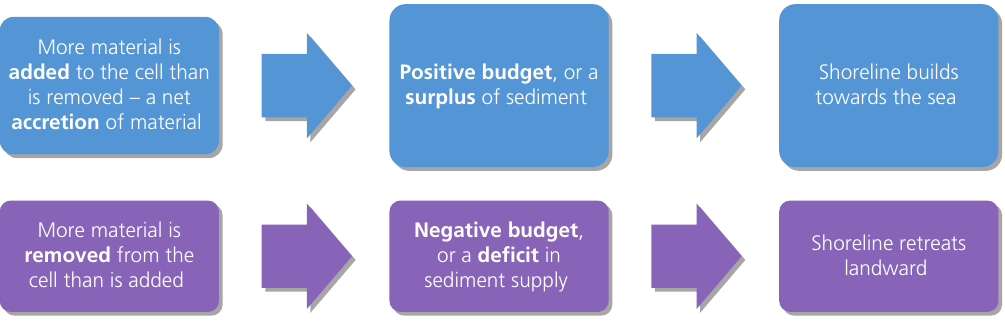
The coastal sediment budget represents the balance between sediment being added to and removed from the coastal system within each individual sediment cell.
Think of the sediment budget like a bank account. Material can be deposited (credited) or withdrawn (debited), and the balance determines whether the "account" is growing or shrinking.
Positive sediment budget
When more material is added to a section of coast than is removed, a net accretion of sediment occurs. This creates a positive budget or sediment surplus. The result is that the shoreline builds outward towards the sea – a process called progradation. Beaches grow wider, and new land may form through deposition.
Negative sediment budget
When more material is removed from a section of coast than is added, a sediment deficit develops. This creates a negative budget with a sediment supply shortage. The shoreline retreats landward as erosion outpaces deposition. Beaches become narrower, and coastal land is lost.
Understanding sediment sources and sinks
The sediment budget framework helps identify:
- Sources: Where sediment enters the coastal system (e.g., eroding cliffs, rivers, offshore banks)
- Sinks: Where sediment is stored or removed from the system (e.g., estuaries, dunes, offshore movement)
Note
Calculating sediment budgets requires identifying all sources and sinks within a cell, then estimating the amount of sediment added and removed each year. This is extremely challenging work, and most calculations rely on complex computer models alongside field observations and estimations.
Coastal erosion processes control the deficit level by removing material from the shoreline. If removal exceeds addition, the coastline will inevitably retreat. Understanding these budgets is essential for effective coastal management and predicting future coastal changes.
Coastal geomorphological processes
Coastal landscapes develop through the interaction of various processes operating at different rates and scales. These processes, driven by energy inputs, continuously modify the shape and character of the coastline. Over time, coastal systems tend towards a dynamic equilibrium, though this balance is constantly being adjusted.
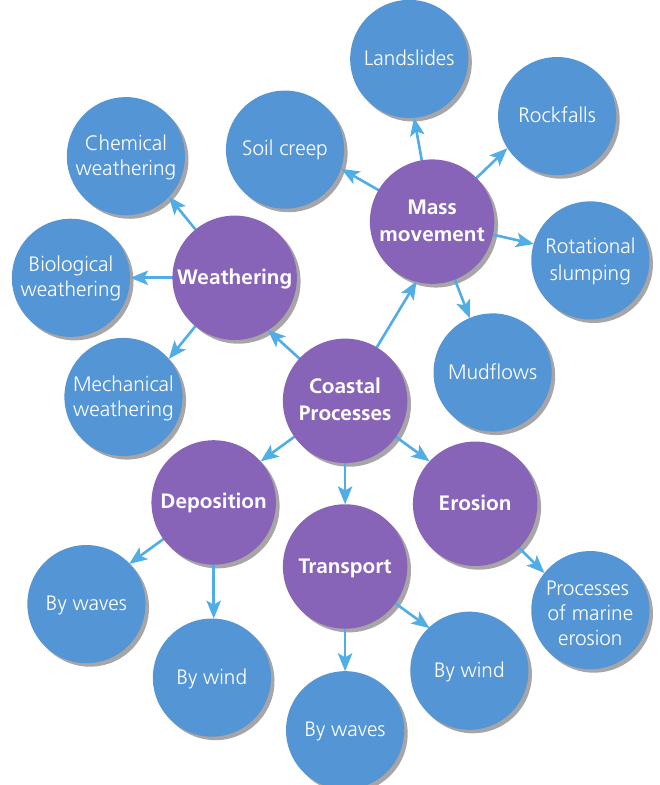
Two main categories of processes shape coastlines:
Marine processes
Important
Marine processes operate upon a coastline and are connected with the sea, such as waves, tides, and longshore drift.
These processes work directly on the coast where land meets sea. Waves provide the primary source of energy, breaking against the shoreline and generating forces capable of eroding rock, transporting sediment, and depositing material. Tides raise and lower the sea level, varying the vertical zone where wave action occurs. Longshore drift moves sediment along the coast parallel to the shore.
Marine processes include:
- Erosion: Wearing away of rock and sediment (by waves)
- Transport: Movement of material along or across the coast (by waves and wind)
- Deposition: Settling and accumulation of sediment (by waves)
Sub-aerial processes
Important
Sub-aerial processes include processes that slowly (usually) break down the coastline, weaken the underlying rocks, and allow sudden movements or erosion to happen more easily. Material is broken down in situ (on site), remaining in or near its original position. These processes may affect the shape of the coastline and include weathering, mass movement, and run-off.
These processes operate on the land but significantly influence coastal form and behaviour. By weakening cliff faces and producing loose material, sub-aerial processes prepare rock for removal by marine processes.
Sub-aerial processes include:
Weathering (breaking down rock in place):
- Chemical weathering: Rock decomposition through chemical reactions
- Biological weathering: Rock breakdown by plant roots and organisms
- Mechanical weathering: Physical disintegration through freeze-thaw, salt crystallisation, etc.
Mass movement (downslope movement of material under gravity):
- Landslides: Rapid movement of rock and soil down slopes
- Rockfalls: Individual rocks falling from cliff faces
- Soil creep: Very slow downslope movement of soil
- Rotational slumping: Curved slipping of material along a failure plane
- Mudflows: Fluid movement of saturated sediment
Run-off: Water flowing across the surface, which can transport weathered material and cause erosion through gullying.
Note
The interaction between marine and sub-aerial processes creates the distinctive character of different coastal landscapes. Weathering and mass movement weaken cliffs and provide sediment, whilst marine processes erode, transport, and deposit this material to create features such as beaches, spits, and bars.
Remember!
Summary
Key Points to Remember:
-
Sediment comes from multiple sources: rivers, cliff erosion, estuaries, offshore banks, and biological material all contribute to coastal sediment supplies.
-
Sediment cells divide the coast into manageable sections: 11 major cells exist around England and Wales, bounded by headlands and deep water, though sediment can move between cells.
-
The sediment budget is like a bank account: positive budgets (more input than output) cause shorelines to build seaward, whilst negative budgets (more output than input) cause coastal retreat.
-
Two process types shape coasts: marine processes (waves, tides, longshore drift) work directly at the coast, whilst sub-aerial processes (weathering, mass movement, run-off) operate on land but supply sediment and weaken cliffs.
-
Understanding sediment systems is crucial for coastal management: knowing where sediment comes from, how it moves, and where it accumulates helps predict coastal changes and plan appropriate management strategies.