Tides (AQA A-Level Geography): Revision Notes
📚Revision Notes
Tides
What are tides?
Tides refer to the regular rise and fall in sea level that happens every day around the world's coastlines. This natural rhythm is driven by the gravitational forces exerted by the Moon and Sun on Earth's oceans.
Important
Tides are the periodic rise and fall of sea level caused by the gravitational pull of the Sun and Moon.
Although both the Sun and Moon contribute to tidal movements, the Moon plays the dominant role. This is because the Moon is much closer to Earth, which means its gravitational pull has a stronger effect on our oceans despite the Sun's much larger mass.
How tides work
The Moon's gravitational force pulls ocean water towards it, creating a bulge of water on the side of Earth facing the Moon. This bulge represents a high tide. At the same time, a compensatory bulge forms on the opposite side of Earth. Between these two bulges, sea level drops, creating areas of low tide.
Note
The compensatory bulge on the opposite side of Earth occurs because the gravitational pull is weakest there, allowing water to bulge outward. This is why most coastal locations experience two high tides and two low tides in a 24-hour period, not just one.
As Earth rotates through these bulges during a 24-hour period, most coastal locations experience two high tides and two low tides each day.
Spring tides and neap tides
The tidal range - the difference in height between high and low tide - varies throughout the month depending on the positions of the Sun, Moon and Earth.
Spring tides
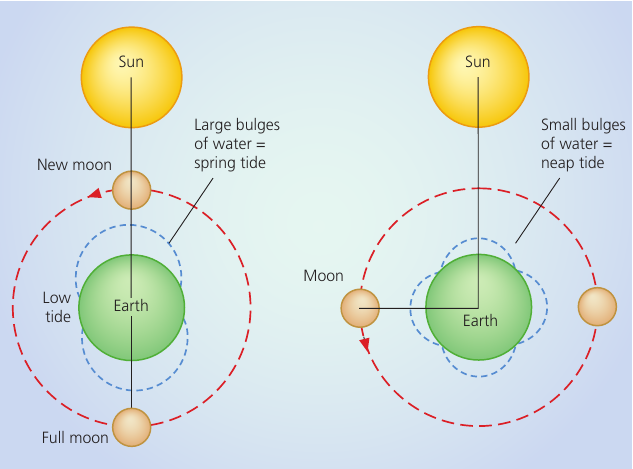
Spring tides occur twice in each lunar month when the Moon, Sun and Earth align in a straight line. This happens during both the new moon and full moon phases. When these three bodies are aligned, their gravitational forces combine and work together, producing the strongest tidal pull.
This alignment creates the highest monthly tidal range, known as a spring tide. The high tides are higher than average, and the low tides are lower than average.
Neap tides
Neap tides also occur twice per lunar month, but under different conditions. They happen when the Moon is positioned at 90 degrees (perpendicular) to the Sun and Earth. At this time, the gravitational pulls of the Sun and Moon work against each other rather than together.
This arrangement produces the lowest monthly tidal range, called a neap tide. During neap tides, the difference between high and low tide is between 10 to 30 per cent lower than the average tidal range.
Example
Understanding the Difference:
Spring Tides (Sun-Moon-Earth in a straight line):
- Occur during new moon and full moon
- Gravitational forces combine
- Result: Maximum tidal range (highest highs, lowest lows)
Neap Tides (Moon at 90° to Sun-Earth line):
- Occur during quarter moons
- Gravitational forces oppose each other
- Result: Minimum tidal range (10-30% lower than average)
Tidal range
Tidal range measures the vertical difference in water level between high tide and low tide. This measurement varies considerably around the world depending on local geography, including the shape of the seabed, the configuration of land masses, and the effects of Earth's rotation (Coriolis force).
Geographers classify coastlines into three categories based on their tidal range:

-
Macrotidal coasts experience tidal ranges greater than 4 metres. Many parts of the British Isles fall into this category, which creates wide zones of wave attack and contributes to the formation of extensive wave-cut platforms.
-
Mesotidal coasts have moderate tidal ranges between 2 and 4 metres.
-
Microtidal coasts experience the smallest tidal ranges of less than 2 metres. The Mediterranean Sea provides a good example, where low tidal ranges restrict wave action to a narrow coastal zone.
Why tidal range matters
Tidal range plays a significant role in shaping coastal landscapes. It determines:
Note
Impact on Coastal Processes:
- The upper and lower limits of erosion and deposition along the coast
- How much time each day the littoral zone (the area between high and low tide marks) remains exposed to sub-aerial weathering processes
- The width of the zone subjected to wave attack
Coastlines with high tidal ranges typically develop wider beaches and more extensive erosional features because waves can attack across a broader vertical range.
Tidal surges
Whilst regular tides follow predictable patterns, tidal surges (also called storm surges) are occasional extreme events that can raise water levels far beyond normal high tide marks.
Important
Tidal surges occur when specific meteorological conditions combine to create dangerously high water levels. These events can cause severe coastal flooding and pose significant risks to coastal communities.
Strong winds associated with storms can push large volumes of seawater towards the coastline, an effect known as piling-up. Additionally, areas of intense low pressure cause the sea surface to rise - approximately one centimetre for every one millibar drop in atmospheric pressure.
The shape of particular sea areas can intensify these effects. The North Sea, for example, funnels water into an increasingly confined space, concentrating the surge. When a tidal surge coincides with a spring high tide, the results can be catastrophic.
Historical examples
Example
North Sea Tidal Surges:
The North Sea region has experienced several severe tidal surges that demonstrate the devastating potential of these events:
1953 Event:
- Major tidal surge devastated coastal areas
- Caused widespread flooding and loss of life
- One of the worst natural disasters in British and Dutch history
2013-2014 Storms:
- December 2013 and January 2014 brought severe storms
- Water levels at some sections of England's east coast exceeded those recorded 60 years earlier
- Demonstrated that modern infrastructure remains vulnerable to extreme tidal surges
These events show how tidal surges can cause severe coastal flooding and damage to coastal infrastructure and communities, especially when they coincide with spring high tides.
Remember!
Summary
Key Points to Remember:
-
Tides are caused by the gravitational pull of the Moon and Sun, with the Moon having the greatest influence due to its proximity to Earth
-
Spring tides occur twice monthly when the Sun, Moon and Earth align, producing the largest tidal ranges
-
Neap tides occur twice monthly when the Moon is perpendicular to the Sun-Earth line, producing the smallest tidal ranges (10-30% lower than average)
-
Tidal range is classified into three categories: macrotidal (>4m), mesotidal (2-4m), and microtidal (<2m)
-
Tidal surges are extreme events caused by meteorological conditions that can push water levels far above normal high tides, creating significant flooding hazards