Food Chains, Trophic Levels and Food Webs (AQA A-Level Geography): Revision Notes
📚Revision Notes
Food Chains, Trophic Levels and Food Webs
Understanding energy flow in ecosystems
Energy flows through ecosystems in a structured way. All organisms need energy to survive, and this energy ultimately comes from the Sun. Plants capture solar energy through photosynthesis and convert it into chemical energy stored in organic matter. This energy then passes from one organism to another through feeding relationships.
Note
Energy in ecosystems flows in only one direction - from the Sun through producers to consumers. Unlike nutrients that can be recycled, energy cannot be reused once it has been transformed or lost as heat.
What is a food chain?
A food chain is a linear pathway that shows how energy and nutrients move from one organism to another through feeding relationships. It follows a direct route from producers through various levels of consumers.
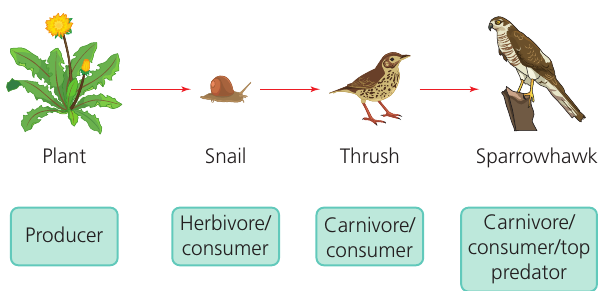
Food chains always begin with producers (typically plants) and progress through different types of consumers:
- Producers make their own food through photosynthesis
- Primary consumers (herbivores) eat the producers
- Secondary consumers (carnivores) eat the herbivores
- Tertiary consumers eat secondary consumers and may be top predators
Note
Each arrow in a food chain represents the direction of energy flow. The arrow points from the organism being eaten to the organism doing the eating, showing where the energy is going.
Examples of food chains
Example
Food Chain Examples from Different Ecosystems
Marine food chain: Phytoplankton → zooplankton → fish → seal → killer whale
Terrestrial food chain: Grass → grasshopper → frog → heron
In both examples, you can see the clear progression from plant life through various animal consumers, with each organism serving as food for the next level.
Trophic levels explained
Important
A trophic level is the position an organism occupies in a food chain. It indicates how many feeding steps an organism is away from the original source of energy (producers).
Food chains are organised into distinct feeding levels:
- Trophic level 1: Primary producers (plants that photosynthesise)
- Trophic level 2: Herbivores that eat plants (primary consumers)
- Trophic level 3: Predators that eat herbivores (secondary consumers)
- Trophic level 4: Carnivores that eat other carnivores (tertiary consumers)
- Trophic level 5: Apex predators at the top of the food chain
The number of feeding steps from the start of the chain determines an organism's trophic level. For instance, a sparrowhawk that eats a thrush (which ate a snail that ate a plant) is at trophic level 4.
Pyramid of numbers
A pyramid of numbers is a visual representation showing the quantity of organisms at each trophic level. The diagram demonstrates a fundamental ecological principle: there are typically more organisms at lower trophic levels than at higher ones.
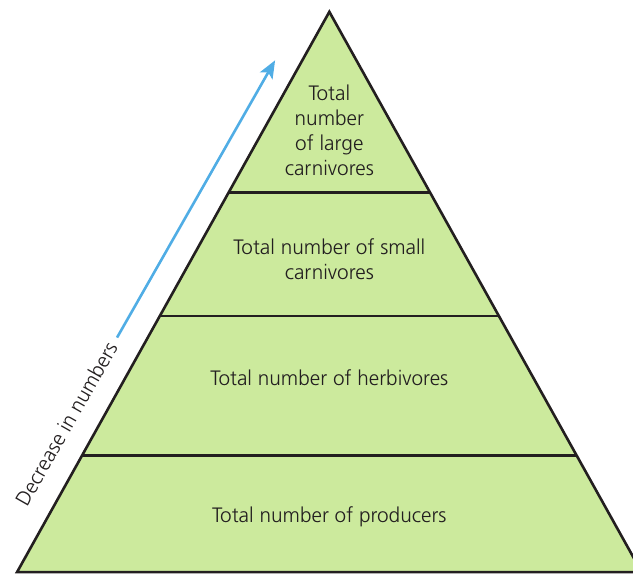
The pyramid shape occurs because:
- Large numbers of producers support fewer herbivores
- These herbivores support even fewer small carnivores
- Small carnivores support a small number of large carnivores at the top
Note
Pyramids of numbers can sometimes look unusual. For example, a single tree (one producer) might support thousands of insects (many primary consumers). This is why ecologists sometimes prefer to use pyramids of biomass instead, which provide a more consistent representation.
Pyramid of biomass
A pyramid of biomass represents the total mass of living material at each trophic level, rather than just counting individual organisms. This approach provides a more accurate picture of energy distribution in an ecosystem.
In a biomass pyramid, the mass of organisms generally decreases at higher trophic levels. This occurs because energy is lost at each stage through:
- Respiration and heat production
- Movement and life processes
- Waste materials that aren't consumed
This means a large mass of plant material is needed to support a smaller mass of herbivores, which in turn supports an even smaller mass of carnivores.
Primary productivity in ecosystems
Important
Primary productivity is the rate at which plants produce biomass through photosynthesis per unit area and per unit time.
Through photosynthesis, plants convert sunlight, carbon dioxide and water into glucose and other carbohydrates. They release oxygen as a by-product. This process forms the foundation of all food chains.
Gross primary productivity (GPP)
Gross primary productivity (GPP) represents the total amount of energy that plants capture through photosynthesis in a community. It measures all the biomass produced before any is used by the plants themselves.
Note
GPP is typically expressed in energy units such as joules per square metre per day (), or in units of dry organic matter such as kilograms per hectare per year ().
Respiration and energy use
Plants don't keep all the energy they produce. They use a significant proportion for their own life processes through respiration. This energy powers:
- Growth and reproduction
- Transport of nutrients
- Repair of tissues
- Other physiological activities
Net primary productivity (NPP)
Net primary productivity (NPP) is the amount of biomass available for consumption by other organisms after plants have used energy for respiration.
The relationship can be expressed as:
NPP represents the actual rate of biomass production that herbivores and decomposers can access. Heterotrophic organisms (bacteria, fungi and animals) depend entirely on this net productivity for their energy needs.
Note
Global terrestrial NPP is estimated at approximately 48-69 billion tonnes per year. When oceanic NPP is included, this figure nearly doubles, demonstrating the enormous productivity of Earth's ecosystems.
Food webs and ecosystem complexity
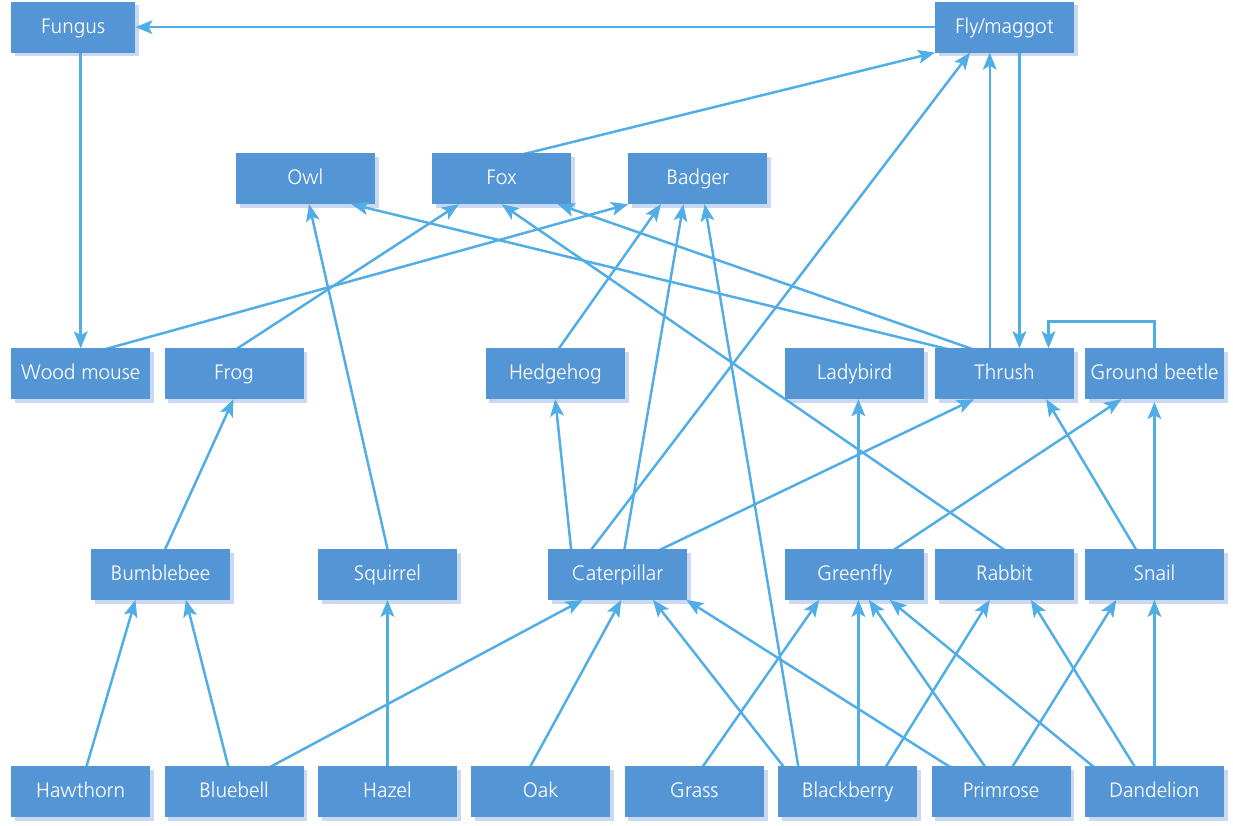
While food chains show simple, linear feeding relationships, real ecosystems are far more complex. Most animals eat a variety of foods and are themselves eaten by multiple predators. These interconnections create food webs.
A food web is a network of interconnected food chains that shows the multiple feeding relationships within an ecosystem. It provides a more realistic representation of how energy flows through natural communities.
Characteristics of food webs
Food webs reveal several important features of ecosystems:
- Organisms typically have varied diets rather than eating just one food source
- Many species serve as prey for multiple predators
- The same organism can occupy different trophic levels depending on what it eats
- Changes to one species can affect many others through the interconnected relationships
Note
The woodland food web shown contains 25 species, but real food webs are often much more complex. Large ecosystems may have food webs involving hundreds or even thousands of species, creating an intricate network of dependencies.
Why food webs matter
Understanding food webs helps us predict how ecosystems respond to changes. If one species declines or disappears, the impact spreads through multiple pathways.
Example
Impact of Population Changes in Food Webs
Consider the effect of rabbit population decline:
- A decline in rabbit populations would directly affect foxes, badgers, and other predators that rely on rabbits as a food source
- However, these predators have alternative food sources (like mice or birds) that buffer the impact
- This interconnection provides ecosystem stability and resilience, preventing the complete collapse of predator populations
Summary
Key Points to Remember:
-
Food chains show linear feeding pathways from producers through consumers, with energy flowing in one direction through trophic levels.
-
Trophic levels represent feeding positions, starting with producers at level 1, then herbivores at level 2, followed by successive levels of carnivores.
-
: Net primary productivity is what remains after plants use energy for their own life processes, and this is what's available to support all other organisms.
-
Pyramids of numbers and biomass typically decrease at higher trophic levels because energy is lost at each stage through respiration, movement and waste.
-
Food webs show the complex reality of ecosystems where organisms have multiple food sources and predators, creating interconnected networks that provide ecosystem stability.