Warm- and Cold-based Glaciers (AQA A-Level Geography): Revision Notes
📚Revision Notes
Warm- and cold-based glaciers
Introduction to glacier classification
Glaciers around the world display different characteristics depending on their location and climate. Glaciologists have developed a classification system that divides glaciers into three main types: temperate (or warm-based), polar (or cold-based), and sub-polar glaciers. This note focuses on understanding the key differences between warm-based and cold-based glaciers.
Note
The classification is based on the thermal characteristics of the ice, particularly whether the ice is at its melting point or remains frozen throughout. This thermal regime fundamentally determines how glaciers move and interact with their landscape.
Warm-based (temperate) glaciers
Location and occurrence
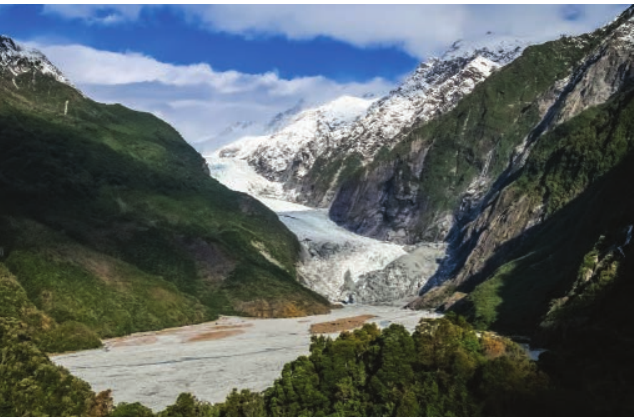
Warm-based glaciers typically occur in temperate coastal regions with maritime climates. Key locations include:
- Western coastal mountain ranges of North America
- Western Norway
- Southern Iceland
- New Zealand
- Patagonia in Chile
- Alpine valley glaciers of the European Alps
These glaciers usually range from hundreds of metres to several kilometres in width, and from hundreds of metres to tens of kilometres in length.
Temperature conditions
The thermal properties of warm-based glaciers are distinctive:
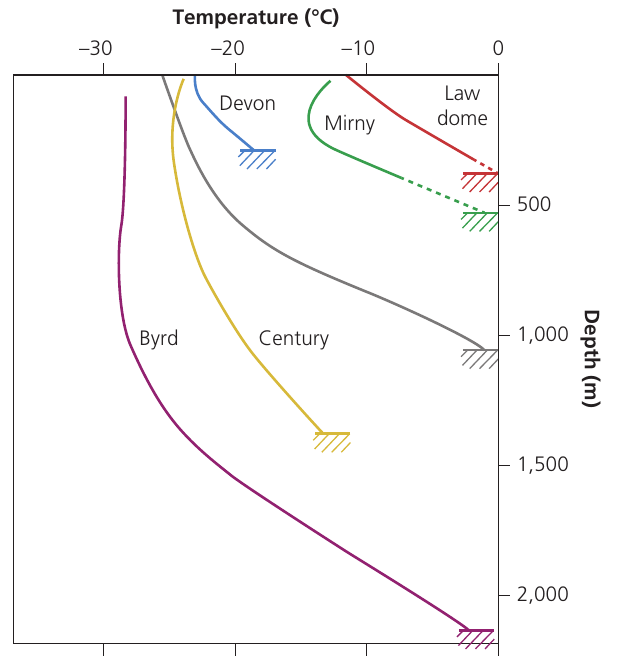
- The surface layer (a few metres thick) consists of recent snow and firn that experiences seasonal temperature changes, reaching approximately 0°C during summer months
- This surface layer provides insulation for the ice below
- As depth increases, the ice experiences greater pressure from the overlying ice mass, which has an important effect on its melting point
Important
The pressure melting point is the temperature at which ice melts under pressure. As pressure increases with depth, the melting point of ice is lowered. This is a crucial concept for understanding warm-based glacier behaviour.
Example
Worked Example: Pressure Melting Point
At the surface, ice melts at 0°C under normal atmospheric pressure. However, at the base of a glacier 2,000 metres deep, the immense weight of overlying ice creates such high pressure that ice melts at -1.27°C rather than 0°C.
This demonstrates how pressure from thousands of metres of ice above can lower the melting point by more than 1°C.
Throughout a temperate glacier, ice exists at or very near its melting point. This occurs because of three factors:
- Warmer atmospheric temperatures at the surface
- The weight and depth of overlying ice
- Geothermal heat rising from the glacier bed
Since temperate glaciers are relatively thin, a larger proportion of the ice mass is influenced by heat from the Earth's interior.
Movement and glacial processes
Warm-based glaciers are characterised by their dynamic behaviour:
- High accumulation rates: These glaciers experience substantial winter snowfall and high spring and summer temperatures, leading to rapid summer melting
- Meltwater production: Water from melting ice acts as a lubricant at the glacier base, reducing friction between the ice and the bedrock
- Enhanced mobility: The presence of meltwater makes warm-based glaciers far more mobile compared to their cold-based counterparts
- Active erosion: Faster movement rates mean these glaciers are more effective at eroding, transporting and depositing material
- Basal sliding: Movement occurs through both internal ice deformation and sliding across the bedrock
Note
The combination of abundant meltwater and faster movement rates makes warm-based glaciers powerful agents of landscape change. They actively shape the terrain through erosion and deposition, creating distinctive glacial landforms.
Cold-based (polar) glaciers
Location and occurrence
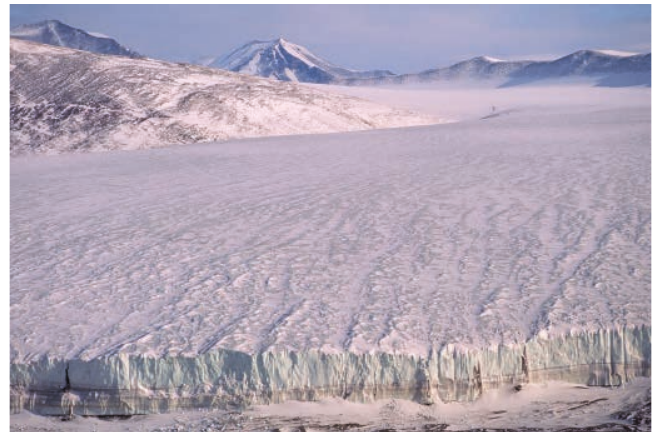
Cold-based glaciers are found almost exclusively in high-latitude regions within the Arctic and Antarctic circles. They occur in particularly cold areas of:
- Alaska
- Canada
- Antarctica
These glaciers include very cold valley glaciers but also encompass the much larger glaciers associated with ice caps and ice sheets, which can cover hundreds of square kilometres.
Temperature conditions
The thermal regime of cold-based glaciers differs significantly from temperate glaciers:
- Precipitation rates are extremely low, with some areas experiencing near-arid conditions
- Little new snow accumulates each year
- Minimal or no melting occurs
- Ice can be exceptionally old – some Arctic and Antarctic ice sheets contain ice dating back around 100,000 years
- All ice, except for the uppermost surface layers that may experience summer atmospheric warming, remains below the melting point throughout the year
Note
The extreme age of ice in cold-based glaciers makes them invaluable for climate research. Ice cores from Antarctic ice sheets provide climate records spanning tens of thousands of years, preserving ancient atmospheric gases and particles that reveal Earth's climate history.
The combination of low atmospheric temperatures and insufficient geothermal heat means that the melting point is rarely reached within these glaciers.
Movement and glacial processes
Cold-based glaciers exhibit much more limited activity:
- Minimal meltwater: Very little liquid water is produced, as atmospheric and geothermal heat sources are insufficient to cause melting
- Limited mass loss: Apart from some surface melting in summer, the majority of ice loss occurs through sublimation (ice converting directly to water vapour) and the calving of icebergs or blocks
- Slow movement: Movement is much slower than in temperate glaciers because the ice is often frozen to the bedrock
- Internal flow dominates: Most movement occurs through internal deformation of the ice rather than sliding at the base
- Reduced erosion: Erosion, transportation and deposition processes are significantly less active compared to warm-based glaciers
Important
Unlike warm-based glaciers that slide over their beds, cold-based glaciers are typically frozen to the underlying bedrock. This prevents basal sliding and results in movement rates that are orders of magnitude slower than their temperate counterparts.
Comparing warm-based and cold-based glaciers
| Feature | Warm-based glaciers | Cold-based glaciers |
|---|---|---|
| Location | Temperate maritime regions | High-latitude polar regions |
| Temperature | At or near melting point | Below melting point throughout |
| Meltwater | Abundant, acts as lubricant | Minimal or absent |
| Movement | Fast, includes basal sliding | Slow, mainly internal flow |
| Ice age | Relatively young | Can be over 100,000 years old |
| Erosion | Active and significant | Limited |
| Accumulation | High snowfall rates | Low precipitation rates |
| Mass loss | Primarily through melting | Primarily through sublimation and calving |
Remember!
Summary
Key Points to Remember:
-
Warm-based (temperate) glaciers are found in maritime locations, exist at their melting point, and are highly mobile due to meltwater lubrication, making them effective agents of erosion.
-
Cold-based (polar) glaciers occur in high-latitude regions, remain frozen throughout, and move slowly through internal flow, with minimal erosion and meltwater production.
-
The pressure melting point is crucial for understanding warm-based glaciers – increasing pressure from overlying ice lowers the temperature at which ice melts.
-
Ice in cold-based glaciers can be exceptionally old (around 100,000 years) because minimal melting occurs, whereas warm-based glaciers have younger, more dynamic ice.
-
Movement mechanisms differ fundamentally: warm-based glaciers slide over their beds aided by meltwater, whilst cold-based glaciers rely primarily on internal deformation as they remain frozen to the bedrock.