Weathering (AQA A-Level Geography): Revision Notes
📚Revision Notes
Weathering
What is weathering?
Weathering involves the breaking down and deterioration of rock at or close to the Earth's surface. This process produces loose rock material (called regolith) that stays in place in situ until it gets transported away by erosion.
There are three main types of weathering:
- Mechanical weathering - physical breakdown of rock without changing its chemical composition
- Chemical weathering - breakdown through chemical reactions that alter the rock's composition
- Biological/organic weathering - breakdown caused by living organisms
In cold glacial environments, weathering plays a crucial role in shaping the landscape and providing material for glacial erosion. However, the extremely low temperatures in these areas severely limit biological and organic weathering processes.
Note
In cold environments, mechanical and chemical weathering are the dominant processes, particularly in shaping glacial systems and providing sediment for ice to transport. Biological weathering is largely inactive due to the harsh conditions and lack of organic activity.
Weathering processes in cold environments
Frost action and freeze-thaw cycles
Frost action is one of the most important weathering processes in glacial environments. It operates through repeated freeze-thaw cycles and causes a type of mechanical weathering called frost shattering.
Note
Frost shattering is the breaking apart of rock caused by the repeated freezing and thawing of water within cracks and joints in the rock.
How the process works:
The process requires specific temperature conditions:
- Temperatures must rise above 0°C during the day
- Temperatures must drop below freezing at night for a substantial part of the winter
Important
These temperature fluctuations are essential for frost shattering to occur. Without the repeated crossing of the 0°C threshold, the process cannot operate effectively. This is why frost action is particularly active in areas with diurnal (daily) temperature variations around freezing point.
When these conditions occur:
- Water seeps into existing cracks and joints in the rock
- When temperatures drop below 0°C at night, the water freezes
- As water freezes, it expands by nearly 10%
- This expansion forces the cracks to widen and puts enormous pressure on the surrounding rock
- As the process repeats over many freeze-thaw cycles, the cracks widen further
- Eventually, pieces of rock break off completely
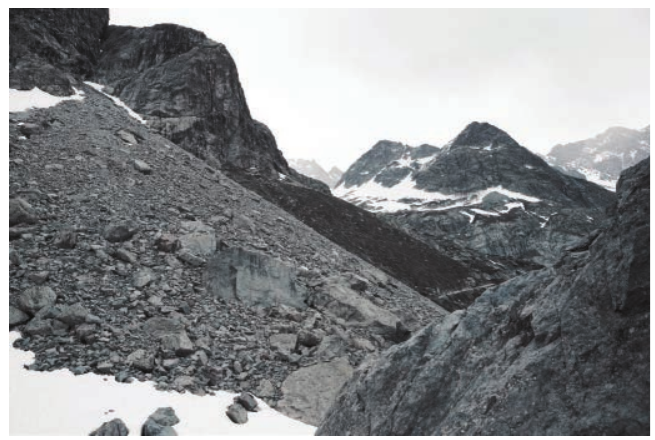
Formation of scree:
On steep slopes, the broken rock fragments produced by frost shattering fall downslope and collect at the base. This accumulation of angular rock debris is called scree. Scree deposits are a characteristic feature of glacial valleys and mountainous areas affected by freeze-thaw weathering.
Role in glacial valleys:
In glacial valleys, frost shattering is particularly active. Much of the broken material falls from the valley sides onto the edges of the glacier itself. This provides an input of rock debris that becomes incorporated into the glacier. Some material also finds its way down to the base of the ice through:
- Crevasses - deep cracks in the glacier surface
- Moulins - vertical shafts in the glacier formed by meltwater
This means frost action not only shapes the valley sides but also supplies the glacier with material that it can then use for erosion.
Nivation
Nivation refers to a combination of weathering processes that work together beneath patches of snow. These processes are particularly active in hollows on north-facing and east-facing slopes in the northern hemisphere, where snow can persist for longer periods.
Component processes:
Nivation involves several interconnected processes working simultaneously:
-
Freeze-thaw action - Similar to the frost shattering described above, water freezes and thaws beneath and around the snow patch, breaking down the underlying rock
-
Chemical weathering - Chemical reactions occur beneath the snow, causing the rock to disintegrate and weaken. The presence of moisture from snowmelt facilitates these chemical processes
-
Meltwater and solifluction - When snow melts in spring, the weathered rock particles get "flushed out" of the hollow. The meltwater moves these particles downslope, and solifluction (the slow downslope movement of saturated soil) helps transport the debris away
Seasonal patterns:
Nivation operates through repeated seasonal cycles:
- During winter, more snow accumulates in the hollow
- Freeze-thaw cycles continue breaking down rock
- In spring and summer, meltwater removes the weathered debris
- Over many years, more and more material accumulates
Development of nivation hollows:
The repeated accumulation of debris and the removal of weathered rock through freeze-thaw cycles and meltwater action leads to the formation of nivation hollows. These are depressions in the landscape created by nivation processes.
Note
When enlarged over long periods, nivation hollows can develop into the beginning stages of a corrie (also called a cirque). A corrie is an armchair-shaped hollow in a mountainside, typically formed by glacial erosion. This shows how nivation acts as a preparatory process, weakening rock and creating initial depressions that glaciers can later develop into more dramatic landforms.
Remember!
Summary
Key Points to Remember:
-
Weathering breaks down rock in place - it produces loose material (regolith) that stays where it formed until erosion moves it
-
Mechanical and chemical weathering dominate in cold environments - biological weathering is limited by low temperatures
-
Freeze-thaw cycles cause frost shattering - water expands by nearly 10% when freezing, forcing cracks wider and breaking rock apart
-
Scree forms at the base of steep slopes - angular rock fragments broken by frost shattering accumulate at slope bases
-
Nivation combines multiple processes - freeze-thaw action, chemical weathering, and meltwater movement work together under snow patches to create nivation hollows that can develop into corries