Distribution, Frequency, Magnitude and Effects (AQA A-Level Geography): Revision Notes
📚Revision Notes
Distribution, Frequency, Magnitude and Effects
Understanding hazard characteristics
When studying natural hazards, geographers analyse three key characteristics: where they occur (distribution), how often they happen (frequency), and how powerful they are (magnitude). Understanding these features helps us predict hazard events and prepare for their impacts.
Note
These three characteristics form the foundation of hazard analysis. By examining distribution, frequency, and magnitude together, geographers can identify patterns and assess risk levels for different regions.
The effects of natural hazard events
The effects of a hazard describe the impact an event has on both the physical environment and human populations. These effects are typically classified into two categories.
Primary and secondary effects
Primary effects are the immediate, direct impacts caused by the hazard itself. These occur at the time of the event.
Example
Earthquake Primary Effects:
When an earthquake strikes, the primary effects occur instantly:
- Ground shaking and surface rupture - the direct result of seismic energy release
- Ground cracking and displacement - physical changes to the earth's surface
Secondary effects are the subsequent consequences that follow from the primary impacts. These develop after the initial event.
Example
Earthquake Secondary Effects:
Following the initial ground shaking, numerous secondary effects can emerge:
- Soil liquefaction - ground behaves like liquid
- Landslides and avalanches - triggered by ground instability
- Tsunamis - generated by undersea earthquakes
- Building collapses from structural weakening
- Fires from damaged gas lines
- Flooding from burst water mains
Long-term consequences
The impact of a hazard event can persist for years after the initial disaster. Communities may experience:
- Disrupted communication systems
- Reduced agricultural productivity, affecting food security
- Economic damage that takes years to repair
- Population displacement and social disruption
Important
The severity and duration of these impacts depend on factors such as the level of development, preparedness measures, and the speed of relief efforts. Less developed regions often face longer recovery periods and more severe long-term consequences.
Distribution
Distribution describes the geographical area where a hazard occurs and the spatial extent of its impact.
Distribution can vary significantly between hazard types:
-
Localised hazards: Some events affect only a small, specific area. Individual landslides or flash floods have a limited geographical footprint.
-
Widespread hazards: Other events can affect vast regions or even have global consequences. Tsunamis can cross entire ocean basins, whilst volcanic eruptions can eject dust into the upper atmosphere, leading to short-term climate change affecting the whole planet.
Distribution also refers to where hazards are likely to occur. Different hazards have characteristic geographical patterns:
Note
Geographical Patterns of Hazards:
- Earthquakes and volcanoes typically occur along tectonic plate boundaries
- Tropical cyclones form over warm ocean waters between 5° and 25° north and south of the Equator
Understanding distribution patterns helps identify vulnerable regions and target preparedness efforts effectively.
Frequency
Frequency describes how often a hazard event occurs over a given time period.
This characteristic examines the temporal (time-based) distribution of hazards. Some hazards are relatively common whilst others are rare events.
Frequency is closely linked to magnitude through an important principle in hazard geography.
Magnitude
Magnitude measures the severity, size or power of a hazard event.
Different hazards use different scales to measure magnitude:
Note
Common Magnitude Scales:
- Earthquakes: Richter scale or Moment Magnitude Scale
- Tropical cyclones: Saffir-Simpson scale
- Volcanic eruptions: Volcanic Explosivity Index (VEI)
The frequency-magnitude principle
There is an inverse relationship between frequency and magnitude:
- Small events occur frequently: Minor earthquakes, small floods, and weak storms happen regularly and cause minimal damage
- Large events occur rarely: Major earthquakes, catastrophic floods, and powerful hurricanes are infrequent but cause extensive damage
Important
The Frequency-Magnitude Principle:
This principle helps us understand that whilst devastating mega-disasters grab headlines, most hazard events are relatively small and manageable. We expect many small insignificant events and fewer large-scale ones. This pattern is consistent across different hazard types and helps inform risk assessment and resource allocation.
The Park Model of recovery
The Park Model illustrates how communities recover from hazard events and shows that recovery trajectories vary considerably.
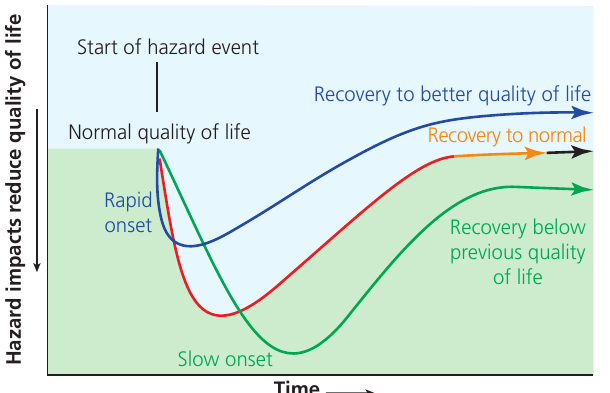
The model demonstrates how quality of life changes over time following a hazard event. Three different recovery pathways are possible:
Rapid recovery to improved conditions (blue line)
- Quick initial response and effective relief
- Investment in rebuilding with improved infrastructure
- Community emerges more resilient than before
- Final quality of life exceeds pre-disaster levels
Standard recovery to normal conditions (red line)
- Moderate speed of recovery
- Infrastructure restored to previous standards
- Quality of life returns to baseline
- Community resilience maintained
Slow recovery to degraded conditions (green line)
- Prolonged decline in quality of life
- Insufficient relief efforts or resources
- Poor rebuilding and inadequate investment
- Final quality of life remains below pre-disaster levels
Factors affecting recovery
Several factors influence which trajectory a community follows:
Note
Key Recovery Factors:
- Type of hazard: Different hazards cause varying levels of destruction
- Degree of preparedness: Well-prepared communities recover faster
- Speed and quality of relief efforts: Prompt, effective aid accelerates recovery
- Nature of rebuilding: Investment in improved infrastructure creates long-term benefits
- Economic resources: Wealthier regions typically recover more quickly
- Governance and planning: Effective leadership and coordination matter
Understanding these recovery patterns helps planners develop strategies to move communities towards the most positive recovery pathway.
Summary
Remember!
-
Distribution, frequency and magnitude are three key characteristics used to analyse natural hazards: where they occur, how often, and how severe they are.
-
Primary effects are the immediate, direct impacts of a hazard (e.g. ground shaking in earthquakes), whilst secondary effects are the subsequent consequences (e.g. tsunamis, fires, landslides).
-
The frequency-magnitude principle states that small hazard events occur frequently whilst large, devastating events are rare.
-
The Park Model shows that communities can follow different recovery pathways after a disaster, with outcomes ranging from improved conditions to degraded quality of life.
-
Recovery speed and quality depend on multiple factors including preparedness, relief effectiveness, and investment in rebuilding.