Impacts of Volcanic Activity (AQA A-Level Geography): Revision Notes
📚Revision Notes
Impacts of Volcanic Activity
Volcanic eruptions can create a wide range of effects that vary from localised impacts near the volcano to global consequences. These impacts are classified into primary effects (direct results of the eruption) and secondary effects (indirect consequences that follow).
Understanding volcanic explosivity
Volcanic eruptions show enormous variation in their intensity and scale. The nature of the eruption depends largely on the characteristics of the lava itself. Lava that is not viscous (meaning it's thin and runny) will escape from the volcano quite easily. However, when lava is highly viscous (thick and pasty), gases become trapped and cannot move freely. This causes tremendous pressure to build up inside the volcano, eventually leading to explosive eruptions.
Note
The viscosity of lava is crucial in determining eruption style. Think of it like this: thin, runny lava is like water flowing from a tap, whilst thick, viscous lava is like trying to squeeze honey through a narrow opening. The thicker the lava, the more likely gases will get trapped, leading to explosive eruptions rather than gentle flows.
These explosive eruptions can launch volcanic dust high into the upper atmosphere. This reduces the amount of incoming solar radiation reaching Earth's surface, which can cause short-term global climate change.
Important
The Volcanic Explosivity Index (VEI) is a logarithmic scale running from 0 to 8 that measures the magnitude of volcanic eruptions based on the volume of erupted material (tephra). Each increase in VEI number represents a tenfold increase in erupted material.
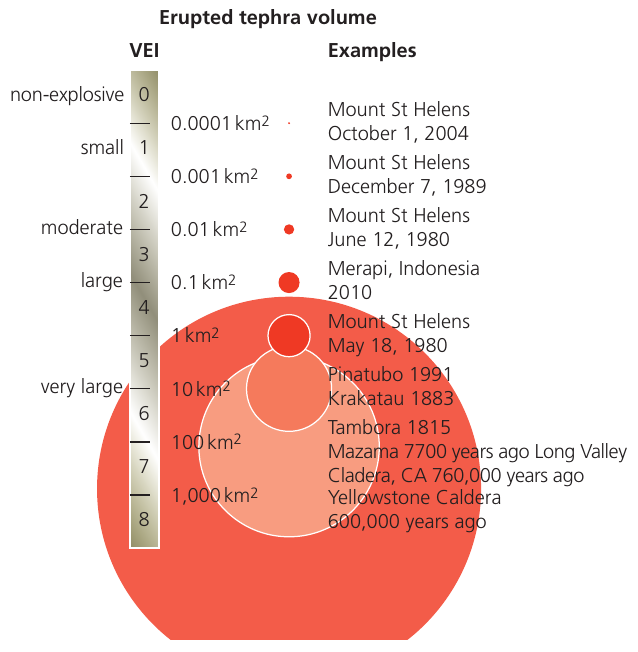
The VEI scale helps scientists and geographers classify eruptions and compare their relative sizes. For example, the 1980 eruption of Mount St Helens had a VEI of 5, whilst the massive 1815 Tambora eruption reached VEI 7. The largest eruptions on the scale (VEI 8) are rare super-volcano events that occurred thousands of years ago.
Primary effects
Primary effects are the immediate impacts caused by material directly ejected from the volcano during an eruption.
Tephra
Important
Tephra refers to solid material of varying grain sizes, ranging from large volcanic bombs down to fine ash, all ejected into the atmosphere during an eruption.
The size of tephra particles determines how far they travel and what damage they cause:
- Volcanic bombs (as large as a bus) are extremely dangerous but affect only a small area because few people venture close enough to the vent to be struck by them
- Fine ash can be thrown high into the atmosphere where strong winds carry it around the Earth, spreading over vast distances
- Ash reduces incoming solar radiation and has a cooling effect on global temperatures
Pyroclastic flows
Important
Pyroclastic flows (also known as nuées ardentes) are extremely hot (over 800°C), gas-charged, high-velocity flows consisting of a mixture of gas and tephra.
These flows are among the most deadly volcanic hazards:
- They typically hug the ground and flow down the sides of the volcano
- Speeds can reach up to 700 km per hour
- The extreme heat and speed make them virtually impossible to outrun
Example
Case Study: Pompeii (79 AD)
In 79 AD, pyroclastic flows from Mount Vesuvius completely destroyed the Roman city of Pompeii in Italy, killing thousands of people. The flows moved so quickly and were so hot that people had no chance to escape, with many victims preserved in the positions they died.
Lava flows
Lava flows rarely cause injury to people because of their relatively low velocity. People can usually move out of their path in time. However, lava flows cause significant damage in other ways:
- They destroy crops and agricultural land
- They damage and destroy buildings and infrastructure
- They block roads, cutting off access routes
Note
While lava flows might look dramatic in photos and videos, their slow movement (typically just a few kilometres per hour) means they're actually one of the less dangerous volcanic hazards to human life. The real damage comes from property destruction rather than loss of life.
Volcanic gases
Volcanoes release various gases during eruptions, including:
- Carbon dioxide
- Carbon monoxide
- Hydrogen sulphide
- Sulphur dioxide
- Chlorine
Example
Case Study: Lake Nyos, Cameroon (1986)
In 1986, carbon dioxide emissions from the lake in the crater of Nyos volcano in Cameroon killed 1,700 people. The heavy gas flowed down valleys and suffocated people in their homes. This disaster highlighted the danger of invisible volcanic gases, which can be deadly even without a visible eruption.
Secondary effects
Secondary effects are indirect consequences that result from the initial eruption, often causing damage after the eruption itself has finished.
Lahars
Important
Lahars (volcanic mudflows) occur when unconsolidated ash from a recent eruption combines with water to create a hot, dense, fast-moving mudflow that sweeps down river valleys.
The water that triggers lahars can come from several sources:
- Heavy rainfall during or after an eruption
- Melting snow and ice on the volcano's summit
- The collapse of crater lakes
Example
Case Studies: Lahars
Mount Pinatubo, Philippines (1991): During the 1991 eruption, lahars were triggered by heavy rain, continuing to cause destruction for years after the initial eruption.
Nevado del Ruiz, Colombia (1985): The volcano produced a lahar that completely destroyed the town of Armero, killing three-quarters of its population (approximately 23,000 people). This remains one of the deadliest lahar disasters in history.
Flooding
When an eruption melts glaciers and ice caps on a volcano, serious flooding can result downstream. The rapid melting of large volumes of ice can release enormous quantities of water in a very short time.
Example
Case Study: Grímsvötn, Iceland (1996)
In 1996, when Grímsvötn volcano erupted beneath Iceland's ice sheet, massive floods were generated as the ice melted rapidly. The floodwaters damaged roads, bridges, and infrastructure across a wide area.
Volcanic landslides
Important
Volcanic landslides range in size from less than 1 km³ to more than 100 km³ and can travel at extremely high speeds.
The high velocity and great momentum of volcanic landslides enable them to:
- Cross between valleys
- Run up slopes for several hundred metres
- Travel long distances from their source
Example
Case Study: Mount St Helens (1980)
The landslide at Mount St Helens had a volume of 2.5 km³, reached speeds of 50-80 metres per second, and surged up and over a 400-metre-high ridge located about 5 km from the volcano. This was the largest landslide in recorded history.
Tsunamis
Sea waves can be generated by violent volcanic eruptions, particularly when they occur in or near the ocean. These can be triggered by underwater explosions, landslides entering the sea, or the collapse of volcanic calderas.
Example
Case Study: Krakatoa, Indonesia (1883)
The eruption of Krakatoa volcano in Indonesia in 1883 generated massive tsunamis. These waves are estimated to have killed 36,000 people along nearby coastlines, with waves reaching heights of over 40 metres in some locations.
Acid rain
Volcanoes emit gases that include sulphur compounds. When sulphur mixes with atmospheric moisture, acid rain forms. This can damage:
- Vegetation and crops over a wide area
- Buildings and infrastructure
- Water supplies
- Ecosystems
Note
Acid rain from volcanic eruptions can affect areas hundreds or even thousands of kilometres from the volcano itself. The sulphur dioxide gas rises into the atmosphere where it combines with water vapour to form sulphuric acid, which then falls as acidic precipitation.
Climatic change
When huge amounts of volcanic debris and gases are ejected into the high atmosphere, they can:
- Reduce global temperatures by blocking incoming solar radiation
- Create a "volcanic winter" effect
- Cause short-term climate disruption lasting months or years
- Affect weather patterns across the planet
Major eruptions with high VEI values have been linked to past climatic changes, with ash and gas remaining in the atmosphere for extended periods. For instance, the 1815 eruption of Mount Tambora led to the "Year Without a Summer" in 1816, causing widespread crop failures and food shortages across Europe and North America.
Responses to volcanic hazards
Preparedness and prediction
Early prediction provides the opportunity to evacuate people from danger zones before an eruption occurs, potentially saving many lives. Scientists can now predict volcanic eruptions with increasing certainty by monitoring several warning signs:
- An increase in the release of various gases, particularly sulphur dioxide and carbon dioxide
- A rise in the level of lava lakes in volcanic craters
- The bulging upwards of surrounding land due to pressure from rising magma below
- An increasing number of relatively small earthquakes caused by the rising magma
Example
Case Study: Pompeii vs. Modern Monitoring
In 79 AD, the Roman cities of Pompeii and Herculaneum were overwhelmed by pyroclastic flows and ash from Mount Vesuvius. Thousands died. Despite being part of a sophisticated civilisation, they had no understanding of the danger on their doorstep.
In contrast, modern monitoring means early warning systems can alert populations in time to evacuate. However, this only works if people respond appropriately to warnings.
Studying the previous eruption history of any volcano is crucial. By examining ash, lahar and pyroclastic flow deposits around volcanoes, scientists can:
- Determine the frequency of eruptions
- Identify the types of hazard that occurred
- Predict what might happen in future eruptions
- Map areas at greatest risk
Risk assessments
Important
Risk assessments are detailed evaluations used to identify areas at greatest risk from volcanic hazards and to establish appropriate alert levels for different zones.
Governments in volcanic regions, such as the Philippines, conduct comprehensive risk assessments that:
- Map hazard zones around volcanoes
- Identify populations at risk
- Establish evacuation procedures
- Create alert level systems
Example
Case Study: Mount Rainier Risk Assessment
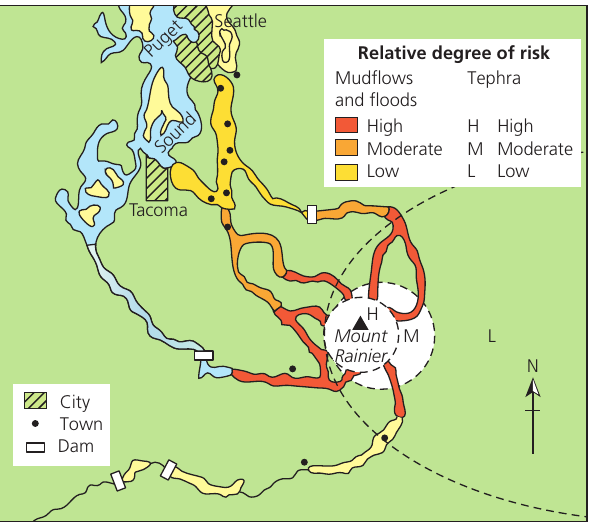
The risk assessment for Mount Rainier (part of the Cascade Range in the USA) identifies three levels of risk - high, moderate and low - for different hazards including mudflows, floods and tephra. This is particularly important because 3.5 million people live and work close to the volcano. Different areas face different levels of threat, with valleys at highest risk from lahars and mudflows.
Mitigation measures
Mitigation involves taking actions before, during and after an eruption to reduce or eliminate long-term risks.
Physical actions during eruptions:
Several practical measures can reduce impacts:
- Diverting lava flows: On Mount Etna in Sicily, trenches have been dug, blocks dropped into lava streams, and explosives used to slow down or divert lava flows. These methods have been successful in some cases
- Protecting water supplies: In 1973, inhabitants of Heimaey in Iceland poured seawater onto the front of an advancing lava flow. This successfully solidified it before it could cut off their vital fishing port from the open sea
- Building barriers: In parts of the Hawaiian Islands, barriers have been constructed across valleys to protect settlements from lava flows and lahars
Note
Physical mitigation measures like diverting lava flows are most effective with slow-moving hazards. They're much less useful against fast-moving threats like pyroclastic flows, where evacuation remains the only realistic option.
Evacuation strategies:
The most common way to reduce human impacts is to evacuate vulnerable areas when risk becomes intolerable. However, evacuations present their own challenges:
- If evacuations are carried out needlessly, future warnings may be ignored
- People may be reluctant to leave their homes and property
- Evacuations are more difficult to manage if carried out repeatedly
Example
Case Studies: Evacuation Success
Evacuations have been carried out successfully several times in the Philippines, including:
- Pinatubo (1991): Tens of thousands were evacuated before the eruption, saving countless lives
- Mayon (2018): Timely evacuations prevented casualties from this active volcano
These examples demonstrate that when warnings are heeded, evacuation can be highly effective at preventing loss of life.
Sometimes permanent evacuation becomes necessary. For example, two-thirds of the Caribbean island of Montserrat has been designated an exclusion zone following the 1995 eruption of the Soufrière Hills volcano. People cannot return to live in this area.
Summary
Key Points to Remember:
-
Volcanic impacts are divided into primary effects (direct results like tephra, pyroclastic flows, lava flows and gases) and secondary effects (indirect consequences like lahars, flooding, landslides, tsunamis, acid rain and climate change)
-
The Volcanic Explosivity Index (VEI) measures eruption magnitude on a logarithmic scale from 0 to 8, with each level representing a tenfold increase in erupted material
-
Pyroclastic flows are among the deadliest hazards, travelling at speeds up to 700 km/hour at temperatures exceeding 800°C
-
Modern monitoring and prediction can provide early warning by detecting signs like increased gas emissions, rising lava lakes, ground deformation and earthquake activity
-
Risk assessments help identify vulnerable areas and populations, enabling targeted evacuation plans and mitigation strategies to save lives