Causes of Aridity (AQA A-Level Geography): Revision Notes
📚Revision Notes
Causes of Aridity
Hot desert regions are typically found at latitudes between 20-30° both north and south of the Equator. Several interconnected factors work together to create and maintain these arid environments. Understanding these causes helps explain why deserts form in specific locations around the world and why they experience such extreme dryness throughout the year.
Note
The formation of hot deserts is not caused by a single factor but rather by multiple interconnected processes working together. The latitude, distance from oceans, mountain barriers, and ocean currents all combine to create the extreme aridity characteristic of these regions.
Global atmospheric circulation
The most significant factor controlling the location of hot deserts is the global pattern of atmospheric circulation, particularly the behaviour of air masses in the subtropical regions.
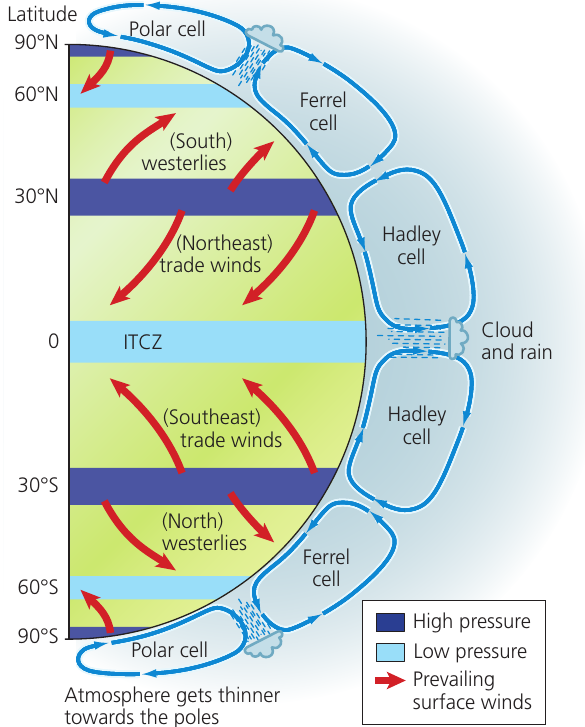
At the Equator, there is a substantial surplus of energy. Large amounts of incoming solar radiation, known as insolation, are received because the Sun sits directly overhead, creating a high angle of incidence. When air comes into contact with the warm Earth's surface at the Equator, it heats up rapidly and begins to rise. As this air ascends, it cools down, causing the water vapour within it to condense into clouds and produce heavy rainfall. This rising air is continuously replaced by air rushing in from both the north and south, creating an area of low pressure known as the inter-tropical convergence zone (ITCZ).
The air that has risen at the Equator doesn't simply disappear. Instead, it begins to cool and track towards the poles. At approximately 20-30° latitude both north and south of the Equator, this now cooler and denser air descends back towards the Earth's surface. These large-scale circulation patterns between the Equator and 30° latitude are called Hadley cells. At mid-latitudes, a second set of circulation cells called Ferrel cells also have descending air. The combination of sinking air from both cell systems creates persistent high pressure zones at the surface around these latitudes.
Important
The Descending Air Process
As air descends in subtropical zones, it warms up and expands. This warming is the key mechanism creating desert conditions: warm air can hold more moisture, causing relative humidity to decrease dramatically. With low humidity, little to no cloud formation occurs, resulting in clear skies throughout most of the year.
As the air descends in these subtropical zones, it warms up and expands. This warming process is crucial for creating desert conditions because warm air can hold more moisture, which means the relative humidity decreases dramatically. With low humidity, little to no cloud formation occurs, resulting in clear skies throughout most of the year. These cloudless conditions are directly responsible for both the intense heat and extreme aridity that characterise hot desert environments at these latitudes.
Continentality (distance from the sea)
Continentality refers to the effect that distance from the sea has on the climate of a region, influencing both temperature patterns and precipitation levels. This factor significantly contributes to the aridity of many desert areas, particularly those located deep within continental interiors.
Coastal locations typically experience a moderate climate with relatively little annual variation in temperature. These areas also receive higher levels of rainfall compared to inland regions. This occurs because large water bodies have a high specific heat capacity, meaning they heat up slowly but also cool down slowly. Water also provides a continuous source of moisture through evaporation. When this moist air moves over the land, it can condense to form clouds and produce precipitation.
Note
Temperature vs Moisture Effects
Continentality has two major effects on climate:
- Temperature: Inland areas experience extreme daily temperature ranges (hot days, cold nights)
- Moisture: Continental interiors are much drier because air masses have lost moisture during their inland journey
For desert formation, the moisture effect is most significant.
However, as you move further inland from the sea, temperatures become far more extreme. Inland areas experience much higher maximum daytime temperatures and lower minimum nighttime temperatures, creating a large diurnal (daily) temperature range. More importantly for desert formation, these continental interiors are generally much drier because there is very little moisture available for cloud formation. The air masses reaching these regions have already lost most of their moisture during their journey inland.
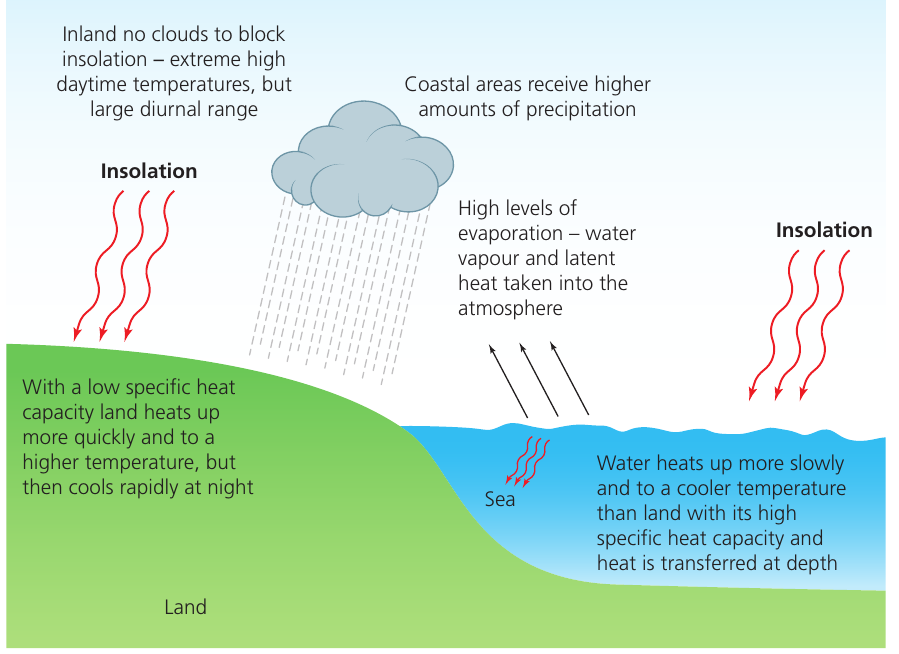
A striking example of continentality can be found in the Sahara Desert. Parts of the central Sahara in North Africa are located more than 2,000 km from the nearest sea. This extreme distance from oceanic moisture sources contributes significantly to the region's aridity, with some areas receiving virtually no rainfall for years at a time.
Relief and the rain shadow effect
Mountain ranges play a crucial role in creating and intensifying desert conditions through a phenomenon known as the rain shadow effect. This process creates extremely dry regions on the leeward (downwind) side of mountain barriers.
When moist air brought inland by prevailing winds encounters a mountain range, it is forced to rise up and over the barrier. As the air rises, it cools due to decreasing atmospheric pressure at higher altitudes. This cooling causes the water vapour in the air to condense, forming clouds and producing relief rainfall on the windward (upwind) side of the mountains. By the time the air reaches the summit and begins to descend on the other side, it has lost most of its moisture.
Note
The Rain Shadow Process
- Moist air approaches mountain range from windward side
- Air is forced upward, cools, and releases moisture as rainfall
- Dry air descends on leeward side, warming and expanding
- Warming reduces relative humidity, preventing cloud formation
- Result: extremely arid conditions on leeward side
As this now-dry air descends down the leeward side of the range, it warms up and expands. This warming further reduces the relative humidity, making cloud formation and rainfall extremely unlikely. The result is a rain shadow – an area of pronounced aridity directly caused by the presence of the mountain barrier.
Important
Major Rain Shadow Deserts
Several major desert regions exist because of the rain shadow effect:
- Arabia: Desert conditions west of the Himalayas
- Central Australia: Aridity west of the Eastern Ranges
- Atacama Desert: One of Earth's driest places, on the leeward side of the Andes mountains
Several major desert regions exist because of this effect. Arabia experiences desert conditions partly due to its position to the west of the Himalayas. Similarly, central Australia suffers from aridity because it lies to the west of the Eastern Ranges. In South America, the Atacama Desert – one of the driest places on Earth – is located on the leeward side of the Andes mountains. Here, the southeasterly trade winds from the Atlantic Ocean are forced to rise over the Andes, depositing their moisture on the eastern slopes and creating extremely arid conditions along the western coast.
Cold ocean currents
Cold ocean currents represent another significant factor in creating coastal desert environments, particularly along the western coasts of continents in subtropical latitudes. These currents form part of the global oceanic circulation system, moving cold water from polar regions towards the Equator.
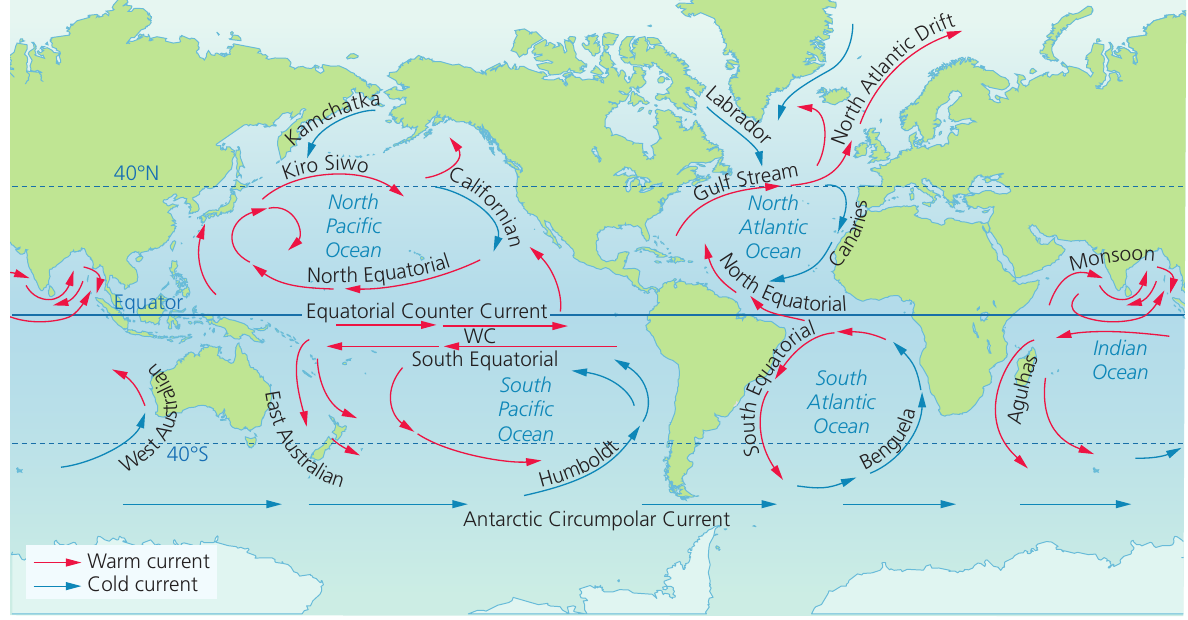
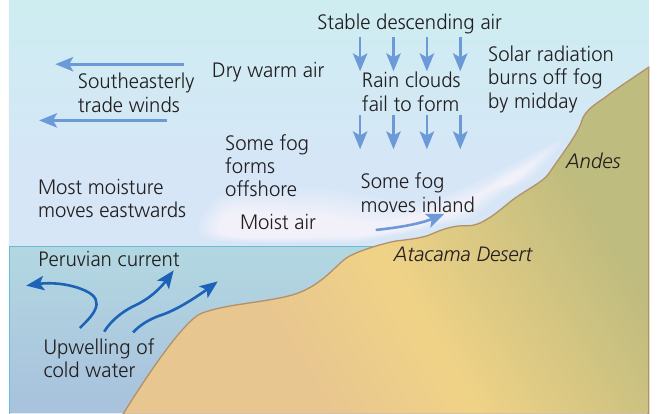
When prevailing winds blow over these cold ocean waters, the air above is cooled considerably. This cooling causes the relative humidity of the air to increase rapidly, and eventually moisture begins to condense, creating fog and mist offshore. As the land heats up more quickly than the sea during the day due to its lower specific heat capacity, gentle onshore breezes may develop. These breezes can carry the fog and mist inland, providing the only source of moisture for some coastal areas.
Note
Why Fog Doesn't Become Rain
Despite the presence of fog along these coasts, rainfall remains extremely rare. The process works like this:
- Cold ocean current cools the air, creating fog through condensation
- Intense solar radiation (Sun directly overhead in subtropics) quickly burns off the fog
- Cool air cannot rise to form rain clouds because it remains too stable
- Result: high humidity but virtually no precipitation
However, despite this moisture, rainfall remains extremely rare. The intense heating from the Sun, which sits almost directly overhead in these subtropical latitudes, quickly burns off the fog and mist. Because the air remains relatively cool (having been cooled by the ocean), it cannot hold much moisture. When this cool air is heated by the Sun, it warms rapidly but remains too stable to rise and form rain clouds. The result is that cloud formation is very unlikely, and precipitation remains virtually non-existent.
Example
Example: The Atacama Desert and Multiple Causes of Aridity
The Atacama Desert in western South America demonstrates how multiple factors combine to create extreme aridity:
Cold Current Effect: The Peruvian Current (also called Humboldt Current) flows northward along the coast, bringing cold water from Antarctica. This cools the air above, creating fog that forms offshore.
Rain Shadow Effect: Southeasterly trade winds bring moist air from the Atlantic Ocean, but this moisture falls as rain on the eastern side of the Andes. The air descending the western slopes is extremely dry.
Atmospheric Circulation: The region lies at subtropical latitudes where descending air from Hadley cells creates high pressure and clear skies.
Result: Although fog forms offshore due to the cold current, intense solar radiation quickly evaporates it. Combined with the rain shadow of the Andes, this creates one of Earth's driest locations.
Some vegetation in northern Chile has even developed remarkable adaptations to take advantage of the moisture that condenses from this fog as dew. For some plants, this represents the only source of water they receive for years at a time, highlighting just how extreme these conditions can be.
Summary
Key Points to Remember:
-
Hot deserts typically form between 20-30° latitude where descending air from Hadley cells creates persistent high pressure zones with clear skies and low humidity.
-
Continentality causes extreme aridity in continental interiors because these areas are too far from oceanic moisture sources – parts of the Sahara are over 2,000 km from the sea.
-
Mountain ranges create rain shadow effects where the leeward side experiences extreme dryness after moist air loses its moisture on the windward side – this explains the Atacama Desert's location.
-
Cold ocean currents along western coasts cool the air and create fog, but intense solar heating burns this away before rain can form, creating some of the world's driest coastal deserts.
-
Multiple factors often work together – the Atacama Desert, for example, experiences aridity from atmospheric circulation, the rain shadow of the Andes, and the cold Peruvian Current simultaneously.