Geomorphological Processes (AQA A-Level Geography): Revision Notes
📚Revision Notes
Geomorphological processes
Hot desert landscapes are constantly shaped by various geomorphological processes. As these systems develop over time and move towards dynamic equilibrium, several processes work together to change the characteristics of desert landforms. These processes are driven by energy inputs and operate through weathering, mass movement, erosion, transportation, and deposition.
Note
These five main processes are interconnected and work together to shape desert landscapes. Material weathered from rock can be moved by mass movement, eroded and transported by wind or water, and eventually deposited to create new landforms.
Weathering
Weathering is the breaking down of rock material in its original location (in situ). Unlike erosion, weathering does not involve moving the broken material away. Instead, it produces loose, broken material called regolith.
Important
Regolith is the loose, weathered material produced when solid rock breaks down through weathering processes.
Weathering in hot deserts can be divided into three main types:
- Mechanical weathering: The physical breakdown of rock through processes like thermal expansion and contraction, freeze-thaw action, and salt crystallisation
- Chemical weathering: The decay of rock through chemical reactions, such as oxidation and hydration
- Organic weathering: The breakdown of rock caused by biological activity, though this is limited in hot deserts due to sparse vegetation
Mass movement
Mass movement describes how material moves downhill under the force of gravity. Rainfall can also assist this process, but in hot deserts mass movement is limited because:
- Moisture levels are very low
- There is little vegetation to destabilise slopes
- Limited soil development means less material available to move
Important
Mass movement in hot deserts is significantly restricted compared to other environments. The lack of moisture and vegetation means that when it does occur, it is dominated by rock falls and rock slides rather than the soil-based movements common in wetter climates.
Where mass movement does occur in hot deserts, it is dominated by two main processes:
Rock falls
Rock falls happen when small blocks of rock become detached from an exposed cliff face and fall freely to the base of the cliff. This commonly occurs in steep, solid rock cliffs.
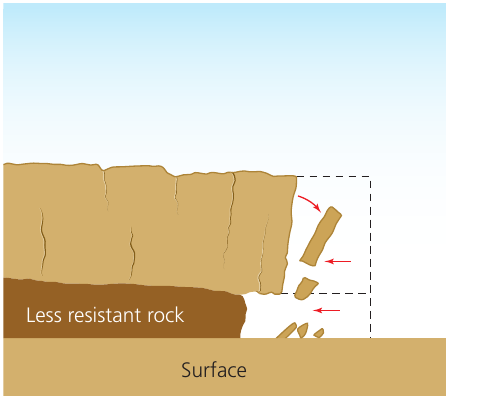
Vertical jointing is often a key feature in rocks where rock falls occur. When vertical joints (cracks) run through the rock, and the cliff is underlain by a less resistant rock layer, the structure becomes unstable. The weaker rock underneath is eroded away, leaving the harder rock above unsupported. Eventually, blocks of rock break away along the joints and fall to the cliff base.
Rock slides
Rock slides occur when there is a failure throughout the entire rock mass. Rather than individual blocks falling, the material collapses en masse (as a whole body) instead of as separate pieces.
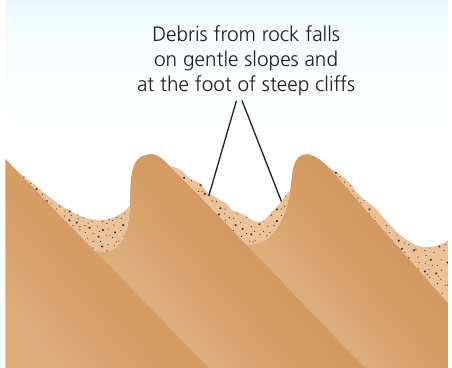
Both rock falls and rock slides create steep slopes with coarse, angular debris (called talus or scree) accumulating at the base. This debris collects on gentle slopes below and at the foot of steep cliffs.

Note
The structure of the rock layers affects how cliffs retreat. When rock has more horizontal bedding planes, the cliffs retreat more uniformly due to normal weathering and erosion. However, when bedding planes are tilted (dipping), they can form a gentle slope parallel to the dip on one side and a steep cliff on the other.
Erosion
Erosion refers to processes that wear away the land surface through mechanical action. The key agents of erosion include glaciers, rivers, wind, and ocean waves and currents. In hot deserts, only wind and water perform this role.
Important
The key difference between weathering and erosion is that erosion removes and transports the broken material away, whilst weathering simply breaks it down in place.
Erosion causes denudation, which means the degradation and wearing down of the Earth's surface.
Transportation
Transportation is the process of moving material from where erosion occurred to where it will be deposited. In hot deserts, the two main agents of transportation are moving water and wind.
The material being transported is called the load. Water generally transports its load through four main processes:
Note
Remember the four transportation processes with: "Try Some Salty Soup"
- Traction
- Saltation
- Suspension
- Solution
Traction
Larger stones and boulders are rolled along the channel bed by the movement of water flowing downstream. This process requires high levels of energy and discharge (the volume of water flowing).
Saltation
Smaller stones and pebbles are bounced along the channel bed in a leaping motion. The water needs high discharge and energy levels to pick up (thrust) small particles into the water column. However, the flow is not fast enough to keep particles off the bed, so they fall back down after moving a short distance downstream.
Particles landing on the bed can dislodge other particles, pushing them up into the moving water. This creates a repeating bouncing action as material moves downstream.
Suspension
The smallest particles (generally silt and clay) are carried along within the moving water column by the flow itself. The turbulence of moving water allows rivers to pick up this fine load and carry it downstream. These finest particles are only deposited when the water becomes almost stationary.
Solution
Dissolved minerals are transported within the mass of moving water itself. These minerals remain dissolved and invisible as they move with the water flow.
Deposition
Since moving water and wind are not continuously present in hot desert environments, depositional features are very common. Both water and wind deposit their load when they experience a reduction in the amount of material they can carry. This happens through:
- A reduction in energy levels
- A reduction in capacity (the maximum amount of material that can be transported)
With a loss of energy, both water and wind deposit their load. A common cause of deposition in hot deserts is evaporation. Water and streams simply dry up, leaving their load behind on the desert surface.
Note
Evaporation is particularly important in hot deserts as a cause of deposition. Unlike in wetter environments where rivers flow continuously to the sea, desert streams often simply evaporate, causing sudden deposition of all transported material.
Summary
Key Points to Remember:
- Weathering breaks down rock in situ (on the spot) to produce regolith, whilst erosion wears away and transports material from the land surface
- Mass movement in hot deserts is limited due to low moisture and sparse vegetation, occurring mainly through rock falls and rock slides
- Transportation has four main processes: traction (rolling), saltation (bouncing), suspension (carried in water), and solution (dissolved minerals)
- Deposition occurs when energy or capacity decreases, often in deserts when water evaporates and streams dry up
- The structure of rock layers (vertical joints vs dipping bedding planes) affects how cliffs form and retreat in desert landscapes