Water and Carbon Cycles and the Atmosphere (AQA A-Level Geography): Revision Notes
📚Revision Notes
Water and Carbon Cycles and the Atmosphere
Understanding Earth's energy balance and radiative forcing
The Earth maintains its temperature through a delicate balance between incoming solar radiation and outgoing infrared energy. When this balance shifts in either direction, the planet experiences either warming (if more energy enters than leaves) or cooling (if more energy leaves than enters).
Important
Radiative forcing is the measure of how much Earth's energy budget is out of balance. It represents either recent warming or cooling activities and is measured in watts per square metre () of the Earth's surface.
Historical changes in radiative forcing
Before 1750, radiative forcing was virtually negligible, meaning Earth's energy balance remained relatively stable. However, since the mid-18th century, radiative forcing has steadily increased due to two primary factors:
- Rising greenhouse gas emissions from human activities
- Changes in albedo (surface reflectivity) caused by land use modifications
Note
Accurately measuring radiative forcing presents significant challenges because numerous complicating factors must be considered, including:
- Natural variations in solar radiation
- Effects of aerosols, such as carbon particles from diesel exhausts, which contribute to warming
Current radiative forcing levels
According to the Intergovernmental Panel on Climate Change (IPCC) Fifth Assessment Report (AR5), current radiative forcing stands at 2.8 watts/m², with an uncertainty range between 2.5 and 3.1 . If CO₂ concentrations continue rising at current rates, scientists predict the Earth will become considerably hotter. Some projections suggest temperatures could rise sufficiently to melt much of the planet's existing ice cover.
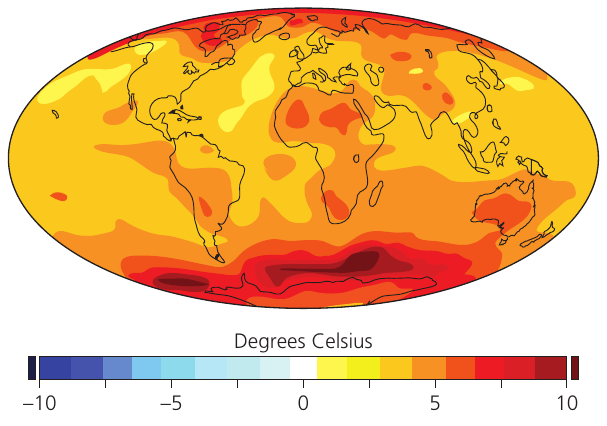
The map above shows predicted increases in surface air temperature from 1960 to 2060 based on NASA's Global Climate Model, illustrating the substantial warming expected across different regions of the planet.
Carbon and water: essential elements for life
Carbon serves as the fundamental building block for all known life on Earth. It combines with other elements—particularly oxygen, hydrogen and nitrogen—to create the complex molecules necessary for living organisms. Similarly, water plays an indispensable role in sustaining life as we understand it.
Every living organism requires continuous access to both carbon and water as they cycle through air, land and sea environments. These elements must be available for use by organisms before being recycled back into the environment.
Important
Despite Earth containing substantial water reserves, only approximately one per cent of this water is accessible to support life on land.
Two growing pressures threaten this limited water reserve:
- Climate change altering precipitation patterns and water availability
- Expanding human populations increasing demand for freshwater resources
How the water and carbon cycles interact with the atmosphere
The warming effect of carbon dioxide
When CO₂ emissions increase in the atmosphere, they trap more heat, causing atmospheric temperatures to rise. This warming triggers a series of connected effects:
- Higher temperatures increase evaporation rates from oceans, lakes and land surfaces
- More water vapour enters the atmosphere
- Since water vapour is itself a potent greenhouse gas, this amplifies the warming effect
This sequence creates what scientists call a positive feedback loop—where the initial warming leads to changes that cause even more warming.
Greenhouse gas contributions
Different greenhouse gases and atmospheric components contribute varying amounts to Earth's overall greenhouse effect:
- Carbon dioxide: approximately 20% of the total greenhouse effect
- Water vapour: roughly 50% of the total greenhouse effect
- Clouds: about 25% of the total greenhouse effect
- Other sources: aerosols and minor greenhouse gases like methane make up the remainder
Why carbon dioxide controls the system
Although water vapour contributes more to the overall greenhouse effect than CO₂, scientists emphasise that it is carbon dioxide that fundamentally controls atmospheric temperature. Here's why this matters:
Note
CO₂ determines the baseline temperature of the atmosphere, which in turn controls how much water vapour the air can hold. As CO₂ levels rise and temperatures increase, the atmosphere's capacity to hold water vapour grows, amplifying the greenhouse effect further. This is detailed in Figure 1.56 (referenced on page 42 of the source material).
The time lag in climate response
An important consideration when examining climate change is that not all warming happens immediately after CO₂ is released. There exists a significant time lag between rising CO₂ concentrations and the full warming response. This delay occurs because:
- Oceans absorb and store vast amounts of heat from the atmosphere
- This absorbed heat is released gradually over time
- Even if CO₂ emissions stopped today, Earth's temperature would continue rising
Important
Current scientific estimates suggest that Earth's temperature will increase by at least another 0.6°C beyond present levels due to CO₂ already present in the atmosphere, regardless of future emission reductions.
Climate change mitigation strategies
Various approaches exist to reduce or prevent greenhouse gas emissions and limit future warming. These mitigation strategies encompass multiple sectors and approaches, from renewable energy adoption to carbon capture technologies. The full range of mitigation methods is detailed in Figure 1.57 (referenced on page 42 of the source material).
Note
Effective mitigation requires coordinated action across multiple sectors including energy production, transportation, agriculture, and industrial processes. The implementation of these strategies must be balanced with economic and social considerations to ensure sustainable development.
Remember!
Summary
Key Points to Remember:
- Radiative forcing measures Earth's energy imbalance in and currently stands at 2.8 watts/m² according to IPCC AR5
- CO₂ contributes 20% to the greenhouse effect, water vapour 50%, and clouds 25%, with the remainder from aerosols and minor gases like methane
- Although water vapour has a larger greenhouse effect than CO₂, carbon dioxide controls atmospheric temperature and therefore determines how much water vapour the atmosphere can hold
- A positive feedback loop exists where warming increases evaporation, putting more water vapour into the atmosphere, which causes additional warming
- Earth's temperature will continue rising by at least 0.6°C due to ocean heat absorption, even without further CO₂ emissions