Thermionic emission (AQA A-Level Physics): Revision Notes
📚Revision Notes
12.1.2 Thermionic Emission
Note
Thermionic emission occurs when a metal is heated, causing the free electrons on its surface to gain enough energy to be emitted. These electrons are released as they overcome the attractive forces binding them to the metal.
Application of Thermionic Emission: Electron Guns
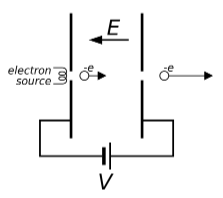
An electron gun is a device that utilises thermionic emission to produce a stream of electrons. Here's how it works:
- Heating the Cathode: The metal cathode is heated to induce thermionic emission, releasing electrons from its surface.
- Acceleration of Electrons: Once emitted, these electrons are accelerated towards a positively charged anode due to a potential difference (voltage) applied between the cathode and anode.
- Electron Beam Formation: Electrons passing through a small gap in the anode form a narrow beam that moves at a constant velocity beyond the anode, resulting in a focused stream of electrons.
Work Done on a Charged Particle
The work done on an electron in an electric field can be calculated by:
Where:
- is the charge on an electron (approximately 1.6 × 10^-19 C).
- is the potential difference through which the electron is accelerated. This equation shows the relationship between the work done on the electron and the potential difference it experiences.
Measuring Energy in Electron Volts (eV)
The energy gained by an electron is often measured in electron volts (eV), where 1 eV represents the kinetic energy of an electron accelerated across a potential difference of 1 V.
Energy Transformation in the Electron Gun
As an electron moves from the cathode towards the anode, its electrical potential energy is converted into kinetic energy. This means the electron gains speed as it travels. By the time it reaches the anode, the electron's kinetic energy equals the work done on it by the electric field:
Where:
- is the mass of the electron,
- is the final velocity of the electron. This equation helps to determine the speed of electrons after they are accelerated by the electron gun.
Note
Key Points
- Thermionic Emission: A process where heating a metal causes electrons to gain enough energy to be emitted from the metal surface.
- Electron Guns: Utilise thermionic emission and a potential difference to produce a controlled beam of electrons.
- Energy Calculations: The kinetic energy of an electron after acceleration can be calculated using or by finding .