Principle of Millikan’s determination of the electronic charge, e (AQA A-Level Physics): Revision Notes
📚Revision Notes
12.1.4 Principle of Millikan's determination of the electronic charge, e
Note
Millikan's oil drop experiment was a crucial experiment for determining the charge of an electron. The setup includes an oil atomiser to produce tiny droplets of oil, which become negatively charged due to friction. These droplets are then suspended between two parallel plates that create a uniform electric field. Here's how the apparatus works and the key equations used:
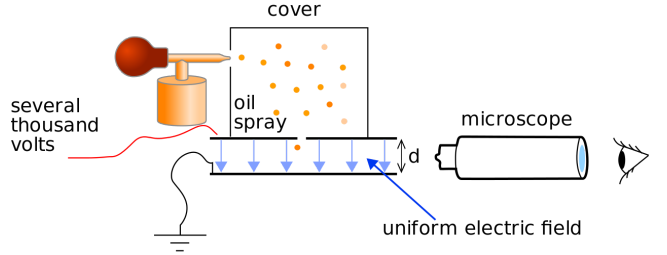
Apparatus and Method
- Atomiser: Produces tiny oil droplets that carry a negative charge.
- Electric Field: When a potential difference () is applied across the plates, a uniform electric field is created. Each charged oil droplet experiences an electric force in the direction of the field.
- Microscope: Used to observe the droplet and measure its behaviour within the field. The electric field strength (E) can be expressed as:
where:
- is the potential difference across the plates,
- is the separation between the plates. When an oil droplet becomes stationary, its weight is balanced by the electric force acting on it:
Thus:
where:
- is the charge on the droplet,
- is the mass of the droplet,
- is the acceleration due to gravity.
Finding the Mass of the Oil Droplet
To determine the charge on the droplet, we need to know its mass, which requires additional steps:
- Remove the Electric Field: When the potential difference is turned off, the droplet begins to fall due to gravity.
- Viscous Drag: As the droplet falls, it reaches terminal velocity (where gravitational force is balanced by the viscous drag force). The viscous drag force on the droplet, according to Stokes' Law, is:
where:
- is the viscosity of the air,
- is the radius of the oil droplet,
- is the terminal velocity. At terminal velocity:
Since the droplet's mass is related to its volume and density , we can rewrite:
Substituting this back into the drag equation and solving for :
With known, can be calculated, allowing the charge to be determined from:
Key Findings and Significance
Millikan's measurements showed that the charges on the oil droplets were always multiples of 1.6 × 10⁻¹⁹ C. This supported the idea that charge is quantised, meaning it exists in discrete "packets" or units. The smallest observed charge was interpreted as the charge of a single electron.
Millikan's experiment was significant as it demonstrated that:
- Electric charge is quantised, existing in multiples of a fundamental unit,
- The fundamental charge, , is approximately 1.6 × 10⁻¹⁹ C,
- This provided critical support for atomic theory and the understanding of electrons as discrete particles carrying a fixed charge.