The Michelson-Morley experiment (AQA A-Level Physics): Revision Notes
📚Revision Notes
12.3.1 The Michelson-Morley Experiment
Note
The Michelson-Morley Experiment was designed to test the concept of absolute motion and the existence of the ether. In the 19th century, scientists believed that all motion was relative to a medium called the ether, thought to permeate the entire universe, through which light would travel.
The purpose of the Experiment:
Michelson and Morley aimed to measure the absolute speed of the Earth through the ether. They hypothesised that if the ether existed, light moving parallel to the Earth's motion would travel at a different speed than light moving perpendicular to it, due to the Earth's movement through this medium.
Apparatus – The Interferometer:
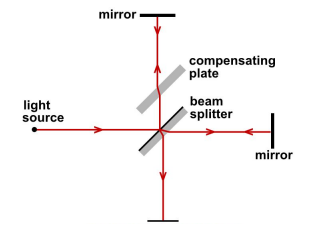
The experiment was conducted using an instrument called an interferometer, which used the following components:
- A partially reflective surface known as a beam splitter, which allowed some light to pass through while reflecting the rest.
- A compensating plate and two mirrors placed at right angles to each other to create two distinct paths for the light.
- A light source directed towards the beam splitter to create two perpendicular beams. Here's how it worked:
- The beam splitter divided the light into two beams travelling at right angles.
- These beams then moved towards the mirrors set at an equal distance from the splitter, ensuring that both beams traversed an equal path length and passed through the same thickness of glass.
- The beams reflected off the mirrors and recombined at a detector, forming an interference pattern that could be observed.
Hypothesis and Prediction:
Michelson and Morley predicted that:
- The speed of light parallel to the Earth's motion would be affected due to the Earth moving through the ether.
- Light moving perpendicular to the Earth's motion would remain unaffected. If the ether existed, the light beam travelling along the direction of Earth's motion would take longer to reach the mirror and return to the detector than the perpendicular beam. Therefore, rotating the apparatus by 90° would alter the path lengths and shift the interference pattern.
Results and Observations:
Contrary to the hypothesis, the experiment showed no shift in the interference pattern when the apparatus was rotated. This indicated that the time taken for light to travel in both directions was the same. Three main conclusions were drawn from this result:
- The ether does not exist, or the Earth drags the ether along with it in such a way that it does not affect light's speed.
- The speed of light is invariant in free space. This means that the speed of light remains the same regardless of the observer's or the source's motion.
- This result later became fundamental to Einstein's theory of special relativity, which postulates that the speed of light in a vacuum is constant and independent of the motion of the source or observer.