Analogue signal processing (AQA A-Level Physics): Revision Notes
📚Revision Notes
13.3.2 The ideal operational amplifier
Operational Amplifiers (Op-Amps) and Amplification
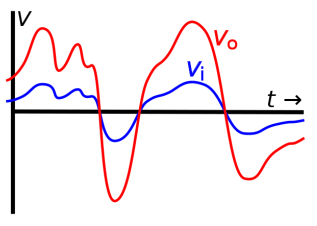
An amplifier is a device designed to increase the strength of an analogue signal's input. Amplifiers are widely used in electronics to boost signals for various applications, from audio to instrumentation.
- The output of an amplifier is a larger version of the input signal, which means it follows the same pattern or waveform as the input but with greater amplitude.
- Output voltage represents the amplified signal, while input voltage is the original signal.
What is an Operational Amplifier?
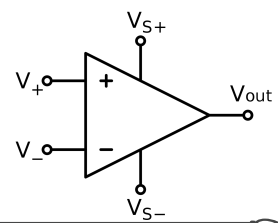
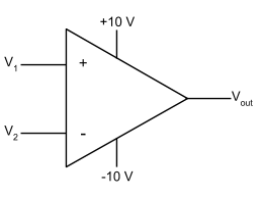
An operational amplifier (op-amp) is an essential electronic component that provides amplification of signals. It has two inputs:
- Inverting input – often marked with a minus sign
- Non-inverting input – marked with a plus sign The symbol for an op-amp typically shows these two inputs and an output .
- Op-amps are versatile and can be set up in different ways to achieve various levels and types of amplification.
- A key measure of amplification in op-amps is the gain (A), defined as the ratio of output voltage to input voltage:
Types of Gain in an Op-Amp
- Open-loop Gain :
- In this mode, there is no feedback in the circuit; signals are not fed back from the output to the input.
- This produces very high gain, as there is nothing limiting the amplification.
- Closed-loop Gain :
- In this configuration, part of the output is fed back to the input.
- This feedback can control and stabilise the gain, making it more useful in practical applications.
Op-Amp Transfer Function and Ideal Characteristics
An operational amplifier amplifies the difference between the two input voltages ( ) and , described by the equation:
where is the open-loop gain.
An ideal operational amplifier is assumed to have the following characteristics:
- Infinite open-loop gain , allowing it to generate any necessary finite gain in a closed-loop setup.
- Infinite input resistance between the inputs, meaning no current is drawn from the input sources.
- Infinite bandwidth, enabling the op-amp to amplify signals at any frequency.
- Zero output resistance, ensuring the output current remains unaffected by changes in the output load.
Saturation in Operational Amplifiers
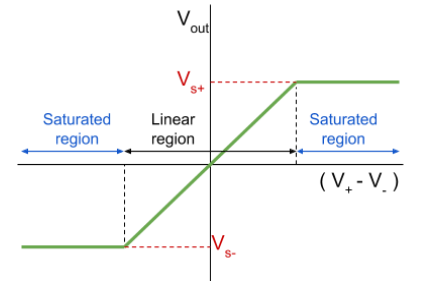
An op-amp cannot produce an output voltage exceeding its supply voltage. If the input voltage difference attempts to generate an output voltage larger than the supply, the op-amp reaches saturation. In this state:
- If attempts to exceed the positive supply , it remains at .
- If attempts to go below the negative supply , it remains at . This behaviour can be visualised on a graph showing how changes with .
Comparator Circuits Using Op-Amps
In comparator circuits, an op-amp in an open-loop configuration can compare two input voltages:
- If , the output reaches the positive supply voltage (e.g., + V).
- If , the output reaches the negative supply voltage (e.g., V).
- If , the output is theoretically V, but this scenario is rare and usually results in an undefined output.
Note
Example: Temperature Sensor Circuit
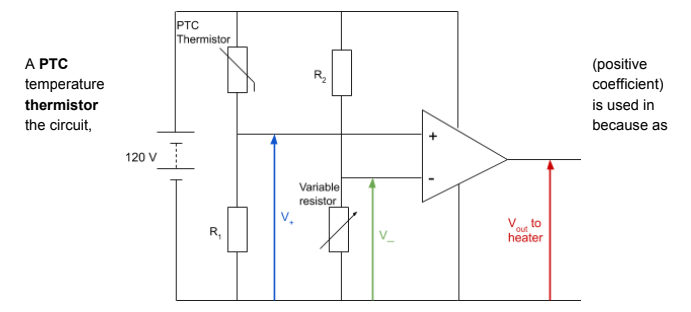
An op-amp comparator can be used in temperature control circuits. Consider a PTC thermistor circuit where:
- Non-inverting input is connected to a voltage divider with a thermistor.
- Inverting input is set to a constant reference voltage using a variable resistor.
- When the temperature drops, the thermistor's resistance increases, increasing , causing to rise, which could activate a heater.
- When the temperature rises, the thermistor's resistance decreases, reducing , causing to fall, which could turn off the heater. The variable resistor can be adjusted to set the exact temperature at which the heater is activated or deactivated.