Non-inverting amplifier configuration (AQA A-Level Physics): Revision Notes
📚Revision Notes
13.4.2 Non-inverting amplifier configuration
Note
A non-inverting amplifier configuration is useful when the original polarity of a signal needs to be preserved while being amplified. This type of amplifier does not invert the input signal, meaning the output signal has the same polarity as the input.
In a non-inverting amplifier, the output voltage is fed back to the non-inverting input of the operational amplifier (op-amp), creating a closed-loop circuit with negative feedback. This feedback stabilises the gain and ensures the circuit operates within the linear range.
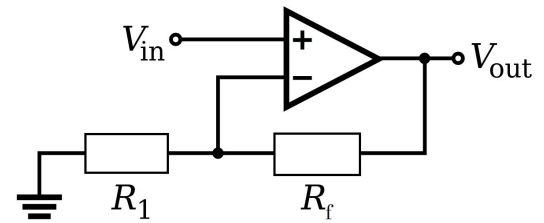
Circuit Diagram:
The diagram below illustrates a typical non-inverting amplifier configuration with components , , and an operational amplifier (op-amp):
- : Input voltage
- : Output voltage
- : Resistor connected to ground
- : Feedback resistor
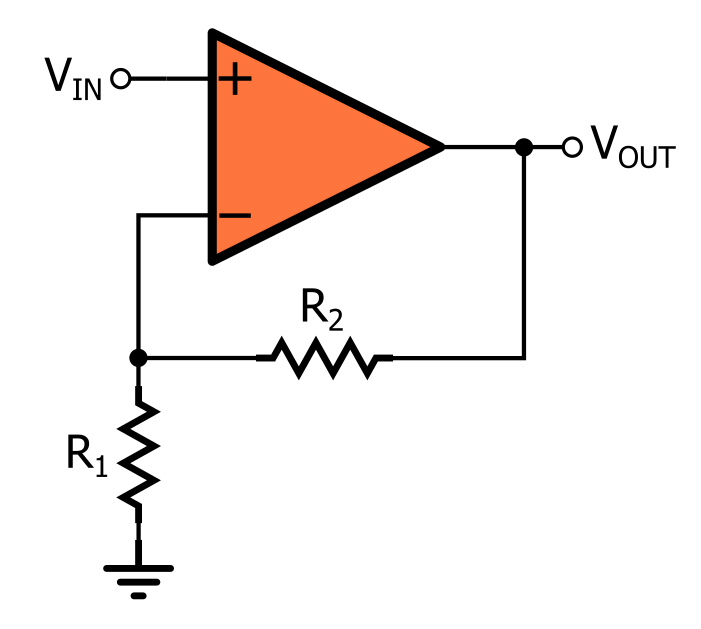
Transfer Function and Gain
The transfer function (gain formula) for a non-inverting amplifier is given by:
This formula shows how the resistors and determine the gain of the amplifier. Note that the gain cannot be lower than 1, meaning this amplifier configuration can only provide amplification or unity gain.
Advantages:
- Direct Connection of Input Signal: Unlike an inverting amplifier, where the input signal goes through a resistor, in a non-inverting amplifier, the input signal is connected directly to the op-amp. This allows the circuit to draw no current from the source due to the op-amp's extremely high input resistance.
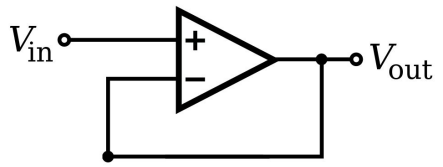
- Unity Gain Buffer Option: If the resistance is or becomes infinite, the circuit behaves as a unity gain buffer (or voltage follower), which outputs the same voltage as the input (with a gain of ). This configuration provides isolation between circuits without amplifying the signal, which is valuable in systems needing high input resistance to avoid disturbing the source.
Unity Gain Buffer
When configured as a unity gain buffer, the op-amp does not amplify the input signal. The unity gain buffer acts as an interface between a high-impedance signal source and a low-impedance load, allowing signals to pass without loading down the source. This configuration has applications in signal buffering where maintaining the original signal integrity is crucial.
Benefits of Unity Gain Buffer:
- No Amplification: The signal is passed through without any change in amplitude.
- High Input Impedance: Prevents drawing current from the source, preserving the original signal.
- Low Output Impedance: Allows the circuit to drive loads without affecting the signal quality.