Summing amplifier configuration (AQA A-Level Physics): Revision Notes
📚Revision Notes
13.4.3 Summing amplifier configuration
Summing Amplifier Configuration
A summing amplifier allows multiple input signals to be connected to an inverting amplifier and amplified independently. This configuration is commonly used in audio equipment, such as audio mixers, where multiple audio signals need to be combined without interfering with each other. This setup uses the virtual earth in an inverting amplifier, which allows different input signals to be connected without affecting one another.
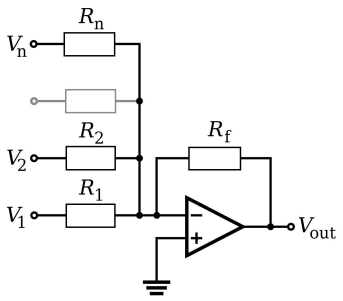
Circuit Diagram:
- The summing amplifier circuit diagram shows several input voltages connected through individual resistors to the inverting input of the operational amplifier.
- The feedback resistor connects the output back to the inverting input, creating a closed-loop with negative feedback.
Transfer Function:
The output voltage for a summing amplifier can be calculated using the following equation:
This equation shows that each input voltage is multiplied by a scaling factor (determined by the resistors) before summing. The negative sign indicates that the output voltage is inverted relative to the input signals.
Difference Amplifier Configuration
A difference amplifier is used to find the difference between two input signals. This configuration is often utilised in applications like noise cancellation, where it helps to subtract unwanted noise from the signal.
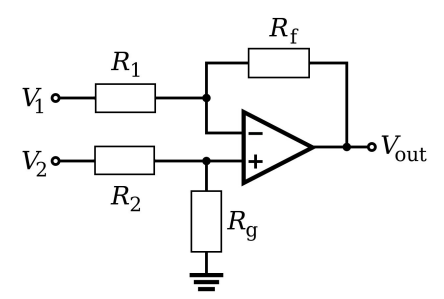
Circuit Diagram:
- The difference amplifier circuit consists of two input signals and connected to the inverting and non-inverting inputs of the operational amplifier.
- Resistors , , , and are used to set up the gain and ensure the circuit responds to the difference between the two signals.
Transfer Function: The output voltage for a difference amplifier is given by:
In many designs, the resistors , , , and are selected to be equal, simplifying the gain calculation and ensuring both input signals are weighted equally.
Applications of the Difference Amplifier:
-
Balanced Microphone In audio applications, balanced microphones can pick up unwanted noise, such as the 50 Hz interference from mains electricity. A difference amplifier can be used to eliminate this noise by inputting the original signal and an inverted version of the signal into the amplifier. The difference amplifier subtracts one from the other, effectively cancelling out the noise.
-
ECG Amplifier An electrocardiogram (ECG) measures the electrical activity of the heart. ECG sensors can pick up 50 Hz mains interference. Using a difference amplifier with an additional electrode in a location that mainly picks up interference, this unwanted noise can be subtracted from the heart signal, giving a cleaner ECG signal.