Time division multiplexing (AQA A-Level Physics): Revision Notes
📚Revision Notes
13.6.3 Time division multiplexing
Overview of Time-Division Multiplexing (TDM)
Time-Division Multiplexing (TDM) is a method for increasing data transmission rates by combining multiple data streams into a single transmission pathway. This approach allows several signals to be sent simultaneously, increasing efficiency in the use of transmission bandwidth.
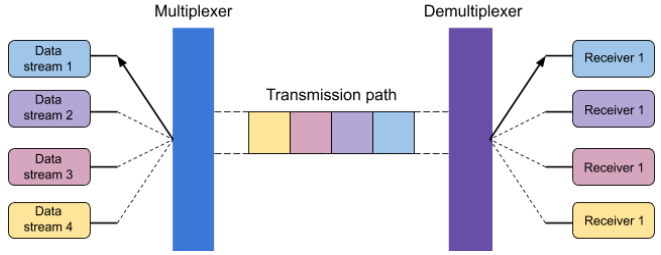
Key Process in TDM
- TDM operates by dividing the transmission time into distinct time slots. Each input data stream (e.g., data stream 1, data stream , etc.) is allocated a specific time slot within the transmission.
- These individual time slots contain packets of data that are marked with identifiers, so they can be recognised and reassembled correctly at the receiving end.
Components in TDM
- Multiplexer (MUX): Combines multiple data streams and allocates them individual time slots for transmission.
- The multiplexer switches between data streams rapidly, assigning each one its designated time slot, which maintains a continuous flow down the transmission path.
- Transmission Path: The medium through which the combined signal travels. This path can accommodate the total data by switching between signals in rapid succession.
- Demultiplexer (DEMUX): Receives the combined signal and separates the packets back into individual streams.
- The demultiplexer must remain synchronised with the multiplexer to ensure each data stream is extracted correctly. It then recombines packets from the same data stream to recreate the original information.
Bandwidth Requirement
An important concept in TDM is bandwidth—the maximum data transfer rate of the transmission medium. For TDM to work effectively, the bandwidth of the transmission medium must be greater than the sum of the bandwidths of the individual data streams.
Advantages of TDM
- Cost-Effective: TDM is generally cheaper than other methods because it makes efficient use of a single transmission path.
- Efficient Bandwidth Usage: The total bandwidth of the transmitted signal does not exceed the bandwidth required for any single data stream, making it suitable for transmission at a single frequency.
- Single-Frequency Transmission: It allows data from different sources to be combined and transmitted at the same frequency, simplifying the design of communication systems.
Disadvantages of TDM
- Decreased Individual Data Rates: As more data streams are added to the system, the transmission rate for each stream decreases because each stream has to wait longer for its turn in the time slots.
- Time Slot Wastage: A time slot is allocated for each data stream, even if no data is currently being sent from that stream. This creates empty slots in the transmission path, reducing overall efficiency.
Note
Example of TDM in Use
Imagine a situation where four different devices (data streams 1 to 4) need to send data over the same connection. The multiplexer assigns each device a dedicated time slot in a repeating cycle. Data from each device is sent in its time slot, resulting in a sequence of packets that move together along the transmission path. At the receiver, the demultiplexer separates the sequence back into the four original data streams, allowing each device's data to be processed individually.