Amplitude (AM) and frequency modulation (FM) techniques (AQA A-Level Physics): Revision Notes
📚Revision Notes
13.6.4 Amplitude (AM) and frequency modulation (FM) techniques
Introduction to Modulation
- Modulation is the process of making a signal suitable for its transmission medium.
- It's essential when transmitting data via electromagnetic waves (radio or light) through free space.
- There are two primary types of modulation:
- Amplitude Modulation (AM)
- Frequency Modulation (FM)
Amplitude Modulation (AM)
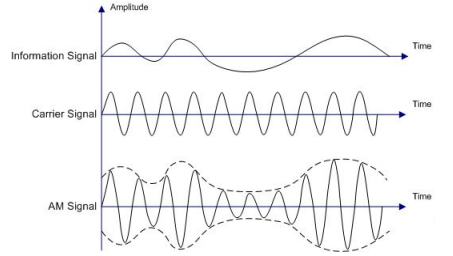
- In Amplitude Modulation, the shape of the information signal dictates the amplitude of the carrier wave.
- The information signal is the data being sent (e.g., audio signal).
- The carrier wave is the medium wave on which this data is "carried" (e.g., radio wave).
- Process:
- The information signal and the carrier wave enter a modulator.
- The information signal's amplitude imprints on the carrier wave, producing an AM signal.
- This AM signal, with the amplitude variations corresponding to the information, is sent for further transmission.
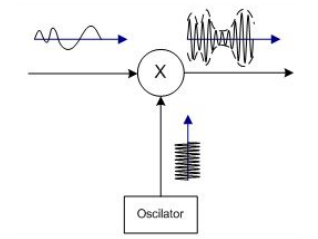
Key Concepts in AM
- Sidebands:
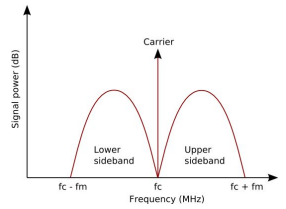
- Amplitude modulation generates two sidebands around the carrier frequency.
- Upper sideband (USB): Frequency (carrier frequency + maximum information frequency).
- Lower sideband (LSB): Frequency (carrier frequency - maximum information frequency).
- Bandwidth:
- The AM bandwidth is the difference between the upper and lower sidebands.
- Formula:
- This bandwidth must be available in the transmission medium to effectively carry the AM signal.
Frequency Modulation (FM)
- In Frequency Modulation, the amplitude of the information signal defines the frequency of the carrier wave. Higher amplitude in the information signal results in higher frequency in the carrier wave.
- Characteristics of FM:
- The amplitude of the FM signal remains constant, only the frequency changes based on the information signal.
- Unlike AM, FM produces an infinite series of side frequencies around the carrier frequency due to frequency variations.
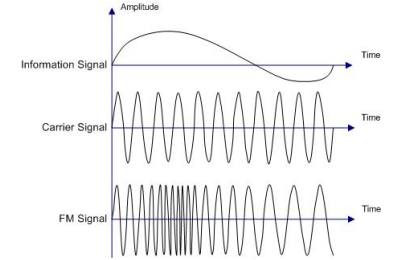
Key Concepts in FM
- Frequency Deviation ($$\Delta f):
- Frequency deviation is the amount by which the carrier frequency can vary according to the information signal.
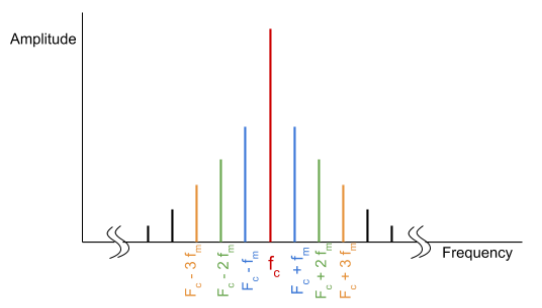
- Bandwidth:
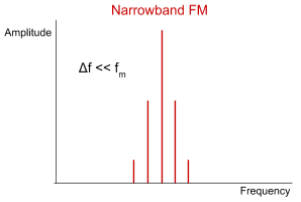
- Narrowband FM: Small frequency deviation relative to ; requires lower bandwidth.
- Wideband FM: Larger frequency deviation, needs more bandwidth.
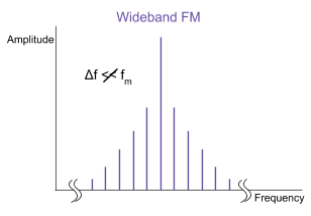
- Carson's Rule approximates FM bandwidth for wideband signals:
Advantages of FM over AM
- Noise Resistance: FM is less susceptible to noise because noise typically affects amplitude, which remains constant in FM.
- Reduced Fading: FM avoids issues from wave reflections which may interfere with amplitude; this is beneficial in environments with many reflective surfaces.
Disadvantages of FM
- Higher Bandwidth Requirement: FM needs more bandwidth than AM, especially for wideband applications.
- Line-of-Sight Requirement: FM signals do not refract well and need direct paths, limiting long-distance or non-line-of-sight applications.
Data Capacity of a Transmission Channel
- The data capacity (maximum data rate) is calculated as:
- This formula helps determine the highest achievable data transfer rate in various transmission media.
Comparison of Bandwidth in Different Transmission Media:
| Transmission Media | Bandwidth |
|---|---|
| Coaxial Cable | Hz |
| Twisted-Pair Cable | Hz |
| Optical Fibre | Hz |