Gravitational potential (AQA A-Level Physics): Revision Notes
📚Revision Notes
7.2.3 Gravitational potential
Gravitational Potential
- Definition: Gravitational potential at a point is defined as the work done per unit mass to move an object from infinity (where potential is zero) to that specific point in the gravitational field.
- Gravitational potential at infinity is set to zero. As an object moves closer to the source of the gravitational field, gravitational potential becomes negative, indicating that energy is released as the object approaches the source.
- Equation for gravitational potential in a radial field:
Where:
- is the gravitational constant,
- is the mass causing the field,
- is the distance between the centres of the objects.
Gravitational Potential Difference
- This is the energy required to move a unit mass between two points in a gravitational field.
- Work done in moving an object with mass over a gravitational potential difference can be calculated by:
Equipotential Surfaces
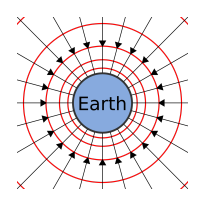
- Definition: Equipotential surfaces are surfaces where the gravitational potential is the same at every point, meaning no work is required to move an object along an equipotential surface.
- Representation: These surfaces are drawn around a mass to indicate areas of equal potential. Movement along the equipotential line does not change potential, and no work is done.
- Graph: Equipotential surfaces are shown as red lines around Earth in a radial field, demonstrating equal potential at points equidistant from the source.
Relationship Between Potential and Distance
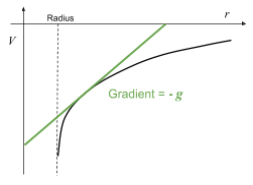
- The gravitational potential is inversely proportional to the distance from the centre of the mass causing the gravitational field, following the relation .
- This relationship can be visualised on a graph of potential against distance .
Gravitational Field Strength from Gravitational Potential
- Gravitational field strength at a certain point can be derived from the gradient of the potential-distance graph:
- To find from the graph, draw a tangent to the curve at the desired point, calculate the gradient, and multiply by .
Gravitational Potential Difference from Field Strength
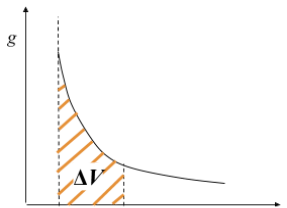
- By plotting gravitational field strength against distance , the area under the curve represents the gravitational potential difference between two points. This area can be used to find how much energy is required to move between these points.
Note
Key Concepts Recap
- Gravitational Potential: Energy per unit mass to bring an object from infinity to a point.
- Equipotential Surfaces: Surfaces where no work is needed to move along them.
- Field Strength and Potential Gradient: Gravitational field strength is the negative gradient of the gravitational potential.
- Visualising Potential Difference: The area under a field strength-distance graph gives the potential difference.