Electric potential (AQA A-Level Physics): Revision Notes
📚Revision Notes
7.3.3 Electric potential
Definition
Note
Electric Potential () at a point in an electric field is defined as the potential energy per unit charge of a positive point charge at that point. The electric potential is at its maximum near the surface of the charge and decreases as the distance from the charge increases. The electric potential at infinity is considered zero, so the electric potential decreases towards zero as distance increases.
The formula for electric potential in a radial field around a point charge is:
Where:
- is the permittivity of free space
- is the charge creating the field
- is the distance from the charge.
Positive or Negative Potential:
The sign of the electric potential depends on the charge:
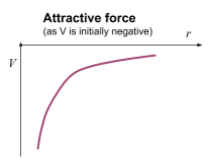
- Positive charge results in positive potential and a repulsive force.
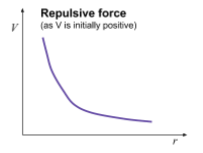
- Negative charge results in negative potential and an attractive force.
Electric Field Strength and Potential
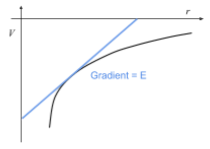
The electric field strength () at a particular point is the gradient of the electric potential () against the distance ():
This can be determined by taking the gradient (slope) of a tangent to a graph of potential against distance .
Electric Potential Difference
The electric potential difference represents the energy needed to move a unit charge between two points in an electric field. The work done ( ) to move a charge across a potential difference is given by:
Equipotential Surfaces
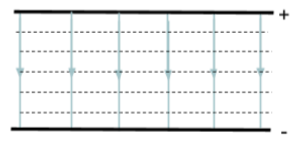
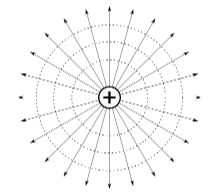
Equipotential surfaces are surfaces where all points have the same electric potential. Therefore:
- No work is done when a charge moves along an equipotential surface, as there is no potential difference.
- In a uniform field, equipotential surfaces are planes parallel to the plates, while around a point charge they form concentric circles.
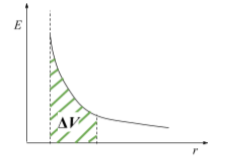
Finding Electric Potential Difference from a Field Strength Graph
By plotting electric field strength () against distance (), the area under the curve between two points on this graph gives the electric potential difference ( ) between those points.