Energy stored by a capacitor (AQA A-Level Physics): Revision Notes
📚Revision Notes
7.4.3 Energy stored by a capacitor
Note
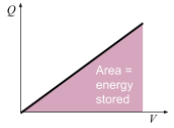
The energy stored in a capacitor is the electrical energy that accumulates as electric charge builds up on its plates. This stored energy can be calculated by finding the area under a graph of charge () against potential difference ().
Energy Stored in a Capacitor
- Graphical Interpretation:
- For a capacitor, charge () is directly proportional to potential difference (). This relationship produces a straight line through the origin when plotted on a graph, as shown in the diagram.
- Since the area under this - graph forms a right-angled triangle, we can calculate the area (and hence the energy stored) as:
- Alternate Forms of the Energy Equation:
- By using the formula for capacitance , we can rearrange and substitute into the energy formula to find two other versions that may be useful depending on the given quantities.
- These variations are:
Where:
- is the charge stored on the plates (in coulombs, ),
- is the potential difference across the plates (in volts, ),
- is the capacitance of the capacitor (in farads, ).
- is the energy stored (in joules, ),
Explanation of Each Form
-
: This form is most direct if both the charge and potential difference are known.
-
: Useful when you know the capacitance and potential difference across the capacitor.
-
: Convenient if you have the charge and capacitance but not the potential difference.
Note
Example Problem
Example: A capacitor is charged to a potential difference of V. Calculate the energy stored in the capacitor.
Solution:
- Given:
- Capacitance
- Potential difference
- Use the formula:
- Substitute the values:
Answer: The energy stored in the capacitor is (or ).
Note
Key Points
- The energy stored in a capacitor is proportional to both the charge and the potential difference.
- The formula for energy can be expressed in three forms depending on what values are known: , , and E = .
- When analysing circuits with capacitors, use the form of the energy formula that best suits the given data.