α, β, and γ radiation (AQA A-Level Physics): Revision Notes
📚Revision Notes
8.1.2 α, β, and γ radiation
Radioactivity
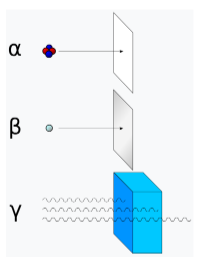
Radioactivity is a process by which unstable nuclei release energy in the form of electromagnetic waves or subatomic particles to become more stable. The three main types of radiation are alpha (), beta (), and gamma (), each with unique properties.
| Radiation Type | Range in Air | Ionising Ability | Deflected by Electric & Magnetic Fields? | Absorbed By |
|---|---|---|---|---|
| Alpha (α) | Highly ionising | Yes | Paper | |
| Beta () | Weakly ionising | Yes | Aluminium foil (~3 mm thick) | |
| Gamma () | Infinite, follows inverse square law | Very weakly ionising | No | Several metres of concrete or several inches of lead |
Identifying Radiation Types
Each type of radiation has different penetrating powers, which allows for easy identification through a straightforward experiment:
- Use a Geiger-Müller (GM) tube to measure the background count (ambient radiation when the source is absent).
- Place the radiation source near the GM tube and measure the count rate.
- Insert a sheet of paper between the source and the GM tube:
- If the count rate decreases significantly, the radiation is alpha.
- Repeat with aluminium foil and several inches of lead:
- Significant reduction with aluminium foil indicates beta radiation.
- Significant reduction with lead indicates gamma radiation.
Applications of Radiation in Industry
These radiation types can be used to monitor material thickness during production processes.
Example
Example:
- Beta radiation is commonly used in the production of aluminium foil.
- A beta source is placed on one side of the material, with a detector on the other.
- If the material becomes too thick, less beta radiation will pass through, prompting rollers to move closer and reduce thickness.
- If too thin, more radiation is detected, and rollers move apart to adjust thickness.
Medical Applications of Gamma Radiation
Due to its weak ionisation and strong penetration:
- Diagnostic Imaging: Gamma-emitting isotopes with short half-lives are injected into patients to diagnose conditions using gamma cameras.
- Sterilisation: Gamma rays effectively kill bacteria, sterilising medical equipment.
- Cancer Treatment: Gamma radiation is directed to target tumours, killing cancer cells while posing minimal harm to healthy tissue.
Note: Gamma rays pose risks due to their penetrating power, so safety protocols such as shielding and exposure minimisation are essential in medical settings.
Safety Precautions with Radioactive Sources
Radioactive sources can be hazardous. To handle them safely:
- Use long-handled tongs for distance.
- Store in lead-lined containers.
- Maximise distance from the source.
- Point sources away from others.
Background Radiation
Background radiation is always present in the environment from various sources:
- Radon gas from rocks.
- Artificial sources such as fallout from nuclear testing.
- Cosmic rays entering Earth's atmosphere.
- Naturally radioactive rocks.
When measuring radioactive sources, it's important to account for background radiation by subtracting it from the total count to get the corrected count:
Inverse Square Law and Gamma Radiation
Since gamma rays spread equally in all directions, their intensity decreases with the square of the distance from the source:
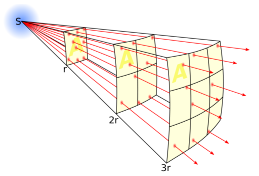
where:
- is the intensity,
- is a constant,
- is the distance from the source.