Radioactive decay (AQA A-Level Physics): Revision Notes
📚Revision Notes
8.1.3 Radioactive decay
Definition
Radioactive decay is a random process, meaning it is impossible to predict exactly when an individual nucleus will decay. However, each type of radioactive nucleus has a constant decay probability, represented by the decay constant , which reflects the likelihood of a nucleus decaying per unit time.
The rate at which the number of undecayed nuclei changes over time, , is proportional to the number of nuclei present, . This can be expressed as:
where is the decay constant.
Exponential Decay Equation
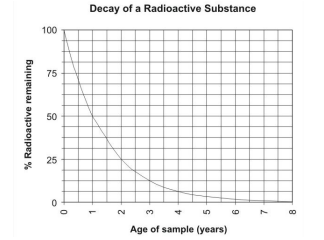
For a sample of radioactive material, the decay follows an exponential decay law over time, which can be described by the equation:
Where:
- is the number of nuclei remaining at time ,
- is the initial number of nuclei,
- is the time elapsed.
Half-Life
Half-life is the time required for half of the nuclei in a sample to decay. Since radioactive decay is exponential, the half-life remains constant over time. To determine half-life experimentally, you can measure the number of nuclei remaining at different times and create a decay curve. The time it takes for the quantity to reduce to half of its original value on this curve represents the half-life.
Alternatively, the half-life can be calculated from the decay constant using:
Measuring Decay Graphically
To measure half-life more accurately, you can plot a graph of against time. The slope of this line, or gradient, equals , allowing the decay constant to be determined, which can then be used to find the half-life.
Activity of a Radioactive Sample
The activity of a radioactive sample is the rate at which nuclei decay, measured in decays per second (Becquerels, ). Activity is proportional to the number of nuclei remaining and is given by:
Since activity also follows exponential decay, it can be described by:
where is the initial activity.
Uses of Radioactive Decay and Half-Life
- Dating:
- Carbon- dating: Carbon-, with a half-life of about 5730 years, is used to date organic materials by comparing the current amount of carbon- to its expected initial amount, giving an estimate of age.
- Medical Diagnosis:
- Technetium-m: This radioisotope has a half-life of 6 hours and emits pure gamma radiation, making it suitable for use in medical imaging, as it decays quickly enough to minimise radiation exposure and can be prepared on site.
Safety and Storage Considerations
The half-life and activity of a radioactive isotope dictate how it should be stored. Materials with long half-lives require stringent containment to prevent environmental contamination, while those with shorter half-lives, like Technetium-m, are safer for temporary use.
Background Radiation
When measuring radiation, it is essential to account for background radiation. Background radiation sources include:
- Radon gas from rocks.
- Artificial sources like nuclear testing.
- Cosmic rays from space.
- Natural radioactive isotopes in the Earth's crust.