Chromatic and spherical aberration (AQA A-Level Physics): Revision Notes
📚Revision Notes
Chromatic and spherical aberration
Introduction to aberrations
Refracting telescopes experience fundamental optical defects called aberrations. These are faults that degrade the quality of images formed by the telescope. The two main types of aberration affecting refracting telescopes are chromatic aberration and spherical aberration.
Note
Both types of aberration represent inherent limitations in the optical design of refracting telescopes. Understanding these defects is essential for appreciating why modern telescopes use sophisticated lens combinations and why reflecting telescopes became popular alternatives.
Chromatic aberration
What causes chromatic aberration?
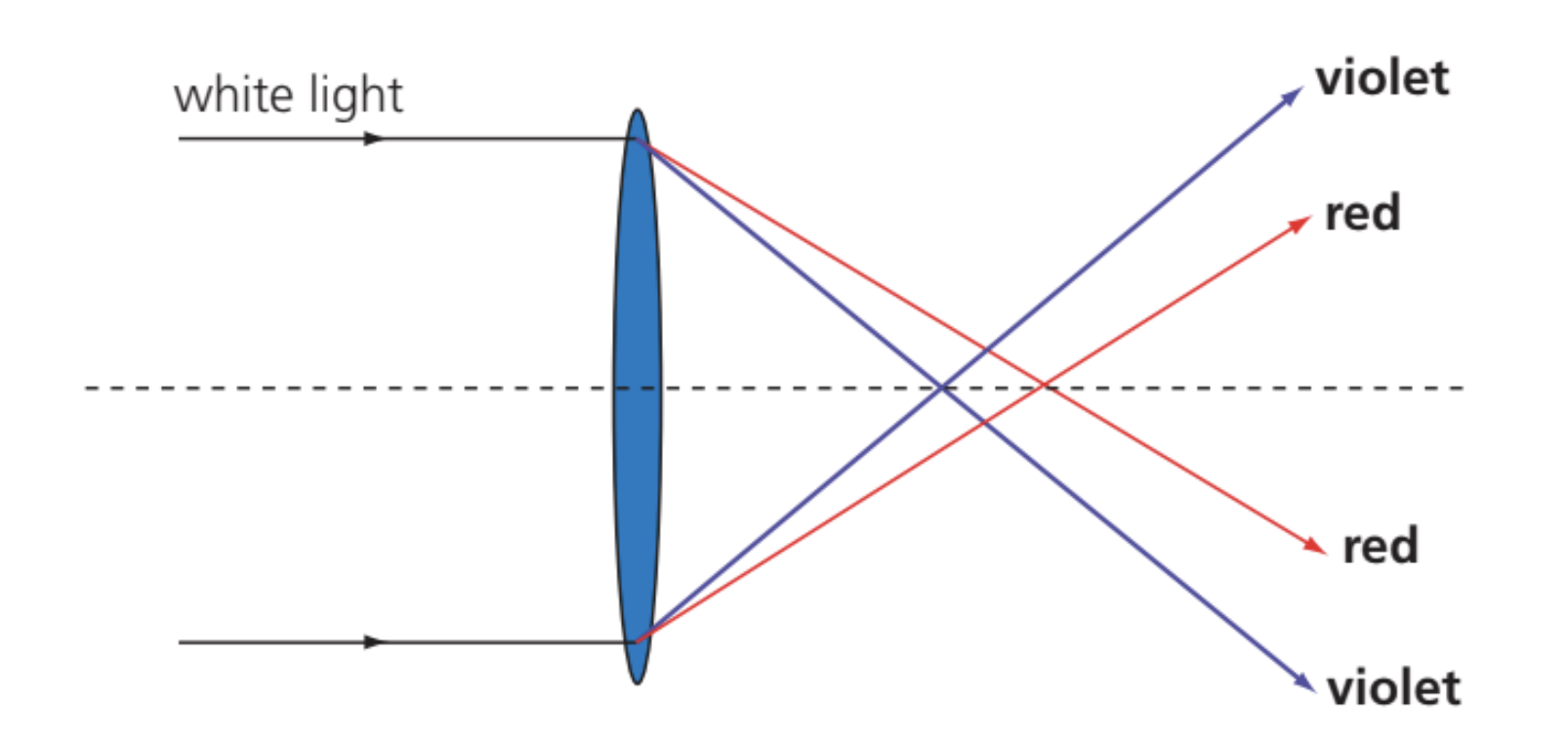
Chromatic aberration is a defect where an objective lens focuses different colours of light at different distances along the optical axis. This occurs due to an effect called dispersion.
Dispersion happens because the refractive index of the lens material varies for different wavelengths of light. When white light passes through a lens, each colour is refracted by a slightly different amount. Blue and violet light, having shorter wavelengths, are refracted more strongly than red light, which has a longer wavelength.
Important
The key to understanding chromatic aberration is remembering that different wavelengths of light bend by different amounts when passing through glass. This is not a manufacturing defect—it's a fundamental property of how light interacts with transparent materials.
 Effects of chromatic aberration
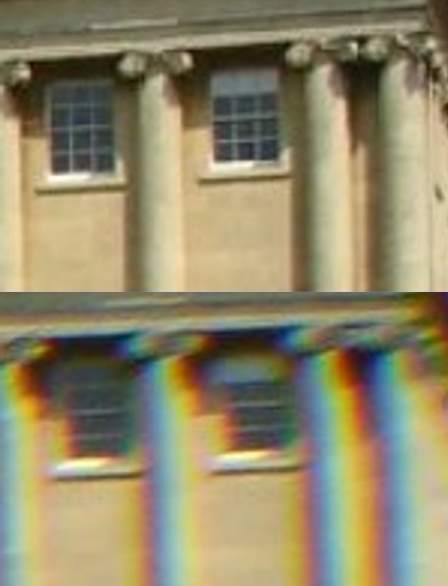
Since different colours focus at different positions along the optical axis, chromatic aberration produces several observable effects:
- Coloured fringes appear around objects in the image
- The image cannot be perfectly sharp for all colours simultaneously
- Different wavelengths have different focal lengths
When observing an image affected by chromatic aberration, you will see coloured edges surrounding features, typically with blue/violet on one side and red on the other.
Correcting chromatic aberration
Chromatic aberration can be reduced through careful optical design and selection of high-quality optical materials. The most effective solution is the achromatic doublet.
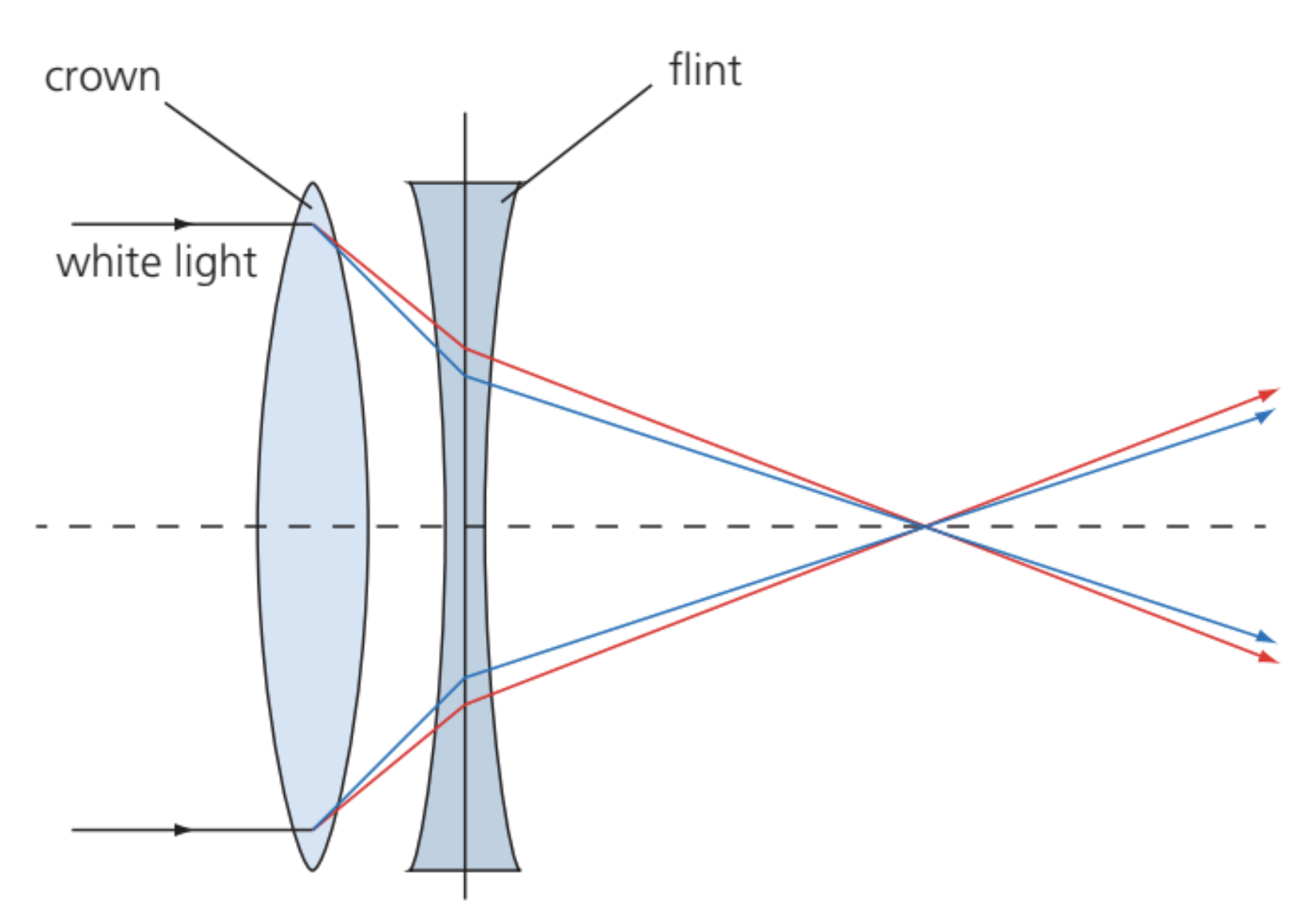
An achromatic doublet consists of two individual lens elements cemented together. These elements work together to correct chromatic aberration by bringing light of two different wavelengths (typically two of red, green, and blue) into focus at the same plane.
Note
The term "achromatic" comes from the Greek words meaning "without colour." While an achromatic doublet doesn't eliminate chromatic aberration completely, it significantly reduces the colour separation that would otherwise occur with a single lens.
The two lenses in an achromatic doublet are made from different types of glass:
- Crown glass: Used for the convex (converging) lens element. This glass has low dispersion, meaning it separates colours less.
- Flint glass: Used for the concave (diverging) lens element. This glass has higher dispersion than crown glass.
The doublet works because the chromatic aberration produced by one lens is compensated by the opposite effect from the other lens. The concave flint glass element is carefully shaped so that its chromatic aberration cancels the chromatic aberration from the convex crown glass element. The doublet is also designed to minimize spherical aberration.
Example
How an Achromatic Doublet Works:
Step 1: White light enters the convex crown glass lens
- All wavelengths are refracted, with blue light bending more than red light
- This creates chromatic aberration
Step 2: Light passes through the concave flint glass lens
- The flint glass has higher dispersion than crown glass
- It introduces chromatic aberration in the opposite direction
Step 3: The two effects combine
- The chromatic aberration from the flint glass cancels most of the chromatic aberration from the crown glass
- Two wavelengths are brought to the same focal point
- The resulting image has significantly reduced colour fringing
Spherical aberration
What causes spherical aberration?
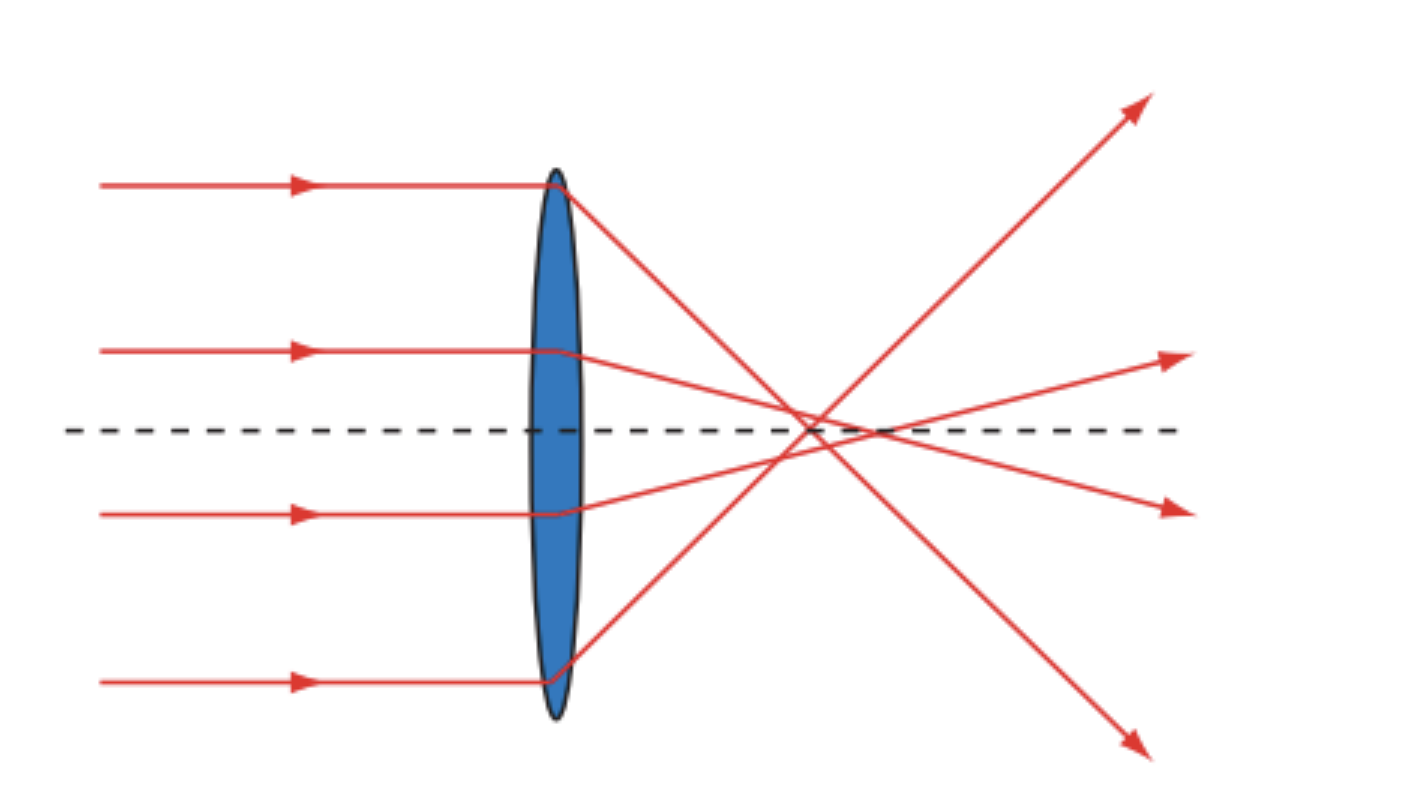
Spherical aberration is a defect resulting from the curved shape of the lens. When parallel light rays pass through a lens with spherical surfaces, different rays focus at different positions along the optical axis.
Specifically:
- Light rays passing through the edge of the lens are deviated more strongly
- Light rays passing near the optical axis are deviated less
- Instead of converging at a single focal point, the rays focus at slightly different positions
Important
Unlike chromatic aberration, spherical aberration is purely geometric—it's caused by the shape of the lens surface, not by the wavelength-dependent properties of the glass. This means spherical aberration affects all colours equally.
Effects of spherical aberration
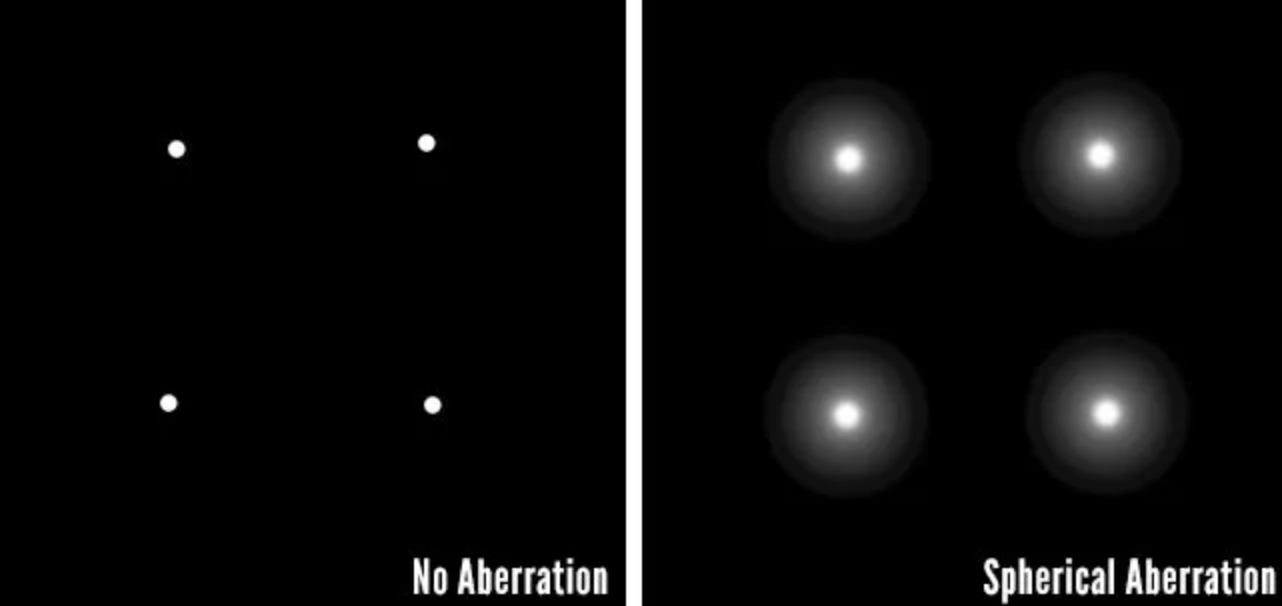
Spherical aberration causes observable degradation of image quality:
- Image blurring occurs because light from a single point in the object does not converge to a single point in the image
- The effect is most pronounced in lenses with large diameter
- Unlike chromatic aberration, spherical aberration affects all wavelengths equally
Note
The blurring caused by spherical aberration is different from the coloured fringes of chromatic aberration. With spherical aberration, the entire image appears soft or out of focus, rather than showing colour separation at edges.
Minimising spherical aberration
The severity of spherical aberration can be reduced by ensuring that both surfaces of the lens contribute equally to the overall deviation of light rays. This distributes the refraction more evenly and reduces the differential focusing effect.
When manufacturing achromatic doublets for telescope objectives, the design takes both chromatic and spherical aberration into account, aiming to minimise both simultaneously.
Remember!
Summary
Key Points to Remember:
-
Chromatic aberration occurs because different wavelengths of light have different refractive indices in glass, causing them to focus at different positions and creating coloured fringes in images.
-
Spherical aberration is caused by the curved surfaces of lenses, which cause rays passing through different parts of the lens to focus at different positions, resulting in blurred images.
-
Spherical aberration is most severe in large diameter lenses, where edge rays differ significantly from central rays.
-
An achromatic doublet corrects chromatic aberration by combining a convex crown glass lens (low dispersion) with a concave flint glass lens (high dispersion) to bring two wavelengths into the same focus.
-
Both aberrations can be minimized through careful optical design, but they represent fundamental limitations of simple refracting telescope designs.