Resolving and collecting power of telescopes (AQA A-Level Physics): Revision Notes
📚Revision Notes
Resolving and collecting power of telescopes
Introduction to resolving power
When we use a telescope to observe distant objects in space, one of the most important characteristics we need to consider is its resolving power. This refers to the telescope's ability to distinguish between two closely spaced objects and produce separate, distinct images of them. Without adequate resolving power, two stars that are close together might appear as a single blurred point of light.
The limitation on resolving power arises from the wave nature of electromagnetic radiation. When light (or other electromagnetic waves) passes through the opening of a telescope, the waves don't simply travel straight through. Instead, they undergo diffraction, bending around the edges of the aperture. This diffraction causes the waves to interfere with each other, creating a characteristic pattern.
Note
Diffraction is a fundamental wave phenomenon that occurs whenever waves pass through an opening or around an obstacle. In telescopes, this effect cannot be eliminated - it is an inherent consequence of the wave nature of light. Even a perfectly constructed telescope will experience diffraction limitations.
Diffraction and Airy discs
Because of diffraction effects, even when a telescope observes a perfect point source like a distant star, the image formed is not a perfect point. Instead, the telescope produces a pattern called an Airy disc. This consists of a bright central disc surrounded by progressively fainter concentric rings.
The Airy disc is a diffraction pattern that results from constructive and destructive interference of light waves as they pass through the circular aperture of the telescope. The central bright region contains most of the light energy, with the first dark ring (the first minimum) marking the boundary of this central maximum.
Important
The amount of blurring in an astronomical image is determined by the size of the central maximum in the Airy disc. A narrower central disc means less blurring and therefore more detail can be observed in the final image. This is why telescope designers work to minimize the width of the Airy disc.
Angular width of the Airy disc
The angular position of the first dark fringe (first minimum) in the Airy disc can be calculated using the following relationship:
Where:
- (lambda) is the wavelength of the electromagnetic radiation in metres
- is the diameter of the objective (the primary lens or mirror) in metres
- (theta) is the angular position in radians
In astronomical observations, the angles involved are extremely small. This allows us to make a useful approximation: for small angles measured in radians, . This simplifies our equation to:
Important
The Small Angle Approximation
This approximation () is only valid when is measured in radians and is much less than 1 radian (approximately 57 degrees). In astronomy, this condition is almost always satisfied since we typically deal with very small angular separations.
This simplified formula tells us two important things about improving the resolving power of a telescope:
- Increasing the diameter of the objective makes smaller, which reduces the width of the central maximum. This means a larger telescope can resolve finer details.
- Using shorter wavelengths (smaller ) also reduces , producing a narrower Airy disc. This is why ultraviolet or X-ray telescopes can potentially achieve better resolution than optical telescopes, assuming the same aperture size.
Example
Worked Example: Calculating Angular Width
A telescope has an objective diameter of 0.25 m and observes visible light with a wavelength of m. Calculate the angular width of the first minimum.
Solution:
Using the formula:
To convert to arcseconds (multiply by ):
This represents the theoretical resolution limit for this telescope at this wavelength.
Overlapping Airy discs and the Rayleigh criterion
When we observe two point sources that are close together (such as two nearby stars or a binary star system), each produces its own Airy disc. If the objects are sufficiently separated, the two Airy discs will be distinct and the objects are easily resolved as separate sources. However, as the objects get closer together, their Airy discs begin to overlap.
Note
Three Cases of Overlap
The degree of overlap determines whether we can still distinguish the two objects as separate light sources:
- When well separated, the two Airy discs are clearly distinct and the objects are resolvable
- At a critical separation, the central maximum of one Airy disc coincides with the first minimum of the other. At this point, the objects are just resolvable
- When even closer together, the Airy discs merge too much and the objects become unresolvable - they appear as a single source
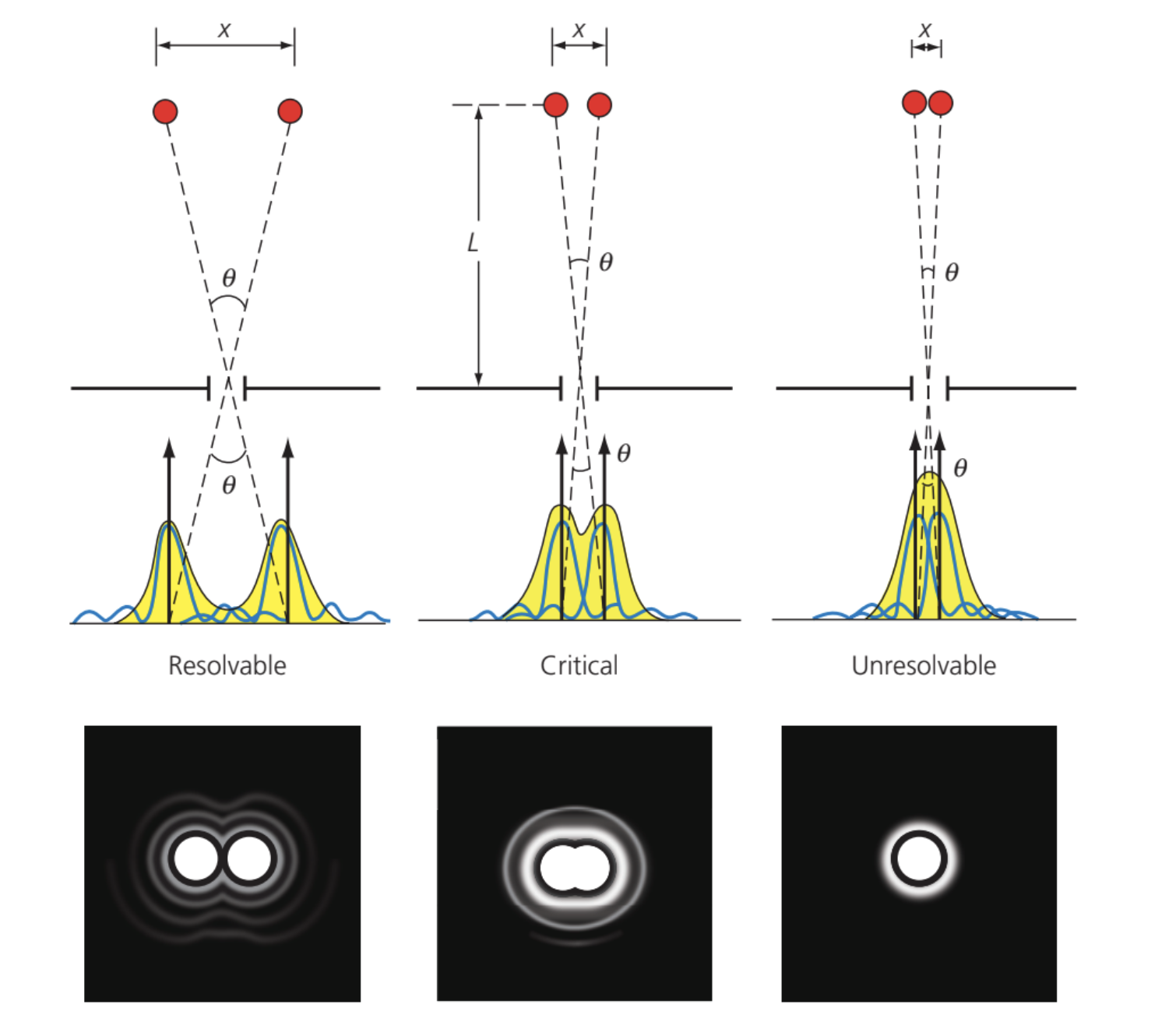
At the critical separation, where two objects are just resolvable, we can write:
Where:
- is the physical separation between the two objects
- is the distance from the telescope to the objects
The Rayleigh criterion provides a precise definition for the minimum separation needed to resolve two point objects. It states that two point sources can be resolved as separate objects if their angular separation is at least:
Important
This angle is known as the minimum angular resolution of the telescope at the specified wavelength. It represents the smallest angular separation that can be distinguished by the instrument. A smaller value of minimum angular resolution indicates better resolving power - the telescope can distinguish objects that are closer together.
The imaging process operating at this limit is described as being diffraction-limited, meaning that diffraction is the primary factor limiting the telescope's performance.
Angular measurements in astronomy
Astronomers use angular measurements to describe the apparent size of objects in the sky (their angular size) and the separation between objects. These measurements use a system based on degrees, with subdivisions into smaller units.
The angular measurement system works as follows:
- 1 degree (1°) = 1/360 of a complete circle
- 1 arcminute (1') = 1/60 of a degree
- 1 arcsecond (1") = 1/60 of an arcminute = 1/3600 of a degree
These units allow astronomers to express very small angles precisely.
Note
Angular Sizes in Context
- The full Moon has an angular diameter of approximately 0.5° or 30 arcminutes (30')
- The Sun coincidentally has almost the same angular size as seen from Earth
- Much smaller objects like Jupiter might have an angular diameter of around 50 arcseconds (50")
- A good optical telescope operating under steady atmospheric conditions can resolve details down to approximately 1 arcsecond (1")
Collecting power of telescopes
The collecting power of a telescope is another vital performance parameter, distinct from resolving power. It measures the telescope's ability to gather incoming electromagnetic radiation from astronomical sources.
The collecting power depends on the area of the objective that is exposed to incoming radiation. For a circular aperture with diameter , the area is proportional to . Specifically, the area of a circle with diameter equals:
This leads to the fundamental relationship:
Where is the diameter of the objective.
Important
The Square Law
Collecting power is directly proportional to the square of the objective diameter. This means that even modest increases in diameter lead to significant improvements in light-gathering ability. For example, doubling the diameter increases the collecting power by a factor of four.
For optical telescopes specifically, the collecting power is often called the light-gathering power (LGP), measured in square metres (m²). The LGP provides a relative comparison between different telescopes - it indicates how much light each telescope can collect from astronomical sources. A telescope with greater light-gathering power will produce brighter images, making it possible to observe fainter objects or gather data more quickly.
Benefits of large-aperture telescopes
Both resolving power and collecting power improve significantly with larger objective diameters. This explains why astronomers continually seek to build telescopes with larger and larger apertures:
For resolving power: Since minimum angular resolution , increasing reduces , allowing the telescope to distinguish finer details and separate closer objects.
For collecting power: Since collecting power , doubling the diameter quadruples the light-gathering ability. A telescope with a 4-metre mirror collects four times as much light as a 2-metre mirror.
Note
Practical Limitations
While larger apertures provide significant advantages, there are practical limits to how large telescopes can be built, including:
- Engineering challenges in constructing and supporting large mirrors or lenses
- Increasing costs that grow rapidly with size
- Physical constraints that vary for different types of telescope designs
- Atmospheric effects that can limit the practical resolution of ground-based telescopes
These advantages make large-aperture telescopes extremely valuable for astronomy, enabling observations of fainter and more distant objects while resolving finer details in astronomical images.
Summary
Key Points to Remember:
-
Resolving power is a telescope's ability to produce separate images of closely spaced objects, limited by diffraction which creates Airy discs rather than perfect point images.
-
The Rayleigh criterion () defines the minimum angular resolution: two objects can be resolved if separated by at least radians, where is wavelength and is objective diameter.
-
Better resolving power is achieved with larger apertures (larger ) and shorter wavelengths (smaller ), both of which reduce the minimum angular resolution .
-
Collecting power measures the ability to gather electromagnetic radiation and is proportional to the square of the objective diameter (), so doubling the diameter quadruples the light collected.
-
Angular measurements use degrees, arcminutes, and arcseconds: 1° = 60', 1' = 60", and 1" = 1/3600 of a degree.