Classification of stars (AQA A-Level Physics): Revision Notes
📚Revision Notes
9.2.6 Supernovae, neutron stars, and black holes
Solar Mass
One solar mass is equivalent to the mass of the Sun, approximately kg. This unit is often used to describe the masses of other stars.
Stages of Stellar Evolution
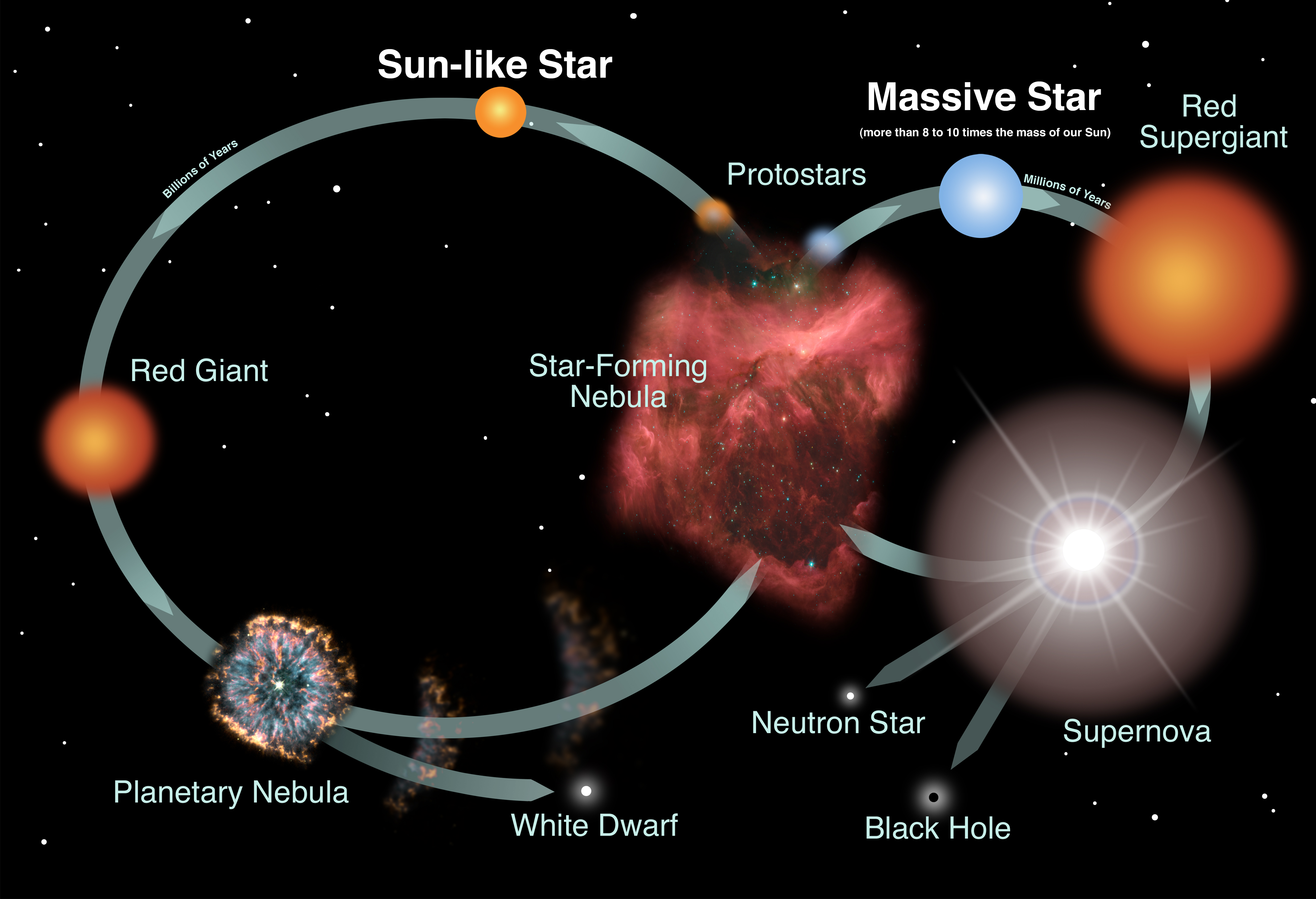
- Protostar
- Nebula: A protostar forms within a nebula, which is a cloud of gas and dust. Gravitational forces cause these particles to clump together, gradually forming denser regions.
- Circumstellar Disc: The protostar is surrounded by a rotating disc of material. The conservation of angular momentum causes the material to spin, pushing mass inward to form a dense core.
- Fusion Begins: Once the temperature rises sufficiently, fusion reactions begin, creating a stellar wind that pushes away remaining material around the protostar.
- Main Sequence
- Fusion and Stability: In the main sequence stage, hydrogen nuclei fuse to form helium. The star is in equilibrium, with gravity pulling inward balanced by the outward pressure from fusion.
- Lifetime: The larger the star's mass, the shorter its main sequence phase, as it consumes fuel more rapidly.
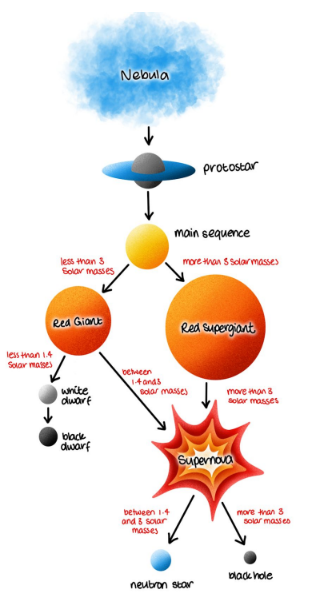
- Red Giant (for stars with mass solar masses)
- Fusion of Heavier Elements: When hydrogen runs out, the core contracts, increasing temperature and enabling helium fusion into heavier elements (e.g., Carbon, Oxygen).
- Expansion: The outer layers expand and cool as the core heats up.
- White Dwarf (for stars with mass solar masses)
- End of Fusion: Fusion ceases, and the star's core contracts further.
- Dense Core: A dense, cooling remnant called a white dwarf forms, eventually cooling to a black dwarf over a very long time.
- Red Supergiant (for stars with mass solar masses)
- These stars undergo similar processes as red giants but on a larger scale, potentially leading to explosive events like gamma-ray bursts.
- Supernova (for stars solar masses)
- Core Collapse: When fuel runs out, the core collapses, producing a massive shockwave. Outer layers are expelled, creating a brilliant explosion.
- Energy Release: Supernovae can release as much energy in a few seconds as the Sun emits over its entire lifetime (~).
- Neutron Star (for stars between and solar masses)
- Extreme Density: The gravitational collapse forces protons and electrons to combine, forming neutrons. Neutron stars are incredibly dense (~).
- Pulsars: Some neutron stars spin rapidly and emit beams of radiation, observed as pulsars.
- Black Hole (for stars with mass solar masses)
- Event Horizon: When a massive star collapses beyond the neutron star phase, it forms a black hole with an event horizon where escape velocity exceeds the speed of light.
- Schwarzschild Radius: The radius of the event horizon is given by:
where is the gravitational constant, is the black hole's mass, and is the speed of light.
Supernovae Types
- Type I
- Occurs in a binary system when a white dwarf accretes mass from its companion star and explodes upon reaching a critical mass.
- Type II
- Results from the core collapse of a massive star that has run out of nuclear fuel.
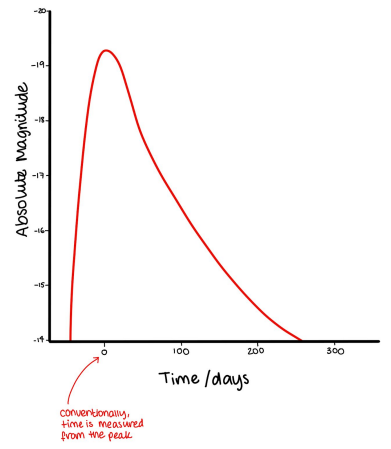
- Type Ia Supernovae
- Known for consistent peak absolute magnitudes (~), used as standard candles to measure vast cosmic distances.
Cosmic Phenomena and Black Holes
- Supermassive Black Holes
- Located at the centre of most galaxies, believed to have formed from either massive gas clouds or the merging of smaller black holes.
- Dark Energy and Expansion of the Universe
- Observations show the universe is expanding at an accelerating rate, potentially due to dark energy. Dark energy is theorised to counteract gravitational attraction and cause this acceleration, although its exact nature remains unknown.