Classification by temperature, black-body radiation (AQA A-Level Physics): Revision Notes
📚Revision Notes
9.2.3 Classification by temperature, black-body radiation
Black-Body Radiator
- A black body is an idealised object that perfectly emits and absorbs all wavelengths of radiation.
- Stars can be approximated as black bodies, which allows us to apply laws of black-body radiation to understand star temperature, size, and luminosity.
Stefan's Law
- Stefan's law states that the power output (luminosity, of a black body radiator is directly proportional to its surface area (A) and the fourth power of its absolute temperature (T)**:
- Where:
- is the Stefan-Boltzmann constant ,
- is the surface area of the star,
- is the absolute temperature in Kelvin.
- This relationship is useful for comparing stars based on their luminosity, temperature, and size.
Wien's Displacement Law
- Wien's law shows that the peak wavelength of emitted radiation by a black body is inversely proportional to its absolute temperature (T)**:
- This means that as temperature increases, the peak wavelength decreases, implying that hotter objects emit shorter wavelengths.
- Wien's law helps estimate the temperature of stars by observing their peak emission wavelength.
Black-Body Curves
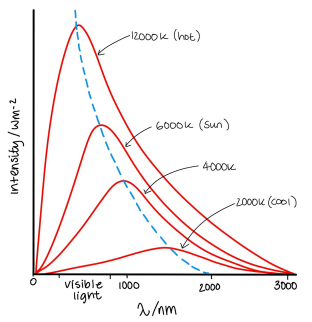
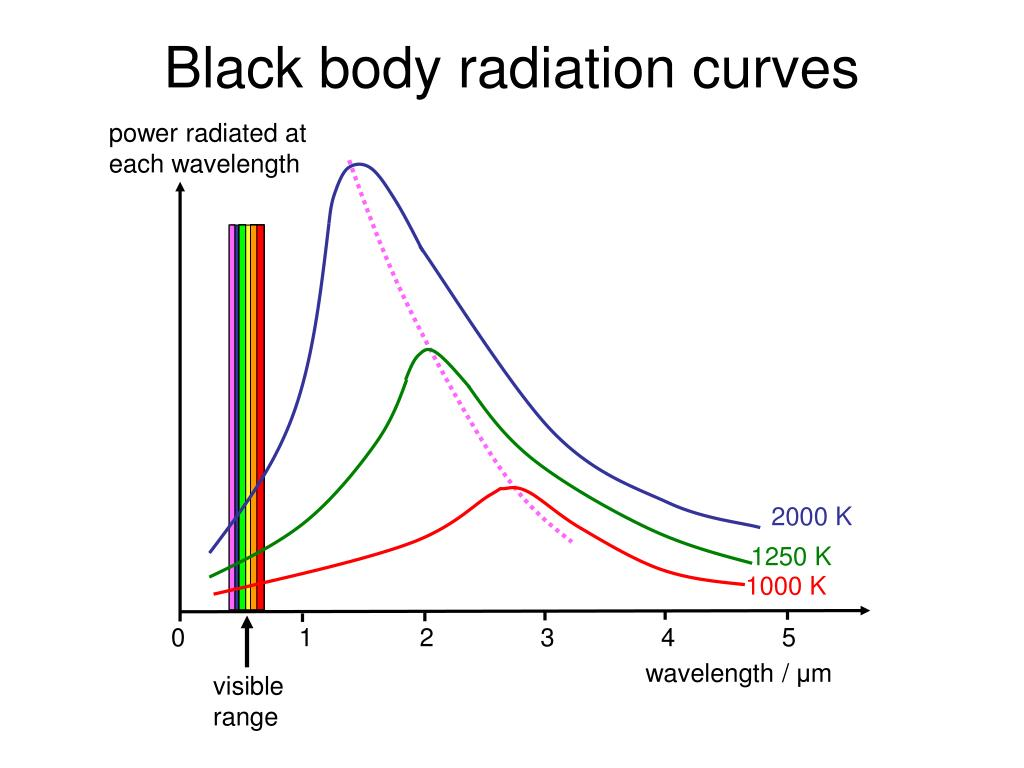
- A black-body curve represents the intensity of radiation emitted by an object against the wavelength of the emitted radiation.
- As the temperature of the black body increases:
- The peak of the curve shifts to shorter wavelengths (indicating higher energy),
- The intensity increases, producing a brighter object.
- This principle allows scientists to infer the temperature and other characteristics of stars based on their emission spectrum.
Inverse Square Law of Intensity
- The intensity () of light emitted by a star decreases with the square of the distance ()** from the star:
- Intensity here refers to the power per unit area received from the star.
- This follows the inverse square law because light spreads out equally in all directions from the point source, covering a larger area as the distance increases.