Cosmology (AQA A-Level Physics): Revision Notes
📚Revision Notes
Evidence for the big bang
The Big Bang theory is supported by two major pieces of observational evidence:
- the cosmological microwave background radiation
- the relative abundances of hydrogen and helium in the Universe.
Both provide strong support for the Hot Big Bang model.
Note
These two independent lines of evidence work together to support the Hot Big Bang theory. The CMB tells us about conditions approximately 300,000 years after the Big Bang, while element abundances reveal what happened in the first few minutes of the Universe's existence.
Cosmological microwave background
The cosmological microwave background (CMB), also called the cosmic microwave background, provides key evidence for the Hot Big Bang model. This radiation is a relic of the early Universe, specifically from approximately 300,000 years after the Big Bang.
Origin and red-shift
According to the Hot Big Bang model, high-energy electromagnetic radiation in the gamma region of the spectrum was produced in the early Universe when it was extremely small and hot. Due to the expansion of the Universe over billions of years, this radiation has been red-shifted down to much longer wavelengths in the microwave region of the electromagnetic spectrum.
This red-shift is a direct consequence of universal expansion - as space itself expands, the wavelengths of photons traveling through it are stretched, shifting them from gamma rays to the microwave range we observe today.
Discovery and characteristics
In the 1960s, scientists discovered background radiation coming uniformly from all directions in space. This radiation was detected as a faint signal that remained constant over time and could be observed at any time of day or year. The key characteristic of this radiation is that it is isotropic, meaning it arrives with equal intensity from all directions in the sky.
The intensity spectrum of this radiation matches a black-body curve corresponding to a temperature of approximately 2.73 K. This is exactly what would be expected from thermal radiation that originated in the hot, dense conditions of the early Universe and has since cooled due to expansion.
Note
The isotropic nature of the CMB is significant because it shows that the early Universe was extremely uniform. The radiation reaching us from opposite sides of the observable Universe has the same characteristics, indicating that these regions were once in thermal equilibrium before the Universe expanded.
COBE observations
In 1989, the Cosmic Background Explorer (COBE) satellite was launched to carry out precise measurements of the cosmological microwave background. COBE measurements determined that the CMB corresponds to a black-body temperature of K, confirming the theoretical predictions.
The satellite also detected tiny temperature fluctuations in the microwave background. Although the CMB temperature is almost completely uniform at 2.7 K, there are very small variations of approximately K from one region to another. These tiny fluctuations represent energy-density variations in the early Universe. Such variations were sufficient for gravitational forces to cause matter to clump together, seeding the formation of galaxies that we observe today.
Important
Temperature Variations and Galaxy Formation
The tiny temperature fluctuations detected by COBE (variations of order K) are crucial to our existence. Without these small irregularities in the early Universe, matter would have remained uniformly distributed, and galaxies, stars, and planets would never have formed. These variations acted as "seeds" where gravity could begin pulling matter together.
WMAP observations
The Wilkinson Microwave Anisotropy Project (WMAP) succeeded COBE and provided much more accurate measurements of temperature differences in the microwave background. WMAP instruments had temperature sensitivity approximately one thousand times greater than COBE, allowing for more detailed observations of temperature variations across the sky.
Note
Key Findings from WMAP
The improved sensitivity of WMAP instruments allowed astronomers to make several groundbreaking discoveries:
- A more precise age of the Universe: billion years
- Determination that the first stars formed only a few million years after the Big Bang
- Strong evidence that the Universe will continue expanding forever
These findings represent some of the most precise measurements in cosmology and have fundamentally shaped our understanding of the Universe's history and future.
Hydrogen and helium abundances
The observed relative abundances of hydrogen and helium in the Universe provide another line of evidence supporting the Big Bang theory.
Observed abundances
Hydrogen and helium together account for nearly all the matter observed in the Universe today. The relative abundance by mass of elements in the Universe is approximately 73% hydrogen, 25% helium, and 2% all other elements combined. These values have been determined from analyzing the spectral characteristics of stars throughout the Universe.
These observed abundances match the predictions of the Hot Big Bang model regarding the formation of light elements in the early Universe.
Note
The remarkable consistency between observed abundances and theoretical predictions is not a coincidence. The specific ratio of hydrogen to helium depends on factors like the density of the Universe, the rate of expansion, and fundamental nuclear physics - all of which are incorporated into the Hot Big Bang model calculations.
Primordial nucleosynthesis
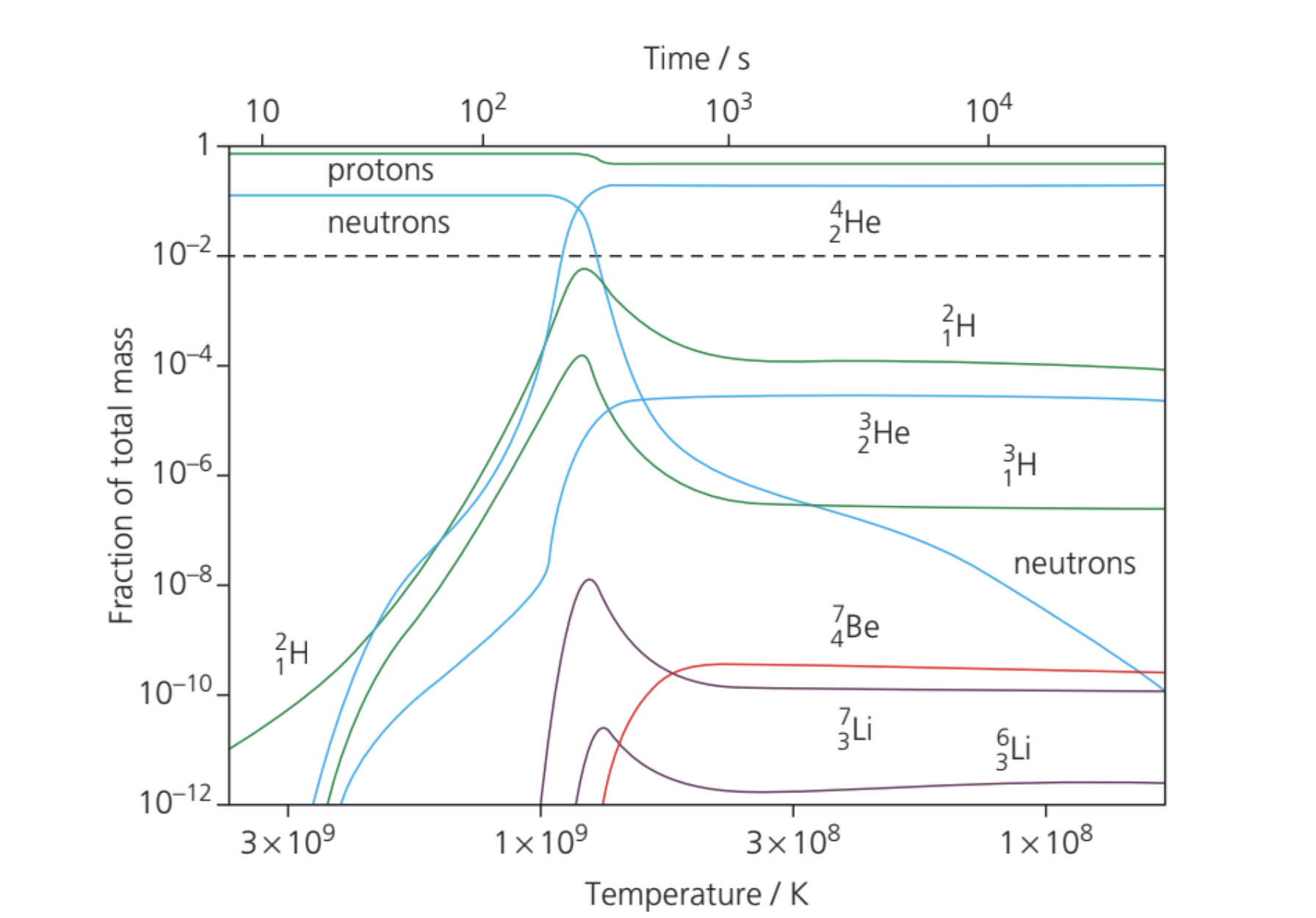
Primordial nucleosynthesis is the process by which the lightest elements, particularly hydrogen and helium, formed in the very early Universe. According to the Hot Big Bang model, this process began approximately 100 seconds after the Big Bang.
At this time, the Universe had immense temperatures and pressures that enabled nuclear fusion reactions to occur. Under these conditions, hydrogen nuclei fused together to form helium nuclei, resulting in a ratio of hydrogen to helium of 3:1. Approximately one quarter of the atomic hydrogen was converted into helium-4 through this process.
Note
Why Nuclear Fusion Could Occur
In the first few minutes after the Big Bang, the entire Universe was essentially one giant fusion reactor. The extreme conditions - temperatures in billions of degrees and enormous pressures - were similar to those found in the cores of stars today, but existed everywhere throughout space. These conditions allowed nuclear fusion to proceed rapidly, converting hydrogen into helium.
Duration and limitations
Primordial nucleosynthesis was a brief process, lasting only about three minutes. This short duration occurred because the Universe was expanding rapidly, causing temperatures to drop below the threshold required to sustain nuclear fusion reactions. Once temperatures fell below this point, nucleosynthesis stopped.
Important
Why Only Light Elements Formed
Due to the conditions and brief timespan of primordial nucleosynthesis, only the lightest elements could form. No elements heavier than lithium were synthesised during this period.
The rapid expansion of the Universe meant that temperatures and densities dropped too quickly for heavier elements to form through fusion. All heavier elements, including those that make up planets and living organisms, were created much later through fusion processes inside stars over long timescales. These heavier elements were subsequently dispersed throughout space when massive stars exploded as supernovae.
Consistency with theory
The fact that observed abundances of hydrogen and helium match the predictions from the Hot Big Bang model provides strong evidence supporting the Big Bang theory. The 3:1 ratio of hydrogen to helium, corresponding to approximately 75% hydrogen and 25% helium by mass, is exactly what the model predicts should have resulted from primordial nucleosynthesis in the early Universe.
This agreement between theory and observation across such a wide range of astronomical observations - from nearby stars to distant galaxies - demonstrates the robustness of the Hot Big Bang model.
Summary
Key Points to Remember
-
The cosmological microwave background is thermal radiation from approximately 300,000 years after the Big Bang, red-shifted from gamma rays to microwave wavelengths with a temperature of K.
-
The CMB is isotropic (uniform from all directions) with tiny temperature variations of order K that seeded galaxy formation.
-
WMAP measurements determined the age of the Universe as billion years and provided evidence for eternal expansion.
-
The observed abundance of 73% hydrogen, 25% helium, and 2% other elements matches predictions from the Hot Big Bang model.
-
Primordial nucleosynthesis occurred approximately 100 seconds after the Big Bang, lasted about three minutes, and produced a 3:1 hydrogen to helium ratio, forming only elements up to lithium.