Doppler effect (AQA A-Level Physics): Revision Notes
📚Revision Notes
9.3.1 Doppler effect
Note
The Doppler effect refers to the compression or stretching of waves caused by the motion of a wave source relative to an observer. This phenomenon affects any type of wave, including sound and light.
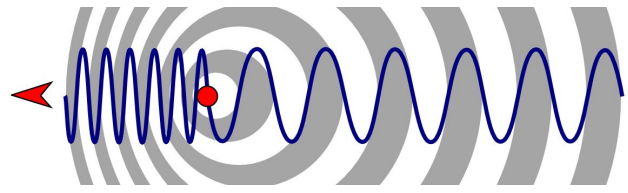
- When the source moves towards the observer, the waves are compressed. This results in a higher frequency and shorter wavelength (known as blue-shift for light waves).
- When the source moves away from the observer, the waves are stretched out, leading to a lower frequency and longer wavelength (referred to as red-shift for light waves). This principle is essential in astronomy because it allows scientists to determine the movement of distant celestial objects. If an object shows a red-shift, it is moving away from Earth, supporting the theory of an expanding universe.
Red-Shift Equation
The red-shift (z) of an object can be calculated using the following equations:
Where:
- = object's receding velocity ()
- = speed of light in a vacuum ()
- = change in frequency
- = original frequency
- = change in wavelength
- = original wavelength
Note
Note: This formula assumes that the speed is much smaller than to ignore relativistic effects.
The red-shift value is positive for objects moving away from Earth (red-shift) and negative for objects moving towards Earth (blue-shift).
Applications of the Doppler Effect in Astronomy
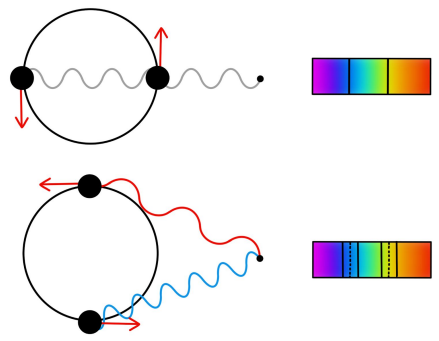
- Binary Star Systems: The Doppler effect helps identify binary stars (two stars orbiting a common centre of mass) that are too close to be visually separated by telescopes. The Doppler shifts in their line spectra reveal their movement:
- As one star moves towards Earth, its light is blue-shifted.
- As it moves away, it is red-shifted.
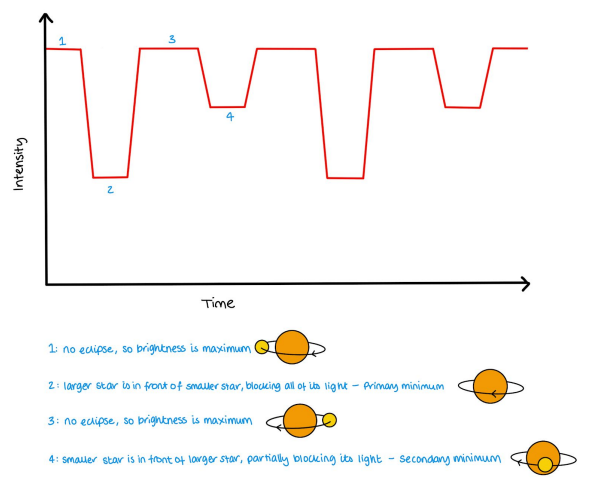
- Eclipsing Binaries: These are binary stars in which one passes in front of the other from Earth's perspective, causing periodic dips in brightness. This can be observed through a light curve, showing changes in intensity over time.
- Quasars: Quasars have large red shifts, indicating they are extremely distant and moving away at high speeds. Their immense brightness, combined with their distance, suggests they are extremely energetic objects, potentially as bright as an entire galaxy.
Light Curve of Eclipsing Binaries
The light curve of an eclipsing binary shows brightness variations as the two stars orbit each other. Key points include:
- Primary minimum: When the larger star eclipses the smaller star, causing the lowest brightness.
- Secondary minimum: A smaller dip when the smaller star partially obscures the larger star. Understanding this pattern can help determine orbital properties and relative sizes of the stars in an eclipsing binary system.