Quasars (AQA A-Level Physics): Revision Notes
📚Revision Notes
9.3.3 Quasars
Quasars
A quasar (quasi-stellar object) is an active galactic nucleus that contains a supermassive black hole at its centre, surrounded by a rotating disc of gas and dust (accretion disc). As material from this disc spirals into the black hole, it heats up due to intense gravitational forces and emits powerful jets of radiation from its poles. This makes quasars some of the brightest objects in the universe.
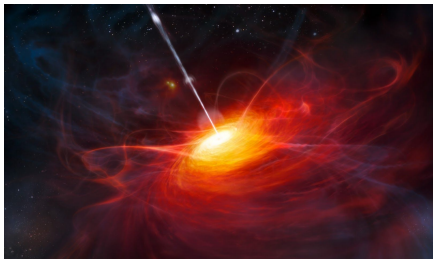
Characteristics of Quasars:
- Large Optical Red-Shift: Quasars exhibit significant red-shift, indicating they are moving away from us quickly. This large red-shift also suggests that they are some of the most distant objects we can observe.
- Intense Light Output: Quasars have extremely high luminosity, sometimes equating to the energy output of several galaxies combined.
- Compact Size: Despite their brightness, quasars are only a few light-years across, similar in size to stars.
Observing Quasars
Quasars are identified through their unique properties, primarily their intense luminosity and high red-shifts. They are often observed in distant parts of the universe and are thought to provide insight into the early stages of galactic evolution.
Estimating the Power of Quasars
The inverse square law for intensity is used to estimate the power output of quasars. This law states that the intensity of light decreases in proportion to the square of the distance from the source. By measuring the quasar's red-shift and using the Doppler effect, astronomers can determine its distance and then apply the inverse square law to estimate its luminosity.
Note
Example: Quasar
The first quasar discovered was C , initially mistaken for a dim star. Observations showed that it emitted far more radio waves than expected. Later, it was found to be 26 billion light years away and to have a luminosity 1,000 times greater than the entire Milky Way galaxy.