Evolution of massive stars (AQA A-Level Physics): Revision Notes
📚Revision Notes
Evolution of massive stars
Introduction to massive star evolution
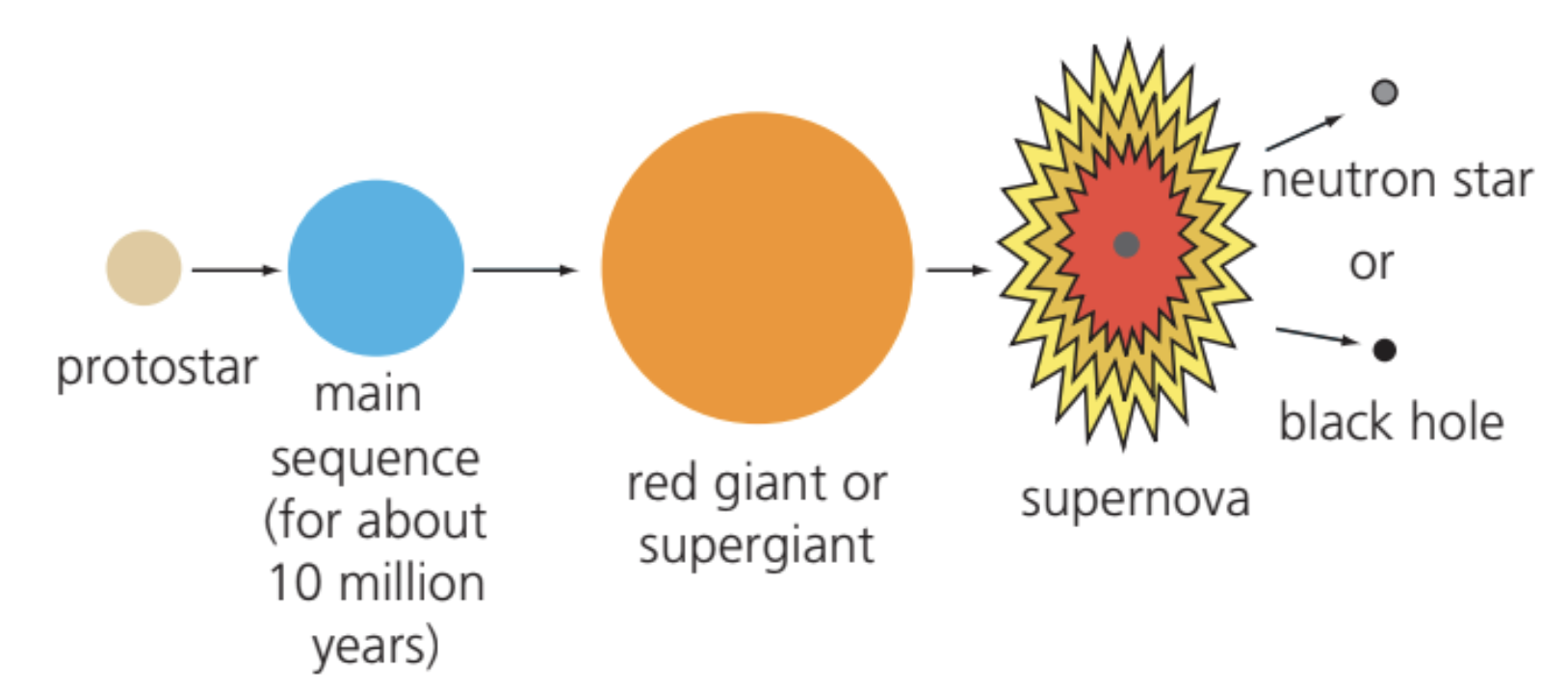
Stars with masses greater than approximately 1.4 solar masses () follow a different evolutionary path compared to lower-mass stars. These massive stars fuse hydrogen into helium primarily through the CNO cycle rather than the proton-proton chain. This difference arises because their cores experience much higher temperatures and pressures.
The evolutionary endpoint depends on the star's mass. Stars between 1.4 and 3 solar masses eventually explode as supernovae, leaving behind neutron stars. Stars with main-sequence masses exceeding 3 solar masses evolve into red supergiants and ultimately produce black holes when they explode.
Note
The CNO cycle (carbon-nitrogen-oxygen cycle) is the dominant fusion mechanism in massive stars because it operates more efficiently at the extreme core temperatures found in these stars. This is in contrast to lower-mass stars like our Sun, which rely primarily on the proton-proton chain.
Red supergiants
Formation process
A red supergiant forms when a high-mass star exhausts the hydrogen fuel in its core. When core hydrogen is depleted, the core contracts under gravity. This contraction increases the core temperature substantially. Meanwhile, the outer envelope of the star expands enormously in response to this core contraction. Hydrogen fusion continues in shells surrounding the core rather than in the core itself.
Properties and characteristics
As the star transitions to the red supergiant phase, several dramatic changes occur. The expansion of the outer layers causes the surface temperature to decrease, which explains why the star appears redder. However, the total luminosity increases dramatically to approximately 100,000 times that of the Sun. This happens because the vast increase in surface area more than compensates for the lower surface temperature.
Important
The interior temperature of red supergiants becomes much higher than in ordinary red giants. These extreme temperatures enable the fusion of elements heavier than helium. The star builds up successive layers of heavier elements through fusion reactions, producing elements as heavy as iron. These layers form in concentric shells around the core, with each layer fusing progressively heavier elements.
Red supergiants consume their nuclear fuel at an extremely rapid rate, burning through all available hydrogen in just a few million years. Their sizes range from 30 to over 1000 solar radii, making them among the largest stars in the universe.
Blue supergiants
Blue supergiants represent another type of massive evolved star. These stars are much hotter than red supergiants but considerably smaller, with radii only about 25 times that of the Sun. They form when stars with more than 10 solar masses exhaust the nuclear fuel in their cores and begin burning their outer layers. Like red supergiants, blue supergiants have very short lifetimes of only a few million years and high luminosities.
Supernovae
Definition and energy release
A supernova is a star that experiences a sudden, catastrophic explosion, ejecting most of its mass into space while rapidly increasing its absolute magnitude. These explosions are among the most energetic events in the universe. A supernova can become so bright that it outshines entire galaxies temporarily.
The energy released during a supernova explosion is extraordinary, on the order of joules. To put this in perspective, the Sun's total energy output each day is only J.
Classification of supernovae
Note
Supernovae are classified into two main types based on their formation mechanisms:
Type I supernova: This type occurs in a binary star system where one star accretes (draws in) matter from its companion. The matter accumulates until the accreting star becomes compressed enough to trigger runaway nuclear reactions. This explosive release of energy blasts the star's matter into space.
Type II supernova: This type involves a single massive star—either a red giant or red supergiant. When this star exhausts its nuclear fuel, it undergoes rapid gravitational collapse, ejecting its outer layers with enormous energy.
Memory tip: Type I = binary (both start with 'b'), Type II = single (both have 'i')
Type II supernova mechanism
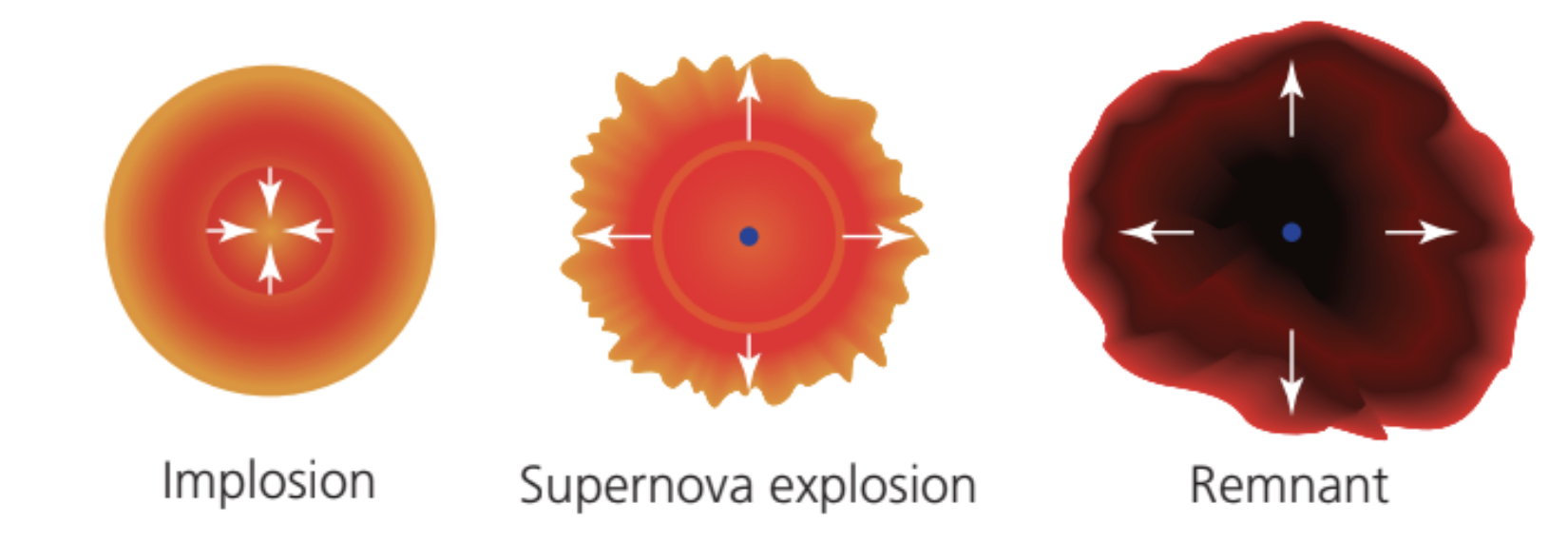
For a Type II supernova to occur, the star must be several times more massive than the Sun. The process begins after the star has evolved through its main-sequence stage and become a red giant or supergiant. When the nuclear fuel is completely exhausted, the star can no longer generate sufficient pressure to counteract gravitational compression.
The collapse happens extremely rapidly—the entire core collapse occurs within a matter of seconds. The gravitational forces are so strong that the infalling matter generates extremely powerful shock waves. These shock waves produce a gigantic explosion that rapidly increases the star's absolute magnitude. The outer layers of the star are blown into space, forming an expanding gas shell. This ejected material travels at speeds between 5000 and 10,000 km·s⁻¹.
Supernova remnants and element dispersal
What remains after the explosion is called a supernova remnant. At the centre of this remnant lies an exotic compact object—either a neutron star or a black hole, depending on the original mass of the star.
Note
Massive stars fuse elements in their interiors during their lifetimes, creating heavier elements in the periodic table, including iron and nickel. When the supernova explosion occurs, these heavy elements are ejected into the interstellar medium. This process disperses the elements throughout the universe, where they eventually become incorporated into new stars, planets, and other astronomical objects, including Earth.
Supernova events are relatively rare. In a galaxy like the Milky Way, astronomers expect to observe two or three supernova events per century. However, because the universe contains billions of galaxies, supernovae in other galaxies can be observed regularly.
Neutron stars
Formation and composition
A neutron star is the extremely dense remnant left behind after a supernova explosion. The gravitational contraction during the collapse becomes so intense that electrons are forced into protons, forming neutrons through a process that overcomes electron degeneracy pressure. As a result, a neutron star consists almost entirely of neutrons.
Physical properties
Neutron stars possess extraordinary physical properties that make them among the most extreme objects in the universe. Their structure includes a rigid core of neutrons and neutron-rich nuclei, surrounded by an iron outer crust. Despite containing masses comparable to the Sun, neutron stars compress this mass into a diameter of only about 20 kilometres. This compression results in a density of approximately kg·m⁻³.
Important
The gravitational field at the surface of a neutron star is times stronger than the gravitational field on Earth. This creates mind-boggling effects: a teaspoonful (5 ml) of neutron star material, if brought to Earth, would weigh approximately kg.
Escape velocity from neutron stars
The escape velocity from an object is the minimum velocity needed for a particle to escape from its gravitational field. The escape velocity depends on the object's mass and radius , and is given by:
where is the gravitational constant, N·m²·kg⁻².
For neutron stars, the escape velocity approaches a significant fraction of the speed of light. The escape velocity from a neutron star's surface would require approximately 0.8 times the speed of light.
Example
Worked Example: Escape Velocity Calculation
Consider a neutron star with a mass two times that of the Sun and a radius of 20 km. We can calculate its escape velocity as follows:
Given:
- Mass of neutron star = kg
- Radius = 20 km = m
- N·m²·kg⁻²
Using the escape velocity formula:
This value is approximately 0.53 times the speed of light, demonstrating the extreme gravitational field strength.
Pulsars
Definition and mechanism
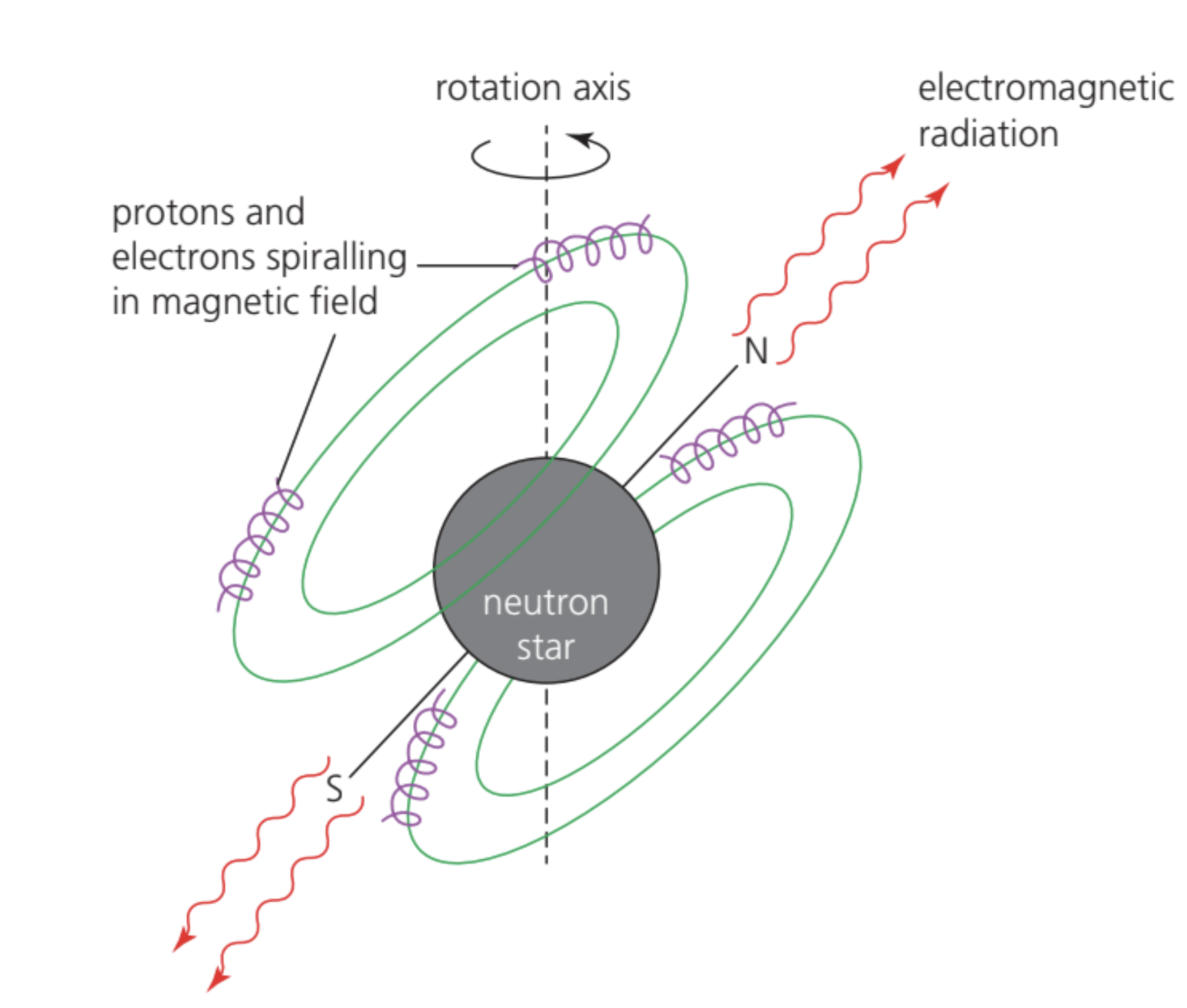
A pulsar is a rotating neutron star that possesses a very strong magnetic field. These objects were first discovered by Jocelyn Bell in 1967. The surface of a neutron star contains numerous protons and electrons in regions where the gravitational field is not strong enough to force them into neutrons.
Note
The magnetic field accelerates these charged particles toward the magnetic poles of the neutron star. As the particles accelerate, they emit electromagnetic radiation across a wide range of wavelengths. This radiation is emitted in narrow beams that point in opposite directions from the magnetic poles.
Properties and observations
The neutron star rotates rapidly, with rotation rates reaching up to 600 times per second. As it rotates, the beams of electromagnetic radiation sweep through space like a lighthouse beam. When one of these beams points toward Earth during each rotation, we detect a pulse of radiation. This gives rise to the name "pulsar"—a pulsating source of electromagnetic radiation.
Pulsars can appear either as single objects or as members of binary star systems. They are typically found within supernova remnants, providing direct evidence of their formation through supernova explosions.
Black holes
Formation conditions
For the most massive stars, whose cores after a supernova explosion exceed approximately three solar masses, gravitational compression continues beyond the neutron star stage. The immense gravitational forces overcome even the pressure that stabilizes neutron stars, leading to the formation of a black hole.
Definition and properties
A black hole is a region of space-time characterized by a gravitational field so strong that no particles or electromagnetic radiation can escape from it. The escape velocity from a black hole equals or exceeds the speed of light, . According to Einstein's theory of special relativity, nothing can travel faster than light, making escape from a black hole impossible.
Schwarzschild radius derivation
The size of a black hole is characterized by its Schwarzschild radius, which can be derived using the escape velocity formula. If we set the escape velocity equal to the speed of light:
Squaring both sides:
Rearranging to solve for :
This radius is called the Schwarzschild radius, named after German astrophysicist Karl Schwarzschild, who first calculated it using Einstein's general theory of relativity.
Note
The Schwarzschild radius tells us how small an object of a given mass must be compressed for it to trap light and therefore appear black. To calculate the Schwarzschild radius of any object—whether a planet, star, galaxy, or even an apple—only the mass needs to be known.
Memory tip: For Schwarzschild radius remember: "2 GM over c-squared"
Event horizon
The Schwarzschild radius effectively forms a boundary called the event horizon of the black hole. Within this boundary, the escape velocity equals or exceeds the speed of light.
Important
All information from inside the event horizon is lost to outside observers. Since black holes cannot be directly observed by detecting light from them, information about black holes must be inferred from their gravitational effects on nearby objects.
Example
Worked Example: Schwarzschild Radius Calculation
Consider a black hole with a mass equal to that of the Sun. We can calculate its Schwarzschild radius:
Given:
- Mass of Sun = kg
- Speed of light, m·s⁻¹
- N·m²·kg⁻²
Using the Schwarzschild radius formula:
This calculation shows that if the Sun were compressed to a radius of approximately 3 km, it would become a black hole. However, the Sun is not massive enough to form a black hole through natural stellar evolution.
Gamma ray bursts
Approximately once per day, gamma ray telescopes detect intense flashes of gamma rays coming from distant galaxies. These gamma ray bursts (GRBs) arrive from random directions in the sky and last from a few milliseconds to tens of seconds.
GRBs are thought to originate during supernova explosions, specifically when supergiant stars collapse to form neutron stars or black holes. Because these bursts are observed from distant galaxies, they must be extraordinarily energetic. Scientists believe the gamma rays are emitted as a narrow, highly focused beam of intense radiation.
Note
The total energy radiated by a typical gamma ray burst is estimated to exceed joules, making GRBs among the brightest electromagnetic events known in the universe. A single GRB may release as much energy in one short burst as the Sun will emit during its entire lifetime of approximately 10 billion years.
Important
GRBs represent a potential hazard. Some scientists have speculated that a supernova generating a GRB within our own galaxy, with radiation directed toward Earth, could cause mass extinction of life. Such events might have been responsible for mass extinction events during previous geological epochs.
Supermassive black holes
Evidence and location
Astronomical observations have revealed that stars and gas clouds orbiting near the centres of galaxies are accelerated to very high orbital velocities. This acceleration can be explained by the presence of a massive, compact object with an extremely strong gravitational field occupying a small region of space. The most plausible explanation for these observations is the presence of a supermassive black hole at the galactic centre.
For example, observations of stars near the centre of the Milky Way galaxy show them following elliptical orbits. By measuring their orbital parameters over many years, astronomers have determined that these stars orbit a supermassive black hole with a mass of approximately 4.1 million solar masses.
Formation theories
Astrophysicists now believe that a supermassive black hole exists at the centre of every galaxy, though the formation mechanism remains uncertain. Several theories have been proposed:
- One possibility is that supermassive black holes formed from the collapse of massive clouds of gas during the early stages of galaxy formation when the universe was young and densities were higher.
- Another hypothesis suggests that ordinary stellar black holes devoured enormous quantities of material over millions of years, gradually increasing their mass to supermassive proportions.
- A third proposed mechanism involves clusters of stellar black holes forming in close proximity and eventually merging with each other. Through successive mergers, these clusters could build up into a single supermassive black hole.
Summary
Key Points to Remember:
-
Massive star evolution: Stars with masses greater than 1.4 solar masses evolve differently from lower-mass stars, using the CNO cycle and eventually exploding as supernovae. Stars between 1.4 and 3 solar masses leave neutron stars, while those exceeding 3 solar masses produce black holes.
-
Red supergiants: These massive stars form when core hydrogen is exhausted, causing core contraction and envelope expansion. They fuse elements up to iron in layered shells and achieve luminosities ~100,000 times the Sun's while having radii ranging from 30 to over 1000 solar radii.
-
Type II supernovae: Massive single stars collapse in seconds when nuclear fuel is exhausted, ejecting outer layers at 5000-10,000 km·s⁻¹ and releasing approximately J of energy. These explosions disperse heavy elements throughout the universe.
-
Neutron stars: Ultra-dense objects composed almost entirely of neutrons, with diameters of ~20 km and densities of ~ kg·m⁻³. Escape velocity is calculated using and can approach 0.8 times the speed of light. Rotating neutron stars with strong magnetic fields become pulsars, emitting beamed electromagnetic radiation at rates up to 600 rotations per second.
-
Black holes: Objects where gravitational compression is so extreme that escape velocity exceeds the speed of light. The Schwarzschild radius defines the event horizon boundary, beyond which no information can escape. Supermassive black holes (millions of solar masses) exist at the centres of galaxies.