The birth of a star (AQA A-Level Physics): Revision Notes
📚Revision Notes
The birth of a star
Introduction to stellar evolution
Stellar evolution describes the process through which stars form, begin to shine, maintain a stable state, and eventually change into different stellar objects depending on their mass. Stars do not shine forever. High-mass stars can have relatively short lifetimes of just a few million years, while low-mass stars may exist for periods exceeding the current age of the Universe.
Note
The changes that occur in stars as they evolve happen too slowly for direct observation, so astrophysicists study many stars at different life stages and use computer models to understand stellar structure and evolution.
The interstellar medium and molecular clouds
Stars form in regions between existing stars, known as the interstellar medium. This medium contains molecular clouds, which are vast regions composed primarily of cold hydrogen gas. The hydrogen exists in various forms including atoms, molecules, and ions. These clouds have extremely low temperatures ranging from 10 to 50 K and particle densities between 10⁸ and 10¹⁵ molecules per cubic metre.
Note
Approximately 1% of the material in molecular clouds consists of dust particles made from silicates and graphite. Despite being called "clouds," these regions contain masses many times greater than that of a single star.
Within these clouds, fragments of varying masses exist and begin to clump together under gravitational attraction.
Formation of protostars
The irregular clumps within molecular clouds tend to rotate. Through the combined effects of gravitational attraction and conservation of angular momentum, these clumps spin inwards. This process creates a denser spherical centre called a protostar. Surrounding the protostar forms a rotating flat disc of material known as the circumstellar disc, where planets may eventually develop.
Important
Conservation of Angular Momentum
The spinning motion of the initial clumps is preserved as they contract, causing them to rotate faster as they become more compact. This fundamental principle explains why protostars develop rotating discs rather than collapsing directly into spheres.
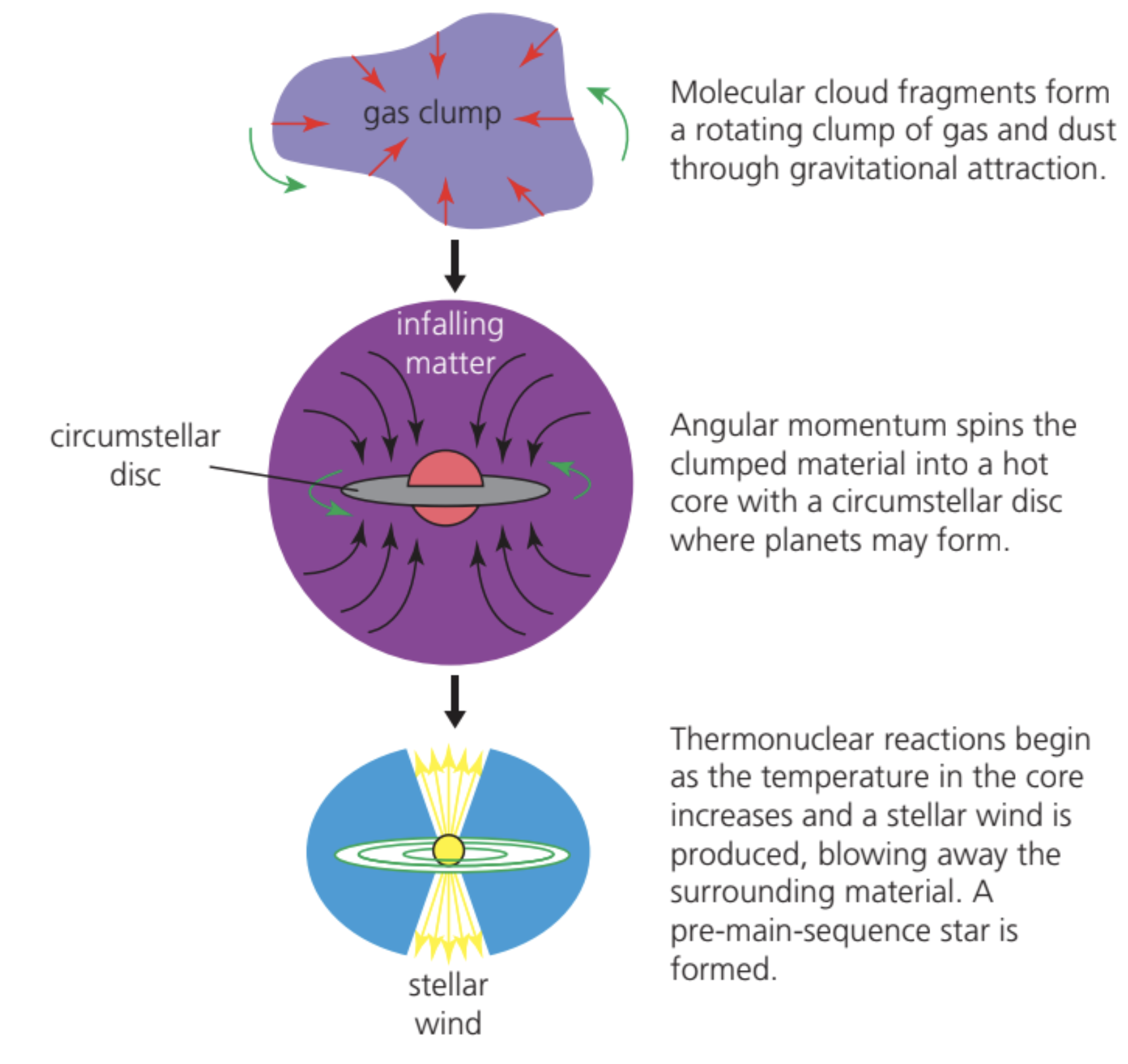
The formation process unfolds through several stages:
Initial gravitational collapse
Molecular cloud fragments form rotating clumps of gas and dust through gravitational attraction. The clumps become increasingly dense as material is drawn inward by gravity.
Protostar development
As infalling matter from the cloud fragment accumulates, the protostar increases in size. Both density and temperature rise within the developing structure. At this stage, the protostar begins to emit radiation in the infrared region of the electromagnetic spectrum.
Note
The energy source for this early radiation is not nuclear fusion, but rather the gravitational potential energy released by the infalling material.
Increasing core temperature
The process of gravitational contraction continues for perhaps several million years. During this time, the temperature in the protostar's core steadily increases. When the core temperature becomes sufficiently high, typically several million kelvin, the electrostatic repulsion between hydrogen nuclei can be overcome, allowing fusion to begin.
Pre-main-sequence stars
Eventually, the core temperature reaches the point where nuclear fusion reactions can begin. At this stage, hydrogen nuclei start to fuse together in the core. The onset of fusion produces a strong outward stellar wind, which opposes the continued infall of material from the surrounding cloud.
The star now begins to shine in the visible part of the electromagnetic spectrum, marking its transition to a pre-main-sequence star. This represents an intermediate stage in stellar development, where fusion has begun but a stable equilibrium has not yet been established.
Main-sequence stars and equilibrium
When nuclear fusion in the star's core becomes fully established, the star reaches an equilibrium state. At this point, the star has a fixed mass, and its energy comes solely from nuclear fusion rather than gravitational contraction. The star is now classified as a main-sequence star, and it will remain in this stable state for most of its lifetime. The star's initial mass determines how long this phase will last and what will happen during future evolution.
Equilibrium forces
Important
The Balance of Forces
A main-sequence star maintains stability through a delicate balance of forces:
- Inward force: The star's own gravitational force, resulting from the tremendous mass of its outer layers
- Outward force: Internal gas pressure created by the energy released from fusion reactions in the core
This equilibrium prevents the star from either collapsing under its own gravity or expanding uncontrollably.
Hydrogen burning in main-sequence stars
Hydrogen burning refers to the fusion of hydrogen nuclei with a release of nuclear binding energy. This process serves as the primary energy source in main-sequence stars. The fusion reactions convert mass into energy according to the mass-energy relation , where represents the small amount of mass lost during fusion, is the speed of light, and is the energy released.
Two principal nuclear reaction pathways exist for hydrogen burning, with the pathway determined by the core temperature of the star:
The proton-proton chain
For stars with masses not exceeding that of the Sun, core temperatures remain below approximately 16 × 10⁶ K. Under these conditions, hydrogen burning occurs through the proton-proton chain (p-p chain). This pathway involves three sequential fusion reactions that ultimately convert four hydrogen nuclei (protons) into a single helium nucleus, releasing positrons, neutrinos, and gamma ray photons in the process.
Example
Worked Example: The Proton-Proton Chain
The p-p chain proceeds through these three steps:
Step 1: Two hydrogen-1 nuclei fuse to form hydrogen-2 (deuterium), releasing a positron and an electron neutrino:
Step 2: Hydrogen-2 fuses with another hydrogen-1 nucleus to form helium-3, releasing a gamma ray photon:
Step 3: Two helium-3 nuclei combine to form helium-4, releasing two hydrogen-1 nuclei:
Net result: Four protons are converted into one helium nucleus, with the release of energy in multiple forms.
The carbon-nitrogen-oxygen cycle
In stars with masses greater than that of the Sun, core temperatures exceed 16 × 10⁶ K. Under these higher temperature conditions, hydrogen burning proceeds through the carbon-nitrogen-oxygen cycle (CNO cycle). This alternative pathway also converts four protons into a helium nucleus, but it uses carbon as a catalyst.
Example
Worked Example: The CNO Cycle
The CNO cycle involves six steps where carbon, nitrogen, and oxygen nuclei are sequentially created and destroyed:
Step 1: Carbon-12 captures a proton to form nitrogen-13:
Step 2: Nitrogen-13 decays to carbon-13:
Step 3: Carbon-13 captures a proton to form nitrogen-14:
Step 4: Nitrogen-14 captures a proton to form oxygen-15:
Step 5: Oxygen-15 decays to nitrogen-15:
Step 6: Nitrogen-15 captures a proton to form carbon-12 and helium-4:
Key insight: Carbon-12 is consumed in the first reaction but regenerated in the final step, meaning carbon is not actually used up overall. Like the p-p chain, the CNO cycle produces a helium nucleus along with positrons, neutrinos, and high-energy gamma rays.
Energy transport in stars
Nuclear fusion reactions in the core continuously provide the star's energy throughout most of its main-sequence lifetime. However, this energy must be transported from the core to the outer layers before it can escape into space. Two mechanisms accomplish this energy transport: convection and radiative diffusion.
Convection
Convection occurs when hot gases from deeper within the star rise towards the surface, while cooler gases sink back down. This creates circulation currents that transfer thermal energy from the star's interior to its outer layers. The process is similar to the way water circulates in a heated pot, with warmer, less dense material rising and cooler, denser material descending.
Radiative diffusion
During fusion reactions, high-energy photons are created in the core. These photons carry energy and gradually diffuse outwards from the hot core towards the cooler outer layers. The photons follow an entirely random path because they are repeatedly absorbed and re-emitted when they interact with atoms and free electrons throughout the star's interior.
Although individual photon motion appears random, the net effect is a gradual migration towards the cooler outer regions. This process of radiative diffusion can take an extraordinarily long time.
Note
The Journey of Starlight
Photons created in the core may require tens of thousands of years to finally escape from the star's surface into space. This means that the light we observe from the Sun today originated from fusion reactions that occurred thousands of years ago.
Summary
Summary
Key Points to Remember:
- Stars form from gravitational collapse of molecular clouds containing cold hydrogen gas and dust in the interstellar medium
- Protostars develop as rotating clumps contract, initially shining in infrared from gravitational energy before nuclear fusion begins
- Pre-main-sequence stars form when core temperatures become high enough for fusion to start, producing a stellar wind that clears surrounding material
- Main-sequence stars exist in equilibrium, with gravitational collapse balanced by outward gas pressure from fusion reactions
- Hydrogen burning through either the proton-proton chain (lower mass stars) or CNO cycle (higher mass stars) provides energy by fusing four protons into helium
- Energy transport from core to surface occurs through convection currents and radiative diffusion of photons over thousands of years