Type IA supernovae as standard candles (AQA A-Level Physics): Revision Notes
📚Revision Notes
Type IA supernovae as standard candles
What are Type Ia supernovae?
Type Ia supernovae are a specific category of stellar explosion that occur in binary star systems. They form through a distinct process involving a white dwarf star orbiting close to a companion star.
Formation mechanism
The formation of a Type Ia supernova follows this sequence:
- A white dwarf exists in a close binary system with a companion star
- As the companion star ages and expands into a red giant, it moves closer to the white dwarf
- The white dwarf's gravitational pull attracts matter from the outer layers of the companion star
- This material accumulates on the white dwarf's surface, compressing the star
- When the white dwarf reaches a critical mass, a runaway nuclear reaction begins
- This reaction causes a catastrophic explosion—the Type Ia supernova
Note
The crucial point is that this explosion always occurs at the same critical mass threshold, making Type Ia supernovae remarkably consistent events. This consistency is what makes them so valuable for astronomical measurements.
Light curves of supernovae
Understanding light curves
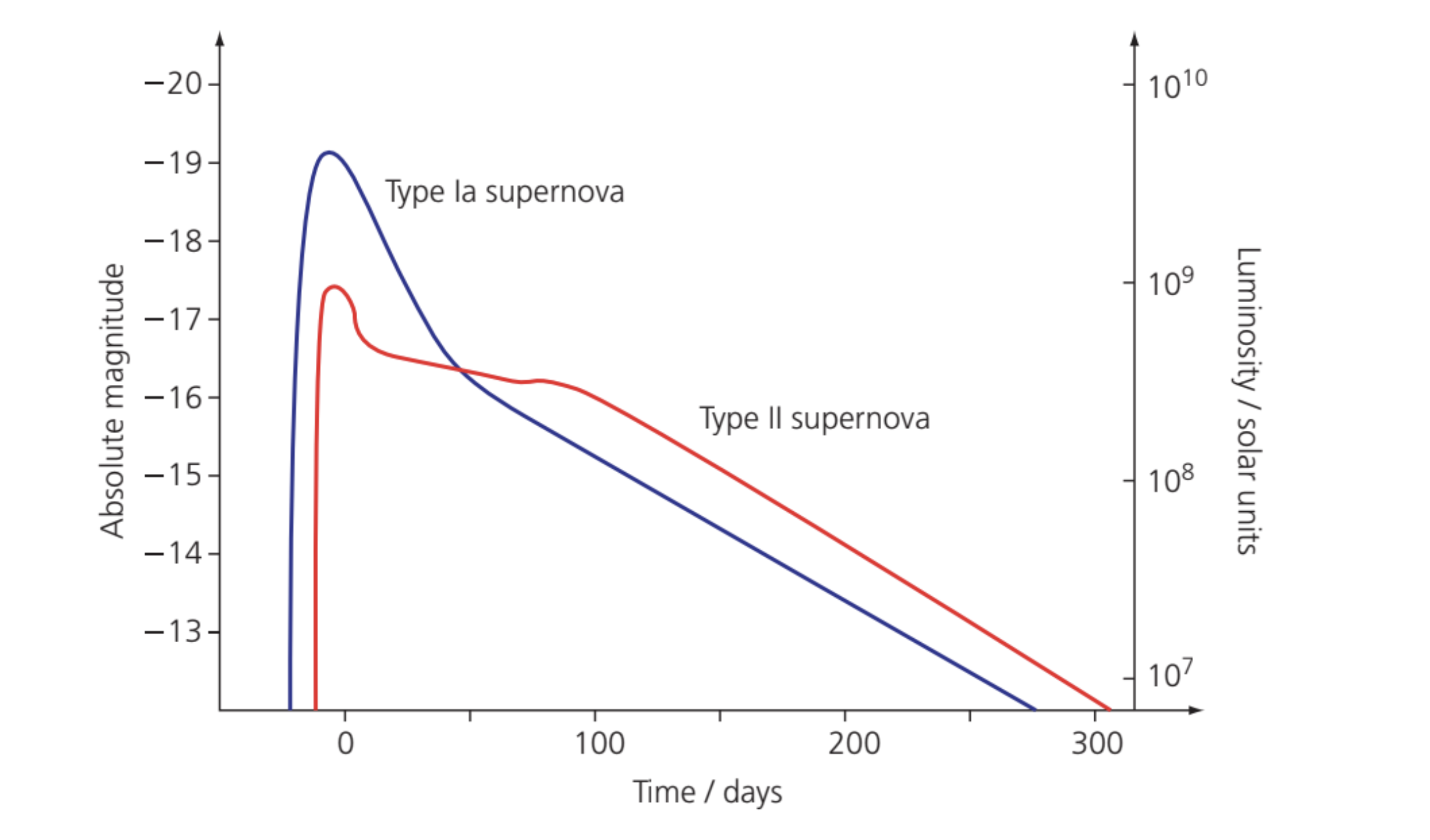
A light curve is a graph showing how the absolute magnitude of an object changes over time. For supernovae, light curves reveal their characteristic brightness patterns.
Characteristics of Type Ia light curves
Type Ia supernovae display a distinctive brightness pattern:
- Rapid increase: The absolute magnitude increases dramatically in less than one day
- Sharp peak: They reach a distinct maximum absolute magnitude
- Gradual decline: After peaking, they dim smoothly and gradually over several months
Note
Distinguishing Type Ia from Type II:
The key feature that distinguishes Type Ia supernovae from Type II is the shape of their light curve. Type Ia supernovae show a sharper peak followed by a smooth, consistent decline, whereas Type II supernovae have a less pronounced peak and a different fading pattern.
Peak absolute magnitude
All Type Ia supernovae reach the same peak absolute magnitude of −19.3, approximately 20 days after the collapse begins. This consistency is the property that makes them so valuable for astronomical distance measurements.
The uniformity occurs because every Type Ia explosion happens when the white dwarf reaches the same critical mass, leading to nearly identical energy outputs.
Type Ia supernovae as standard candles
What is a standard candle?
A standard candle is an astronomical object with a known luminosity and absolute magnitude. Astronomers use standard candles to measure large distances by comparing the object's known absolute magnitude with its observed apparent magnitude.
Why Type Ia supernovae work as standard candles
Type Ia supernovae are excellent standard candles because:
- Consistent brightness: Every Type Ia supernova reaches the same peak absolute magnitude (−19.3)
- Extreme luminosity: They are incredibly bright, making them visible across vast distances
- Distinctive light curves: Their characteristic pattern allows them to be identified reliably
Important
The consistency of Type Ia supernovae is fundamental to their use as distance indicators. Unlike many astronomical objects that vary in brightness, every Type Ia supernova reaches exactly the same peak absolute magnitude, eliminating a major source of measurement uncertainty.
Advantages over other standard candles
Type Ia supernovae extend our distance-measuring capability far beyond other methods. While Cepheid variables are useful for measuring distances to nearby galaxies, individual stars cannot be resolved in very distant galaxies. Type Ia supernovae, however, emit such enormous amounts of energy that they can be detected in galaxies up to 1000 Mpc (3.26 billion light years) away.
Measuring cosmological distances
The distance formula
The distance in parsecs to an object can be calculated using the relationship between apparent magnitude and absolute magnitude :
Where:
- = apparent magnitude (how bright the object appears from Earth)
- = absolute magnitude (intrinsic brightness at 10 parsecs)
- = distance in parsecs
Since we know that Type Ia supernovae have at peak brightness, measuring the apparent magnitude allows us to calculate the distance.
What are cosmological distances?
Cosmological distances refer to distances so vast that individual stars in galaxies cannot be observed. Type Ia supernovae can be seen at distances representing a substantial fraction of the observable universe's radius, making them invaluable for studying cosmic-scale structure and expansion.
Example
Worked Example: Calculating Distance from Apparent Magnitude
Problem: A Type Ia supernova is observed in another galaxy with a peak apparent magnitude of +10. Estimate the distance of the galaxy from Earth in parsecs.
Solution:
Step 1: Write down the known values
- Apparent magnitude:
- Absolute magnitude: (for all Type Ia supernovae)
Step 2: Apply the distance formula
Step 3: Substitute the values
Step 4: Simplify
Step 5: Divide both sides by 5
Step 6: Rearrange using logarithm properties
Step 7: Take the antilog
Step 8: Calculate the final answer
Answer: The galaxy is approximately 7.2 megaparsecs from Earth.
Connection to dark energy
The use of Type Ia supernovae as standard candles led to one of the most significant discoveries in modern cosmology. When astronomers measured distances to numerous Type Ia supernovae and compared them with redshift data, they found unexpected results.
The measurements revealed that the universe's expansion is accelerating rather than slowing down, contradicting previous expectations. This observation implies the existence of an unknown form of energy permeating space that counteracts gravitational attraction.
Important
A Revolutionary Discovery
This mysterious energy has been named dark energy, and its nature remains one of the greatest unsolved problems in astrophysics. Dark energy appears to act in opposition to gravity, driving galaxies apart at an increasing rate. The discovery that the universe's expansion is accelerating was so significant that it led to the 2011 Nobel Prize in Physics.
Summary
Key Points to Remember:
- Type Ia supernovae occur when white dwarfs in binary systems accumulate matter to a critical mass, triggering a consistent explosion
- All Type Ia supernovae reach the same peak absolute magnitude of −19.3, making them reliable standard candles
- The distance formula allows us to calculate distances up to 1000 Mpc by measuring apparent magnitude
- Type Ia supernovae can be observed at cosmological distances where other standard candles like Cepheid variables cannot be detected
- Distance measurements using Type Ia supernovae provided evidence that the universe's expansion is accelerating, leading to the dark energy hypothesis