Factors Influencing Growth and Development (Edexcel A-Level Economics A): Revision Notes
📚Revision Notes
Factors Influencing Growth and Development
Introduction
While economic development encompasses more than just economic growth, growth plays an essential role in both economic and human development processes. Growth provides the increase in resources needed to meet basic citizen needs and expand future choices. It establishes the foundations for sustained development.
The following sections examine the specific challenges developing countries face in achieving economic growth, building on previous discussions about economic growth more generally.
Primary product dependency
Agricultural sector reliance
Numerous developing nations, particularly those in sub-Saharan Africa, depend significantly on the agricultural sector for employment and income generation. However, labour productivity in agriculture tends to remain relatively low, which constrains rural income levels.
Note
One of the key driving forces behind the Industrial Revolution in Britain was rising agricultural productivity, which enabled workers to transition into manufacturing activities. For developing countries today, this same transition faces several significant obstacles.
For a developing country today, this transition faces several obstacles. It is therefore important to examine potential barriers to increasing agricultural productivity.
Land tenure and property rights
In some developing countries, the challenge stems from land tenancy arrangements that lead to inefficiency. In other cases, problems arise from insecure property rights and the inheritance laws that apply.
Important
When farmers do not own the land they cultivate, with landlords receiving a share of the crop as payment, this arrangement can result in inefficiency. The lack of secure ownership reduces incentives for farmers to invest in land improvements or adopt new farming techniques.
Export challenges
The difficulty of improving agricultural productivity makes it challenging for developing countries to engage actively in international trade. In practice, some countries have limited choice but to rely on primary production for their export activity. For many developing nations, the proportion of primary goods in exports remains extremely high.
Example
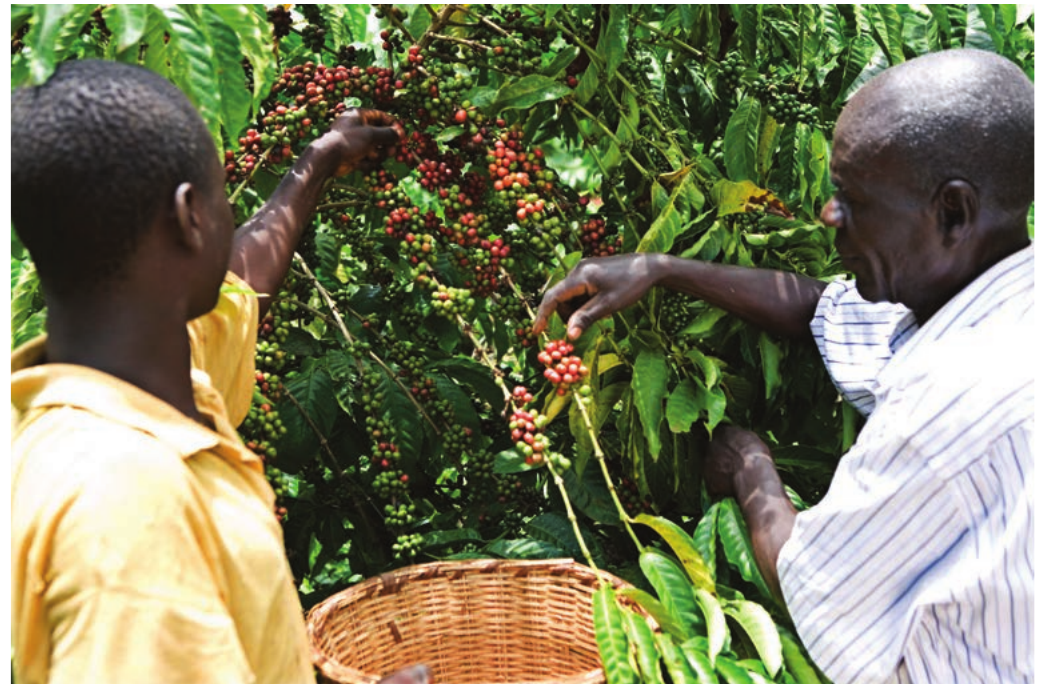
Case Study: Uganda Coffee Farmers
Many small farmers in remote Ugandan villages grow coffee for export. However, they rely on traders travelling around rural areas to buy the coffee and sell it to exporters. This creates several difficulties:
- Farmers struggle to check current market prices in cities
- They lack the storage or market facilities to produce on a larger scale
- Without communication links to determine good crop prices, traders gain an information advantage that can be exploited
The spread of mobile phones is helping to address this issue by enabling farmers to stay informed about market conditions. This improves the information available to them when negotiating fair prices for their produce and when making decisions about which crops to cultivate.
Volatility of commodity prices
Relying on primary exports creates vulnerability for developing countries. In the short run, many primary product prices tend to be volatile, creating uncertainty. This volatility may arise from supply-side variations due to weather conditions, or from demand-side factors if demand fluctuates with the business cycle.
Important
The Prebisch-Singer Hypothesis
The Prebisch-Singer hypothesis is an observation that the terms of trade for primary products relative to manufactures will tend to deteriorate in the long run. Several reasons explain why this might occur:
- The income elasticity of demand for primary products is relatively low, meaning demand does not rise proportionally with real incomes
- Demand for manufactured goods shows stronger income elasticity
- Primary goods production (especially in agriculture) faces diminishing returns as poorer land is brought into use
- Manufacturing activity can exploit economies of scale
This combination of factors affects the relative prices of primary and manufactured goods, particularly if prices tend to follow production costs. This hypothesis may have encouraged some developing countries to adopt import substitution strategies as a path to growth and development, though not always successfully.
However, it could be argued that quality changes occur in manufactured goods over time that affect observed prices. Furthermore, manufacturing activity is more likely to be undertaken in a less competitive environment, resulting in mark-ups on costs that produce higher prices. Nonetheless, some empirical research has provided support for the Prebisch-Singer observation.
Savings and investment
The capital shortage problem
For a developing country, one crucial problem is the inability to produce capital goods. In many developing nations, the capacity to produce capital goods is limited because they lack the necessary technical knowledge and resources. Furthermore, countries with high poverty levels, where many households face low income-earning opportunities, need to devote much of their resources to consumption. The question for developing countries is therefore how to overcome this problem and kick-start a process of economic growth.
Low-level equilibrium trap
Important
The Low-Level Equilibrium Trap
A shortage of capital means low per capita income, which means low savings, which in turn means low investment, limited capital, and hence low per capita incomes. In this way a country can become trapped in a low-level equilibrium situation.
This creates a vicious cycle:
- Low capital → Low per capita income
- Low per capita income → Low savings
- Low savings → Low investment
- Low investment → Limited capital accumulation
- The cycle repeats
One view of economic growth sees it in terms of a shift in the aggregate supply curve. For both developed and developing countries, the potential productive capacity of the economy depends fundamentally on two things: the quantity of factors of production available within the economy, and the efficiency with which they are utilised. By increasing the quantity and/or quality of the factors of production and their productivity, the aggregate supply curve can be shifted to the right.
Note
For developing countries, the problem is magnified because of lack of resources:
- Human capital is low, with limited resources to devote to education, training and improving health
- Capital tends to be scarce, and flows of foreign direct investment (especially to the poorest developing countries) are relatively low
- Markets do not operate effectively to allocate resources efficiently
There are thus many obstacles to be overcome in seeking to promote growth and development.
So, how can savings be mobilised to enable investment?
The Harrod-Domar model
The idea that the initial focus for developing countries should be on savings and investment is supported by the Harrod-Domar model of economic growth. This model first appeared in separate articles by Roy Harrod in the UK and Evsey Domar in the USA in 1939. It became significant in influencing developing countries' attitudes towards the process of economic growth. It was developed in an attempt to determine how equilibrium could be maintained in a growing economy.
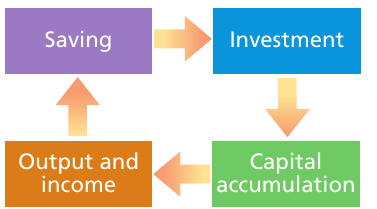
The basic finding of this model was that an economy can remain in equilibrium through time only if it grows at a particular rate, given by the ratio of the savings rate to the capital-output ratio (). This unique stable growth path is seen to depend on the savings ratio and the productivity of capital. Any deviation from this path will cause the economy to become unstable. This finding emphasised the importance of savings in the process of economic growth, and led to the conclusion that a country wishing to achieve economic growth must first increase its flow of savings.
Note
The Harrod-Domar model illustrates the process that leads to growth:
- Savings are crucial in enabling investment to be undertaken
- Investment enables capital to accumulate and technology to be improved
- Capital accumulation leads to an increase in output and incomes
- Increased output and incomes lead to a further flow of savings
- The cycle returns to where it started
Always remember that some investment will have to be used to replace existing capital that has worn out.
Understanding the Harrod-Domar model
Example
Worked Example: The Harrod-Domar Algebra
The algebra of the Harrod-Domar model can be revealing. Suppose there is a closed economy with no government.
Step 1: Equilibrium condition If there is equilibrium in the goods market, then planned saving () equals planned investment ():
Step 2: Capital accumulation Assume that there is no depreciation, so investment results in capital accumulation (, where means 'change in'):
Step 3: Capital-output ratio Assume also that the capital-output ratio () remains constant over time. Then: where is income and/or output.
Step 4: Savings proportion If savings are a proportion () of income, then for equilibrium to be maintained:
Step 5: Growth rate formula Rearranging, this implies that the growth rate of output () must be equal to:
Practical Application: This provides a simple rule. If a government wishes to achieve a growth rate of, say, 5%, and knows that the capital-output ratio is 3, then the saving ratio needs to be .
Important
This is a simple rule, but deceptive. There are many reasons why it is not enough to generate a flow of saving and then sit back and wait for results, especially in the context of developing countries.
The savings gap
The key question is whether this process can allow a developing country to break out of the low-level equilibrium trap. The Harrod-Domar model can be used to identify a number of problems that may prevent the process from being effective for developing countries.
Generating sufficient savings
It has already been argued that generating a flow of savings in a developing country may be problematic. When incomes are low, households may have to devote most of their resources to consumption, so there may be a savings gap - a situation in which a country cannot generate a sufficient flow of savings for investment.
Example
Success Story: South Korea
In the early 1960s, South Korea had an average income level that was not too different from that of countries like Sudan or Afghanistan. However, it managed to build up the savings rate during that decade.
Now, it is a high-income country and a member of the OECD. This demonstrates that with the right policies and circumstances, it is possible to overcome the savings gap challenge.
Can savings be mobilised?
Even if there are savings, there is no guarantee that these can be mobilised for productive investment. The savings gap is not only about the ability to save, but also the ability to do so in such a way that funds can be channelled to where they are needed.
Note
Preconditions for Mobilising Savings
Some important preconditions must be met if savings are to be transformed into investment:
- There must be a way for potential borrowers to get access to the funds
- Financial markets must exist to channel savings to investors
- In developed countries, households save through bank accounts, and banks make loans to entrepreneurs for productive investment
In low-income countries in 2017, only about 35% of people aged 15 and above had an account with a financial institution or mobile-money-service provider. In sub-Saharan Africa, the figure was 42.6%, and in some countries, it was lower. For example, only 15.5% of people in Niger had an account and only 7.1% in Burundi. Any savings are therefore in the form of fixed assets or as cash stored in a pot, and cannot readily be transformed into productive investment.
Important
The Interest Rate Paradox
Governments in some periods have made matters worse by holding down interest rates in the hope of encouraging firms to borrow. The logic seems straightforward: a low interest rate means a low cost of borrowing, which should make borrowing more attractive.
However, this ignores a critical factor: if interest rates are very low, there is little incentive to save. In this case, firms may wish to invest but may not be able to obtain the funds to do so.
Although raising interest rates might normally be expected to have a negative impact on aggregate demand, McKinnon and Shaw pointed out that higher interest rates could encourage a flow of savings and enable higher investment.
The other prerequisite for savings to be converted into investment is that there must be entrepreneurs with the ability to identify investment possibilities, the skill to carry them through and the willingness to bear the risk. Such entrepreneurs are in limited supply in many developing countries.
Foreign currency gap
For investment to be productive in terms of raising output and incomes in the economy, some further conditions need to be met. In particular, it is crucial for firms to have access to physical capital, which will raise production capacity. Given the limited capability of producing capital goods in many developing countries, they may have to rely on capital imported from developed countries. This may be beneficial in terms of upgrading home technology, but such equipment can only be imported if the country has access to the foreign currency to pay for it.
One of the most pressing problems for many developing countries is that they face a foreign currency gap - a situation in which a developing country is unable to import the goods that it needs for development because of a shortage of foreign exchange. In other words, they find it difficult to earn sufficient foreign currency with which to purchase the crucial imports required to allow manufacturing activity to expand. In order to do this, physical capital is needed, together with key inputs to the production process. Indeed, many developing countries need to import food and medical supplies in order to develop their human capital. A shortage of foreign currency may therefore make it difficult for the country to accumulate capital.
Capital flight
Another problem in mobilising savings generated domestically is that potential investors may perceive that they can get a higher return by investing in overseas-based companies abroad rather than domestically. This process is known as capital flight - a situation in which savings generated in a developing country are invested abroad.
This process may be reinforced if the country has encouraged foreign direct investment by transnational companies. These companies may attract funds from domestic investors. Furthermore, the capital flight may often be augmented when transnational companies repatriate their profits to overseas shareholders.
Note
The Tiger Economies Strategy
A number of economies in South East Asia (sometimes known as the tiger economies) were very open to international trade, and focused on promoting exports in order to earn the foreign exchange needed to import capital goods.
This strategy worked very effectively, and the economies were able to widen their access to capital and move to higher value-added activities as they developed their capabilities.
Harrod-Domar and external resources
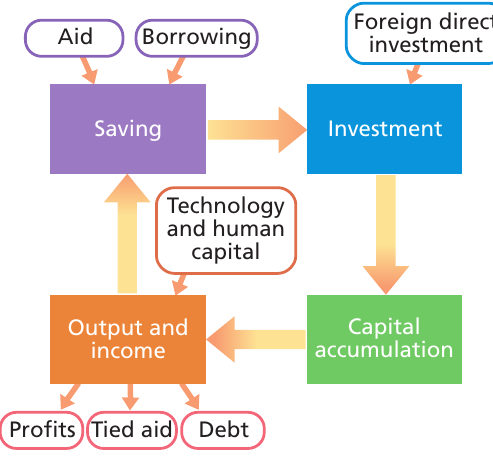
The earlier schematic presentation of the process underlying the Harrod-Domar model of economic growth has been amended to underline the importance of access to technology and human capital.
The discussion above has emphasised the difficulty of mobilising domestic savings, both in generating a sufficient flow of savings and in translating such savings into productive investment.
The question arises as to whether a developing country could supplement its domestic savings with a flow of funds from abroad. The diagram identifies three possible injections into the Harrod-Domar process:
- Overseas assistance from higher-income countries
- Foreign direct investment from transnational companies
- International borrowing on capital markets to finance domestic investment
Note
It is worth noting that the tiger economies of South East Asia took full advantage of these external sources of funds.
Important
Downsides of External Resources
Each of these ways of attracting external resources has a downside associated with it:
Overseas Assistance:
- Often seen by donor countries as part of trade policy
- May be tied aid - funds must be used to buy goods from the donor country (often at an inflated price)
- Has brought less benefit to developing countries than had been hoped
Foreign Direct Investment:
- Transnational companies tend to repatriate profits out of the country
- Profits are not recycled into the domestic economy
International Borrowing:
- Must be repaid at some future date
- Many developing countries have found themselves burdened by debt that they can ill afford to repay
Demographic factors
Early writers on development were pessimists. For example, Thomas Malthus argued that real wages would never rise above a bare subsistence level. This was based on his ideas about the relationship between population growth and real incomes.
Note
Malthusian Theory
Malthus, having come under the influence of David Ricardo, believed that there would always be diminishing returns to labour. This led him to believe that as the population of a country increased, the average wage would fall, since a larger labour force would be inherently less productive.
Furthermore, Malthus argued that:
- The birth rate would rise with the real wage, because if families had more resources they would have more children
- The death rate would fall with an increase in the real wage, as people would be better fed and therefore healthier
Population growth and real wages
One way of looking at the relationship between population growth and real wages examines the relationship between population size and the real wage rate, reflecting diminishing returns to labour in agriculture. When the wage is relatively high, the birth rate exceeds the death rate, leading to population growth. This relationship suggests that as population increases, the average wage falls due to diminishing returns. The birth and death rates adjust until equilibrium is reached where the birth rate equals the death rate, stabilising population at a subsistence wage level.
Summary
Key Points to Remember:
-
Growth is essential for development: Economic growth provides the resources needed to meet basic needs and expand future choices, forming the foundation for development.
-
Primary product dependency creates vulnerability: Relying on agriculture and primary goods exports exposes developing countries to low productivity, volatile prices, and deteriorating terms of trade (Prebisch-Singer hypothesis).
-
The low-level equilibrium trap: Low incomes lead to low savings, which lead to low investment, which leads to low capital accumulation, perpetuating low incomes in a vicious cycle.
-
The Harrod-Domar model emphasises savings: Economic growth depends on transforming savings into productive investment (), but developing countries face multiple barriers including savings gaps, inability to mobilise savings, foreign currency gaps, and capital flight.
-
External resources have trade-offs: Aid, foreign direct investment, and international borrowing can supplement domestic savings but come with downsides such as tied aid, profit repatriation, and debt burdens.