Trading Blocs, the WTO, and the EU (Edexcel A-Level Economics A): Revision Notes
📚Revision Notes
Trading Blocs, the WTO, and the EU
Introduction
Economic theory suggests that specialisation and international trade can bring significant benefits to countries. However, there has been ongoing debate about whether countries should pursue free trade or adopt protectionist measures. Since the Second World War, Europe's economic landscape has been shaped by increasing economic integration, though recent events like Brexit and the Ukrainian conflict have created new challenges. Meanwhile, regional trading arrangements have become more common worldwide, raising questions about whether they help or hinder global trade liberalisation.
Note
The tension between free trade and protectionism remains one of the most significant debates in international economics. While economic theory strongly supports the benefits of trade, political and social considerations often push countries toward protectionist policies.
The World Trade Organization
Historical origins
The Great Depression of the 1930s caused unemployment in major economies like the UK and USA to rise above 20% following a devastating stock market crash. To prevent such economic catastrophe from happening again, world leaders gathered at Bretton Woods in the USA in 1944 to establish a new framework for conducting international trade. This conference created an exchange rate system where countries agreed to fix their currency values relative to the US dollar.
Important
The Bretton Woods conference established three key international institutions that continue to shape global economic policy today:
- The International Monetary Fund (IMF) - to provide support and advice to countries facing balance of payments difficulties
- The World Bank - to offer assistance on long-term development matters
- A framework for international trade oversight - which eventually evolved into the WTO
The formation of the WTO
Initially, trade oversight was managed through the General Agreement on Tariffs and Trade (GATT), which organised a series of negotiating rounds aimed at reducing tariffs, quotas and voluntary export restraints. The final GATT round was the Uruguay Round, covering the period 1986-94. This led to the formation of the World Trade Organization (WTO) in 1995, which replaced GATT as the main international body governing trade.
The WTO continues GATT's work of pursuing reductions in trade barriers. However, it also took on an important additional role: providing a structured framework for resolving trade disputes between nations. This dispute settlement function has become increasingly valuable as regional trading blocs have proliferated. Since 1995, the WTO has handled over 600 dispute cases and issued more than 350 rulings.
Recent developments
In 2000, new negotiations began covering agriculture and services. The fourth WTO Ministerial Conference held in Doha in November 2001 incorporated these discussions into a broader work programme known as the Doha Development Agenda. According to the WTO, this agenda includes work on non-agricultural tariffs, trade and environment issues, WTO rules on anti-dumping and subsidies, investment regulations, competition policy, trade facilitation, transparency in government procurement, intellectual property rights, and various concerns raised by developing countries.
Progress on the Doha agenda has been slow and difficult. Agriculture remains particularly contentious because major economies including the USA, EU and Japan maintain large-scale support policies for their agricultural sectors. Various packages of measures have been agreed over the years - the 'Bali package' in 2013 and the 'Nairobi package' in December 2015 - but critical agricultural issues remained unresolved. The 2017 ministerial meeting discussed key issues like fisheries subsidies, but the G20 Summit in the following year called for urgent WTO reform.
Note
COVID-19 Impact on Trade Negotiations
The COVID-19 pandemic caused further delays in negotiations. However, a ministerial meeting held in Geneva in June 2022 achieved progress in several areas:
- Establishing a well-functioning dispute settlement process after a period of dysfunction
- Measures relating to COVID-19 vaccines allowing developing countries to override patents until 2027
- Food security agreements
- Measures to prohibit harmful fishing subsidies
Trading blocs and the WTO
There has been a significant increase in regional trade agreements in recent years. By March 2022, the WTO's database contained 577 notifications of regional trade agreements, of which 354 were in force. This raises important questions about whether these agreements serve as building blocks towards further global cooperation or whether they might become obstacles to that process.
Important
The Regional vs. Global Trade Dilemma
When nations establish individual agreements with other nations or groups of nations, this may work against reaching agreement on a more global scale. If groups of nations create stronger barriers against trade with non-members, such regional arrangements may prove divisive rather than advancing globally freer trade.
The WTO monitors the establishment and operation of trading blocs and plays a crucial role in arbitrating disputes between countries over the conditions under which trade takes place.
Trading blocs
Definition and purpose
A trading bloc is where a group of countries in a region agrees to cooperate in international trade through some form of free trade area or other association. Trading blocs are established to encourage trade among groups of nations, normally on a regional basis, in order to capture the benefits from trade. Examples include ASEAN (an organisation of ten countries in South East Asia), MERCOSUR (five countries in Latin America), USMCA (formerly NAFTA, covering the USA, Mexico and Canada) and the European Union. These groupings exist at very different stages of integration and cooperation.
Regional trade integration can take various forms, representing different degrees of closeness. The fundamental principle behind integration is to allow trading partners to take advantage of the potential gains from international trade, as demonstrated by the law of comparative advantage. By reducing barriers to trade, specialisation can be encouraged, leading to gains from the process. However, other economic and political forces may affect the nature of the gains and the extent to which integration will be possible and beneficial.
Types of trading blocs
Free trade areas
A free trade area is a group of countries that agree to trade without barriers between themselves, but maintain their own individual barriers with countries outside the area. The United States-Mexico-Canada Agreement (USMCA) represents such a grouping. The Association of South East Asian Nations (ASEAN) formed a free trade area (AFTA) in 1992, and by 2022 had largely removed export and import duties on items traded between member countries, while also entering into trade agreements with other countries.
Customs unions
A customs union goes further than a free trade area. Not only are barriers to trade between member countries eliminated, but members also establish a common tariff barrier against the rest of the world. It's important to note that a customs union does not need to have a common currency to function effectively.
Common markets
Countries within a customs union may wish to pursue even closer integration by extending cooperation between member nations. A common market adds to the features of a customs union by harmonising certain aspects of the economic environment between members. In a pure common market, this would involve adopting common tax rates across member states and establishing a common framework for laws and regulations governing production, employment and trade.
Note
Key Features of a Common Market
A common market extends beyond a customs union by allowing for:
- Free movement of factors of production between member nations, particularly labour and capital
- Common procurement policies across member governments
- Harmonisation of laws and regulations
- Common tax frameworks (though not always fully implemented)
The Single European Market has incorporated most of these features, though tax rates have not been fully harmonised across the member countries.
Economic and monetary union
An alternative form of integration involves countries choosing to share a common currency, though not necessarily with the full degree of cooperation involved in a free trade area or common market. Such an arrangement is known as a monetary union or currency union. A full economic and monetary union combines the common market arrangements with a common currency (or permanently fixed exchange rates between member countries). This requires member states to follow a common monetary policy, and it is generally seen as desirable to harmonise other aspects of macroeconomic policy across the union.
Evaluation of trading blocs
Trade creation and trade diversion
An important question when evaluating both free trade areas and customs unions is whether they are able to generate increased trade and improved efficiency in production. By creating a free trade area or customs union (with or without common barriers against the rest of the world), it is possible that member nations will trade with each other instead of with the rest of the world. In other words, trade may simply be diverted from the rest of the world to the partners in the agreement.
Important
Understanding Trade Diversion vs. Trade Creation
Trade diversion occurs when cheaper imported goods from a more efficient producer outside a trading bloc are replaced by goods from a less efficient trading partner within the bloc. Such trade diversion does not necessarily mean that gains from trade are being fully exploited. Indeed, trade could be diverted from an efficient producer outside the bloc to a less efficient producer within the bloc.
For the bloc to be successful, there needs to be trade creation, in which more expensive domestic production or imports are replaced by cheaper output from a partner within the trading bloc.
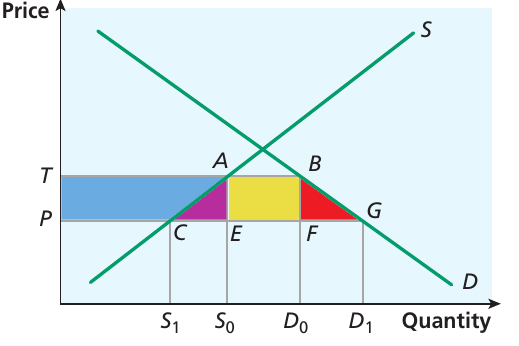
The diagrams below illustrate these concepts.
Example
Worked Example: Trade Creation
Before joining a customs union, a country faces a price T for a good, which includes a tariff element. Domestic demand is shown, with some coming from domestic producers and the remainder imported.
Step 1: Pre-union situation
- Domestic price = T (includes tariff)
- Domestic production + imports = total demand
Step 2: Post-union situation
- Tariff is removed
- Domestic price falls to P
- Consumers benefit from additional consumer surplus
Step 3: Analysing the gains
- Some areas represent redistribution from domestic firms to consumers
- Some represent redistribution from government to consumers through lost tariff revenue
- The net gain comes from resources that were previously used in production but can now be used for other purposes, plus welfare gains to the country
Example
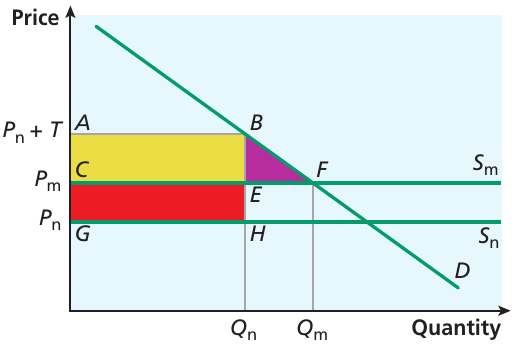
Worked Example: Trade Diversion
This example shows how trade diversion can lead to ambiguous welfare effects.
Step 1: Pre-union situation
- A commodity is initially imported from a country outside the customs union
Step 2: Post-union situation
- After joining the customs union, the good can now be imported tariff-free from a member country
- Trade has been diverted from the lower-cost producer outside the union to the less efficient member producer
Step 3: Analysing the welfare effects
- Consumer surplus has increased
- However, this increase comes partly as a pure gain but partly at the expense of the government (lost tariff revenue)
- There is now a payment by domestic consumers to producers in the other member country
- Key question: Whether the country is better or worse off depends on the relative size of the gain and loss areas
Potential benefits
Trading agreements such as free trade areas or customs unions are hoped to generate efficiency gains. If firms are able to service a larger overall market, they should be able to exploit economies of scale, which would reduce average production costs. This may require countries to alter their pattern of specialisation to take full advantage of the enlarged market. For example, within the European Union there is a wide range of countries with different patterns of comparative advantage, ranging from established industrial nations like France and Germany to more recent members from eastern Europe and the Baltic. The relative endowment of labour and capital among member states can be expected to be very different.
Note
Why Diversity Matters in Trading Blocs
The diversity of member states is important for the success of a trade grouping. It is the difference in relative opportunity costs of production that drives the comparative advantage process and creates the potential gains from trade. However, it is clear that there also tends to be a strong political dimension affecting the outcome of such trade agreements.
The European Union
The European Union represents one of the most prominent examples of regional trade integration and has progressed further than most towards economic and monetary integration. Only some EU members are part of the Eurozone, so the EU most closely resembles a common market. The combined population of the EU27 member states in 2021 was approximately 447 million, compared with about 330 million in the USA.
The Single European Market (SEM)
From the formation of the European Economic Community (EEC) in 1957, member countries began working towards creating a single market with free movement of goods, services, people and capital. The idea was to create a common market where there would be no barriers to trade. The EEC was a customs union with internal tariffs and non-tariff barriers removed and a common tariff set against the rest of the world.
A package of measures that came into effect in January 1993 represented the final stages in the evolution of the Single European Market (SEM). The key measures included the removal (or reduction) of border controls and the winding down of non-tariff barriers to trade within the EU. Through these measures, physical, technical and fiscal barriers were removed.
It has also become increasingly easy for people to move around within the EU, with passport and customs checks being abolished at most internal borders. Associated with these measures were several expected benefits for member countries.
Trade barriers
Tariff barriers between EU countries were abolished under the Treaty of Rome, but various non-tariff barriers had built up over the years as countries sought to protect domestic employment. It was expected that removing these obstacles to trade, combined with removing border controls, would reduce the costs of trade within the EU. However, it is difficult to gauge the significance of these transaction cost savings, as they are not easy to quantify precisely.
Economies of scale
As trade increases, firms operating in a larger market should be able to exploit economies of large-scale production more fully. From society's perspective, this should lead to more efficient use of resources, provided that the resulting trade creation effects are stronger than any trade diversion that may occur.
The nature of technological change in recent years has encouraged the growth of large-scale enterprises. Improved transport and communications have contributed to this process. The SEM has enabled firms in Europe to take advantage of these developments.
Intensified competition
Firms operating within the larger market face more intense competition from firms in other parts of the EU. This brings up similar arguments used to justify privatisation - that intensified competition will cause firms or their managers to seek more efficient production techniques, perhaps through eliminating X-inefficiencies. This is beneficial for society as a whole.
Note
Different Approaches to Competition
From the perspective of individual countries, there has been divergence of views concerning large firms created through mergers and acquisitions:
National Champions Approach: In some countries, large firms have been seen as 'national champions' that have been protected (or even subsidised) by domestic governments, based on the argument that they will be better prepared to compete in the broader European market.
Competition-Driven Approach: Elsewhere, governments have taken the view that the only way to ensure domestic firms are lean enough to be competitive in overseas markets is to face intense competition at home, as an inducement to efficiency.
Who gains most from the SEM?
As trade within Europe becomes freer, two groups of countries stand to gain the most. First, the pattern of comparative advantage between countries is important. Many EU countries are advanced industrial nations where labour is expensive relative to capital. These countries tend to specialise in manufacturing or capital-intensive service activities and already have fairly similar structures. Thus, the relatively labour-abundant countries of eastern and southern Europe may gain more from closer integration and trade expansion. This is because they have a pattern of comparative advantage that is significantly different from existing members. This diversity was reinforced by the characteristics of new entrants who joined between 2004 and 2013.
Second, if the main effect of integration is to remove barriers to trade, the countries with the most to gain may be those that begin with relatively high barriers.
The UK and Brexit
The UK relied heavily on trade with the EU and continues to do so, although the EU share in UK trade has declined. It is therefore difficult to consider the UK in isolation from its European trading partners.
The Brexit referendum decision
In the referendum vote of 23 June 2016, the British electorate voted to leave the EU. For the vast majority of economists, this came as a shock, as it seemed to contradict the economic arguments about the benefits from trade and closer integration of economies. While the rest of the world was globalising and moving towards closer interrelationships between countries, the UK seemingly moved in the opposite direction.
Those in favour of leaving the EU argued that membership of the SEM imposed too many restrictions on the UK and prevented the formation of trade agreements with other countries. They believed the UK could be better off by leaving the EU (even if this meant facing tariffs on exports to Europe), as this would enable free trade with other trading partners.
Important
Brexit: Beyond Economics
The Brexit vote was not based solely on economic principles. Political considerations and unease about perceived growing inequality and immigration influenced voting behaviour.
Key Statistics:
- 48.1% of those voting (34.7% of those entitled to vote) registered a 'remain' vote
- The vote was close and divided the nation
- A further concern was about sovereignty and whether the UK needed to be less tied to European regulations
This demonstrates that trade policy decisions are often driven by factors beyond pure economic analysis.
The UK's economic future
The economic future of the UK economy depends on success in reaching trade deals with countries outside the EU. There are strong arguments suggesting potential gains from specialisation and trade. The challenge for the UK post-Brexit is to find ways of preserving and creating trading relationships that allow the country to continue gaining from international trade. This proved challenging as the world was affected by the COVID-19 pandemic. Subsequently, Russia's invasion of Ukraine added further difficulties in assessing the impact of Brexit.
Economic and monetary union
The final stage of the transition towards a single currency was the European Economic and Monetary Union (EMU). Under the EMU, exchange rates between participating countries were permanently locked together, meaning no further realignments were allowed. Furthermore, the financial markets of member countries were integrated, with the European Central Bank setting a common interest rate across the union. This was achieved in 1999.
Formation of the Eurozone
The single currency area (the 'Eurozone') became fully operational on 1 January 2002 in 12 countries: Belgium, Germany, Spain, France, Ireland, Italy, Luxembourg, the Netherlands, Austria, Portugal, Finland and Greece. Slovenia joined in 2007, followed by Cyprus and Malta in 2008, Slovakia in 2009, Estonia in 2011, Latvia in 2014, Lithuania in 2015 and Croatia in 2023, making a total of 20 member countries.
Costs and benefits of a single currency
Some of the arguments for and against a single currency area such as the Eurozone are similar to those used in evaluating fixed versus flexible exchange rate systems. This is because a common currency effectively creates an area in which exchange rates between member nations are fixed forever, even if that common currency varies relative to the rest of the world. The question of whether such an arrangement is beneficial overall for member states rests on an evaluation of the benefits and costs of joining together. An optimal currency area occurs when a group of countries are better off with a single currency.
Benefits
The main benefits of a single currency area come in the form of a monetary efficiency gain, which has the effect of encouraging more trade between member countries. The hope is that this will bring further gains from exploiting comparative advantage between countries, increasing competition and allowing prices to converge, enabling firms to reap the benefits of economies of scale.
Note
Sources of Efficiency Gains
The efficiency gain comes from two main sources:
1. Reducing Transaction Costs There is no longer the need to convert from one currency into another when trading between member states.
2. Reducing Uncertainty There is no longer a need to forecast future movements in exchange rates - at least between participating countries. This is similar to the gains from a fixed exchange rate system, but it goes further, as there is no longer a risk of occasional devaluation or revaluation of currencies.
The extent to which these gains are significant will depend on the degree of integration between the participating nations. If most of the trade that takes place is between the participants, the gains will clearly be much more significant than if member nations are also trading extensively with countries outside the single currency area.
Costs
The costs come in the conduct and effectiveness of policy. Within the single currency area, individual countries can no longer have recourse to monetary policy to stabilise the macroeconomy. As with the fixed exchange rate system, one key question is how well individual economies are able to adjust to external shocks. Thus, it is important for each economy to have flexibility.
Additionally, individual countries need to be aware that once in the single currency area, it is impossible to use monetary policy to smooth out fluctuations in output and employment. It is very important that the economic cycles of participating economies are well synchronised. If one economy is out of phase with the rest, it may find itself facing an inappropriate policy situation.
Example
Example: The Problem of Unsynchronised Economies
Suppose that most countries within the Eurozone are in the boom phase of the economic cycle and want to raise interest rates to control aggregate demand. If one country within the zone is in recession, then the last thing it will want is rising interest rates, as this will deepen the recession and delay recovery.
Real-world application: These arguments came to the fore during the recession of the late 2000s, as evidenced by the experience of Greece, which suffered a much deeper and more long-lasting recession than some other countries, such as Germany.
Evaluation of a single currency area
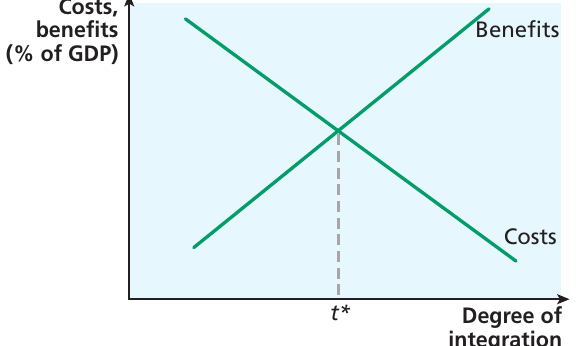
Paul Krugman suggested a helpful way of using cost-benefit analysis to evaluate aspects of a single currency area. He argued that both the costs and benefits from a single currency area will vary with the degree to which member countries are integrated. Thus the benefits from joining such a currency area would rise as the closeness of integration increased, whereas the costs would fall.
Note
The Integration Threshold
The diagram illustrates the balance between costs and benefits. For countries that are not very closely integrated (where 'integration' is less than t*), the costs from joining the union exceed the benefits, so it would not be in the country's interest to join. However, as the degree of integration increases, the benefits increase and the costs decrease, so for a country beyond t*, the benefits exceed the costs, and it is thus worth joining.
For an individual country considering whether to join the Eurozone, a first step is to reach a judgement on whether the country is to the left or right of t*. There may be other issues to consider in addition to the costs and benefits, but unless the country has at least reached t*, it could be argued that entry into the union should not be considered.
One way of viewing the situation is that the costs are mainly macroeconomic, but the benefits are microeconomic. This complicates the evaluation process. Some research argued that most of the boost to trade within the Eurozone occurred during the initial period and would not continue to build up over time. It was also suggested that EU countries that decided not to join the euro (the UK, Sweden and Denmark) gained almost as much as the countries that had joined.
The experience in Europe
Important
The experience of some European countries during and in the aftermath of the financial crisis cast doubt on whether the Eurozone could be viewed as an optimal currency area. In particular, some countries faced problems because they could not pursue independent monetary or fiscal policies to address their specific economic challenges.
Structural change
A feature that all forms of integration have in common is that they involve the removal of barriers to trade among member countries. It is important to be aware that this will not be perceived as beneficial by all parties involved. To benefit from increased specialisation and trade, countries need to allow the pattern of their production to change. The benefits to the expanding sectors are apparent, but industries that formerly enjoyed protection from competition will become exposed and will need to decline to allow resources to be transferred into the expanding sectors. This can be a painful process for firms that need to close down or move into new markets, and for workers who may need to undergo retraining before they are ready for employment in the newly expanding parts of the economy.
An especially contentious area of debate in the UK concerned the structural change that has taken place in recent decades, in which manufacturing activity has declined and financial services have expanded. This reflects the changing pattern of the UK's comparative advantage, in which banking, finance and insurance have become a major strength of the economy, whereas the manufacturing sector has found it more difficult to compete with the influx of new entrants into this market from elsewhere in the world.
Summary
Key Points to Remember:
-
The World Trade Organization (WTO) has a responsibility to promote trade by pursuing reductions in tariffs and other barriers to trade, and also plays a role in dispute settlement between nations.
-
Economic integration can take various forms: free trade areas allow member countries to trade without barriers between themselves; customs unions add a common external tariff; common markets harmonise policies and allow free movement of factors; economic and monetary unions involve a common currency and shared monetary policy.
-
Trade creation occurs when more expensive domestic production is replaced by cheaper imports from bloc partners, while trade diversion occurs when efficient external producers are replaced by less efficient bloc members. Trade creation is beneficial, but trade diversion may not be.
-
The Single European Market (SEM) brought benefits through removing trade barriers, enabling economies of scale, and intensifying competition. However, it also requires structural change as countries adjust their patterns of production and specialisation.
-
A single currency area like the Eurozone can encourage trade by reducing transaction costs and uncertainty, but member countries lose independent control over monetary policy and must be well-synchronised economically. Whether joining is beneficial depends on the degree of economic integration, as illustrated by the optimal currency area concept.