Rates of coastal recession and stability (Edexcel A-Level Geography): Revision Notes
📚Revision Notes
Rates of coastal recession and stability
Geology
| Rock type | Examples | Erosion Rate and Explanation |
|---|---|---|
| Igneous | Granite, basalt | VERY SLOW (<1mm per yr) • Rocks are crystalline, strong and resistant • Granite has few joints for erosion to exploit |
| Metamorphic | Slate, schist, marble | SLOW (1-3mm per yr) • Rocks generally resistant • Some may have crystals oriented in one direction, or may be folded and faulted so have areas of weakness |
| Sedimentary | Sandstone, limestone, shale | MODERATE TO FAST (5-10mm per yr) • Rocks are clastic (stuck together in layers) and less resistant • Rocks with many natural bedding planes (strata) are most vulnerable (shale) |
| Unconsolidated | Boulder clay, sand | VERY FAST (2-10m per yr) • Very weak materials ∴ easily eroded |
Differential erosion
- Many cliff coastlines are made of layers of different rock types and so erosion rates vary (complex cliff profiles)
- Either because of general resistance to erosion or vulnerability to chemical weathering (chalk)
Permeability
- Allow water to pass through (sandstone & limestone)
- Impermeable = no water can pass through (clays, mudstone etc) A cliff with permeable rock strata above an impermeable, weakly consolidated rock strata is vulnerable to mass movement
↳ As rainwater percolating into the upper strata creates instability
- High pore water pressure can also impact general stability - The pressure water experiences at a particular point below the water table due to the weight of water above it
Coastal vegetation
Many coastlines are protected from erosion of unconsolidated sediment by the stabilising influence of plants. These include:
- Coastal sand dunes
- Coastal salt marshes
- Coastal mangroves
How vegetation stabilises sediment
- Roots bind sediments together so increases ↑ their resistance to erosion
- When submerged, plants growing w/in sediment provide surface protection so surface sediment not directly exposed to moving water
- Protect sediment from wind erosion by reducing wind speed through friction
- As plants lose leaves and die, they add organic material to the sand, which eventually forms soil - Humus
Halophytes & Xerophytes
- Halophytes → Can tolerate salt water, either around roots, being submerged (at high tide) or salt spray from the sea
- Xerophytes → Can tolerate very dry conditions, such as on sand dunes where the sandy soil stores little water due to drainage ↳ Due to the combined salt, strong winds, dry conditions etc, only plants w/ special adaptations are able to survive
Plant succession, sand dunes & salt marshes
-
Plant succession Refers to the way vegetation on sandy coastlines change over time, from pioneer species, which initially colonise the bare sand or mud, to the climax stage
-
Plants are specially adapted to conditions (Halophytes & Xerophytes)
-
Sand dunes (psammosere) and salt marshes (halosere) both have plant successions that help stabilise the soil
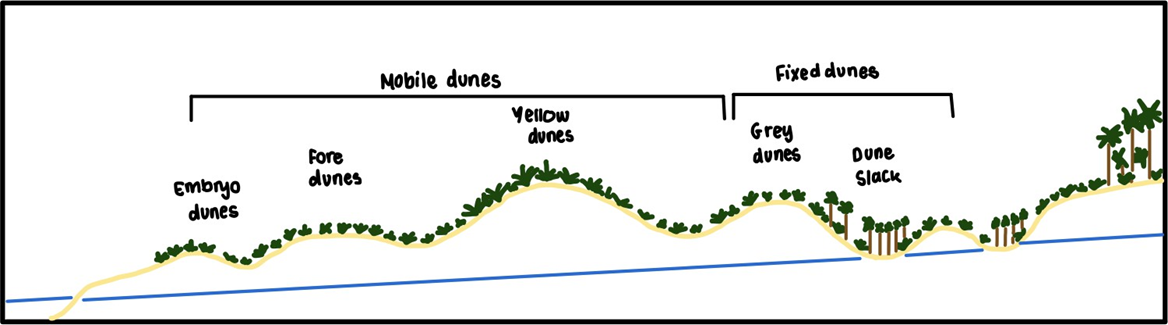
Sand dunes
↳ Succession → The changing structure of a plant community over time as an area of initially bare sediment is colonised by plants
- On a coastline, certain very specialised plants will begin to grow in the bare sand or mud (pioneer species)
- New plants can then tolerate the conditions made by the embryo dunes creating foredunes
- The process continues going from yellow dunes (marram grass), to grey dunes (gorse) along with dune slacks
- Finally a health forms
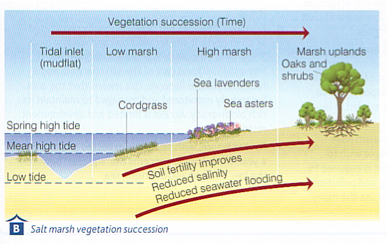
Salt marsh succession
↳ Salt marshes often develop in estuaries because…
- They are sheltered from strong waves, so sediment (mud and silt) can be deposited
- Rivers transport a supply of sediment to the river mouth, which may be added to by sediment flowing into the estuary at high tide
Stages of salt marsh succession
| Serial stage | Algal stage | Pioneer stage | Establishment stage | Stabilisation | Climax vegetation |
|---|---|---|---|---|---|
| Plants | Blue-green algae Gut weed | Glasswort Cordgrass | Salt marsh grass Sea aster | Sea thrift Scurvy grass Sea lavender | Rush Sedge Red fescue grass |
| Processes | Grow on and within bare mud, binding it together | Roots begin to stabilise the mid, allowing further mud accretion | A continued carpet of vegetation is established and the salt marsh height increases | This area of the salt marsh is rarely submerged | Developed soil profile and only submerged once or twice each year |