Sediment transport and deposition creates coastal landforms and landscapes (Edexcel A-Level Geography): Revision Notes
📚Revision Notes
Sediment transport and deposition creates coastal landforms and landscapes
Sediment transport
| PROCESS | EXPLANATION | PARTICLES TRANSPORTED |
|---|---|---|
| Traction | Sediment rolled along shoreline, pushed by waves & currents | Pebbles, cobbles & boulders |
| Saltation | Sediment bounced along the shoreline, driven by either water or wind | Sand |
| Suspension | Sediment carried in the water | Silts & clays |
| Solution | Dissolved material | Chemical compounds |
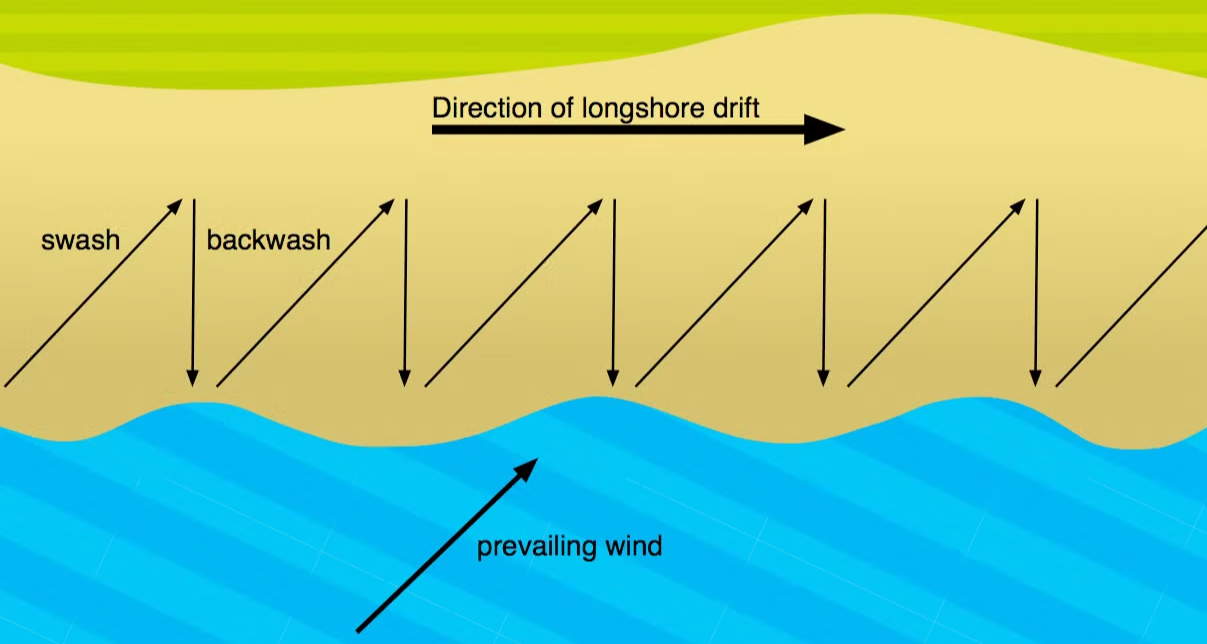
| Longshore drift | Material moved along shoreline by waves that approach beach at an angle. Swash moves sand & shingle up the beach at an angle (direction of prevailing wind) but the backwash is at right angles to the beach. ↳ The sediment is dropped when the force transporting sediment drops. Deposition can occur in the following ways: • Gravity settling • energy of transporting water becomes too low to move sediment • Flocculation • Small sediment particles clump together due to electrical/chemical attraction & become large enough to sink | All |
| Currents & tides | Strong underwater currents & tides move sediment in direction of their movement | All |
Depositional landforms
| LANDFORM | PROCESSES |
|---|---|
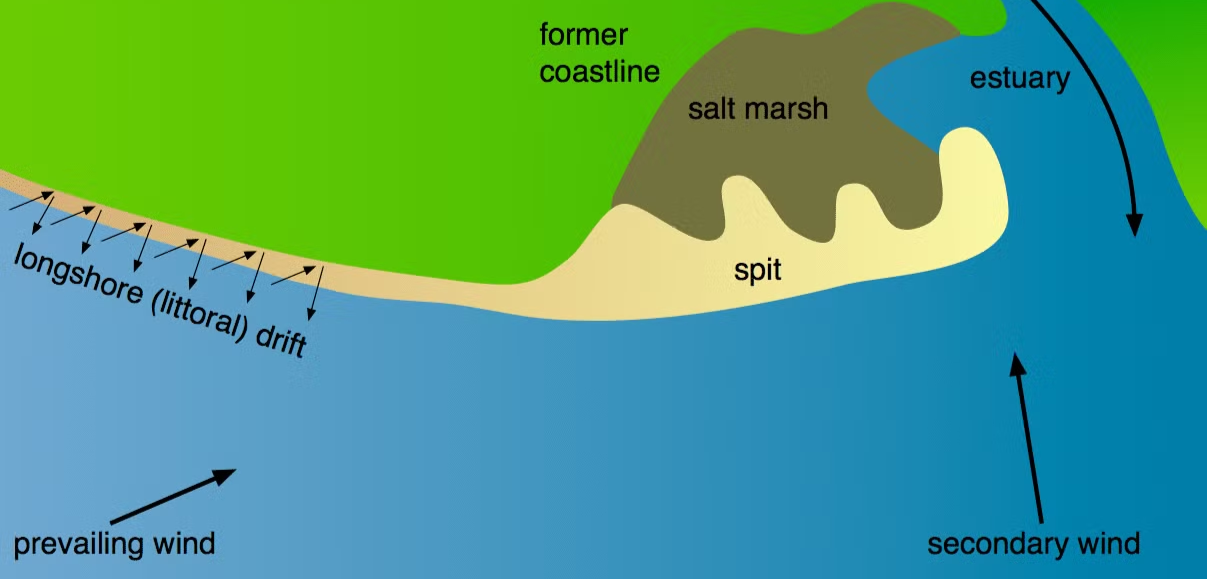
| Spit | • Long, narrow stretches of sand or shingle that protrude into sea • Materials moved along coast by longshore drift • Direction of movement continues despite coastline curving or where there is an estuary |
| Bay beach | A swash-aligned feature where waves break and move sediment into a bay where a beach forms ↳ Deposition can occur in the bay as wave energy is refracted by headlands |
| Tombolo | • Formed where a spit joins the mainland at one end to an island at the other |
| Barrier beach/Bar | • Where a spit has developed right across a bay because there are no strong current to disturb the process • A lagoon is formed behind it |
| Hooked spit | • A spit which end is curved landward • Hook caused by more pronounced waves from a secondary prevailing wind |
| Cuspate foreland | • A triangular shaped feature extending out from a shoreline • They are formed due to two dominant wind & wave patterns causing deposition from two directions |
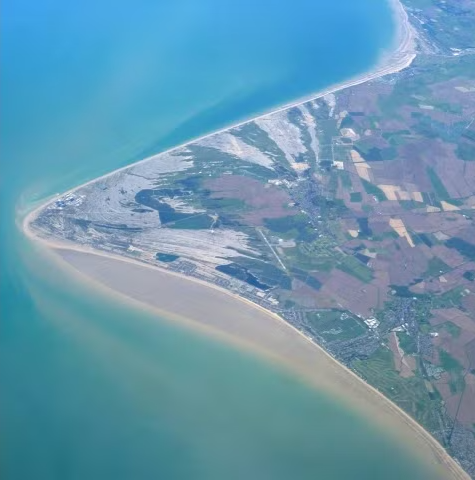
A cuspate foreland
The sediment cell concept
Positive feedback
🔗 Where a change causes a further effect, continuing or even accelerating the original change
Negative feedback → Acts to lessen the effect of an original change & ultimately reverse it
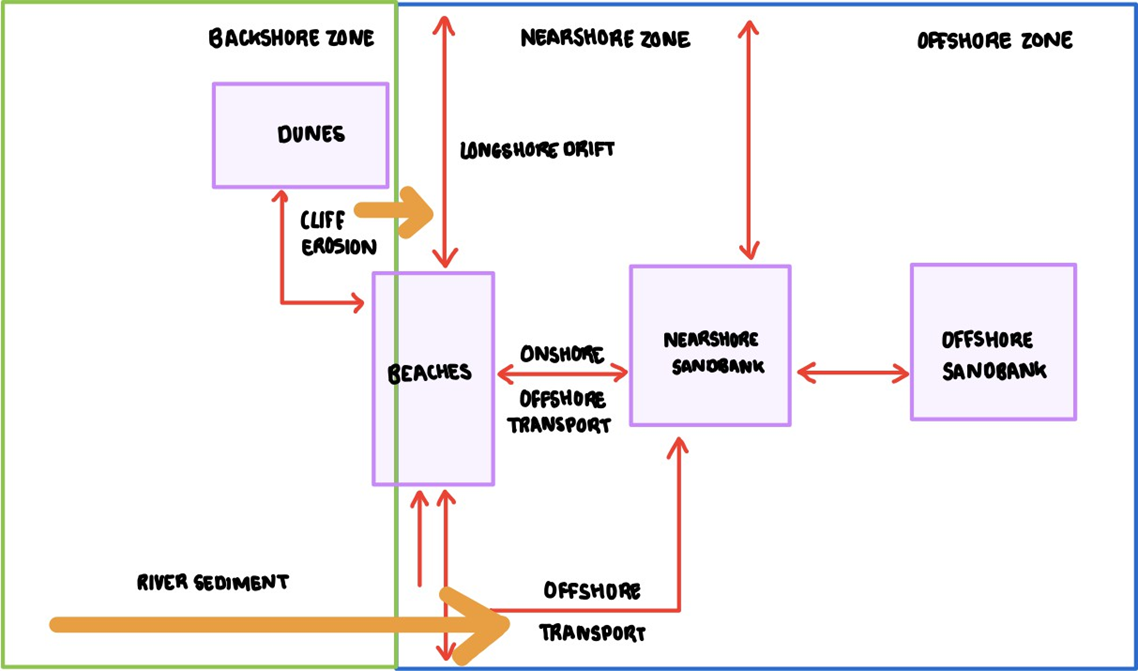
🔗 A sediment cell is comprised of sources, transfers and sinks (closed system) - constantly trying to reach a dynamic equilibrium
- Erosion in one place (source) can be balanced by deposition in another eg. spit (sink) - due to transfers of sediment w/in the cell (eg. longshore drift, currents etc) Sediment budget → Amount of sediment gained from sources & lost to sinks
Sediment cells