Implications for human wellbeing: degradation of the water and carbon cycles (Edexcel A-Level Geography): Revision Notes
📚Revision Notes
Implications for human wellbeing: degradation of the water and carbon cycles
Forest Loss
Forests provide shelter, food, medicinal plants, fuel, timber and stabilise the soil and atmosphere (sequestering CO2 from the atmosphere, storing carbon, providing oxygen, cycling nutrients, balancing the water cycle through interception and absorption and influencing local climates through evapotranspiration - which transfers moisture from the soil back to the atmosphere).
- As people reach higher levels of wealth, societies reach a tipping point when the costs of environmental exploitation are fully realised
- When this point is reached, resource conservation and protection come first, and expansion of forests may also be considered
- ∴ argued that forest lost can have a positive impact in the longer term
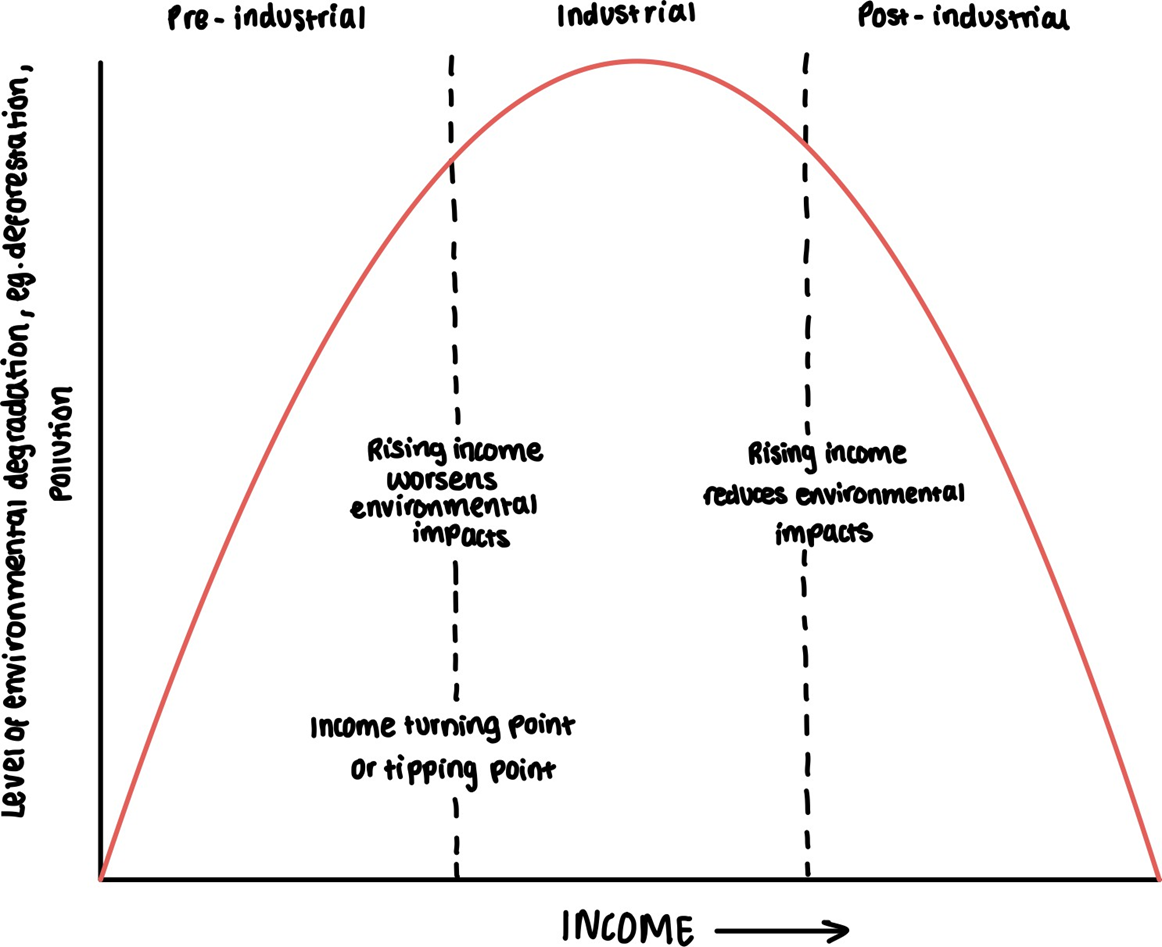
Kuznets' Curve Model
Kuznets' Curve Model → Concludes that as a country's GDP and development improves past the turning point, (ie. from industrial to post-industrial [service] economies), when the cost of resource exploitation is fully realised and more action is taken to conserve and protect the environment.
Temperatures
- Increases in temperature resulting from GHG emissions affect evaporation rates and the quantity of water vapour in the atmosphere
- Has been a loss of sea ice, both in terms of areal extent and thickness
- Has implications on precipitation patterns, river regimes and water stores and can influence availability of water for human consumption
- Additionally, less water is stored in the cryosphere and glacial melting will lead to flooding and loss of freshwater This will be detrimental for locals who rely on glacial freshwater
Declining Ocean Health
Increasing CO2 in the atmosphere due to human activities has direct, chemical effects on ocean waters
-
Oceans are warming, becoming more acidic and changing salinity
-
Threats to ocean health pose threats to human wellbeing which particularly affect people in developing regions who depend on marine resources as a food source, for tourism and for coastal protection
-
Diffusion between the sea surface and atmosphere causes oceans to absorb more CO2 than they emit
-
Anthropogenic emissions due to fossil fuel combustion and land use change (eg. conversion of forest to crops) have increased this level of absorption:
- Since 1850, oceans have absorbed about half the CO2 released into the atmosphere by humans, causing a 26% ↑ in acidity (average pH of ocean surface waters has fallen from 8.2 to 8.1)
-
This rate of change is 10x faster than at any time in the last 55 million years
- Whilst this has slowed the rate of climate change, it also has a direct chemical effect on seawater ↳ The degree of future acidification will be closely linked to future increases in atmospheric CO2.
-
If GHG emissions continue at the present rate, seawater could ↑ its acidity by a further 0.4 units by the end of the
- The capacity of the ocean to absorb CO2 ↓s as acidification ↑s (reducing the carbon store) and more acidic oceans are less effective in climate regulation.
-
Acidification of the oceans in the future will not be uniform worldwide: Polar seas and upwelling regions - where deep, cold waters rise (often off western coasts of continents) are expected to acidify faster than temperate or tropical regions
-
Present day pH of seawater is highly variable and a single organism can cope with fluctuations during its lifetime
- The problem with Ocean acidification is the sustained nature of the change, as the risk comes from lifetime exposure to lower pH levels which affect organisms' ability to
-
The rapid pace of acidification will also influence the extent to which calcifying organisms can adapt - molluscs such as oysters and clams are among the most sensitive groups and commercial losses resulting from declining stocks could be over $100 billion globally
Osteoporosis of the Sea
- Ocean acidification is often called 'osteoporosis of the sea'
- Water and CO2 create a weak carbonic acid which has the ability to dissolve calcium carbonate (an alkaline mineral)
- As oceans become more acidic, it is difficult for calcifying organisms like corals to absorb sufficient calcium carbonate to maintain their skeletons, so reefs begin to dissolve and their reduced strength and density makes them more vulnerable to storm damage
- Coral reefs are very productive ecosystems in shallow water, with a living layer on a hard reef composed of calcium carbonate. ∴ when carbonic acid dissolves the base of a reef it breaks up and reduces the rate of reef building so that coral polyps cannot live there
- Coral reef structures also buffer shorelines against waves, storms and floods - helping to prevent loss of life, property damage and erosion - so their destruction would adversely affect coastal areas, particularly those prone to storm surges and cyclones. In fact, several island nations, including the Maldives, reefs shelter the only habitable land. The protective function of reefs prevents loss of life, property damage and
- The impacts of acidification extend up the food chain to affect economic activities such as fisheries, aquaculture and tourism. They are made worse when combined with the effects of other climate-related hazards, such as rising temperatures, rising sea levels and ocean
Impacts on Algal Life
Algae provide food to corals via photosynthesis
- When ocean temperature rises, Algae leave the coral as the water becomes too warm, causing it to turn white (bleaching)
Sea Life
- Aquaculture is on the rise, but its productivity is being affected by declining pH levels and rising temperatures
- There is evidence to suggest that fish species are migrating from tropical areas to the poles, causing stocks to deplete in many developing countries
- The ability of shellfish to build large shells is also inhibited, making shellfish smaller and more prone to predators. The speed of climatic change is such that many species are unable to adapt and may become extinct
Impacts on the Economy
- Many jobs and economies depend on the fish and shellfish that live in the ocean
- Decreasing harvests could especially hurt the poorest people and the least developed nations who have the fewest agricultural alternatives. These challenges may influence rural-urban migration, leading to further social disruption and even conflict
- Reducing tourism
Human Health
- Human health is also a concern
- Harmful algal species produce more toxins and bloom faster in acidified waters
- This could harm people eating contaminated shellfish and sicken fish and other marine species. Whilst acidification does not make seawater unsafe to swim in, it upsets the balance of microscopic life within it.
What Can Be Done About Ocean Acidification?
- Mitigation measures to reduce GHG emissions are the ultimate solution, but other adaptation measures can be taken to prepare for acidification and counter its adverse effects:
- Water quality improvements can be made by monitoring and regulating localised sources of acidification from runoff and pollutants, such as fertilisers
- Sustainable management of fisheries by regulating catches to reduce overfishing and creating bycatch reduction plans
- Implementing new technologies - eg.new forecasting systems in aquaculture to account for seasonal upwellings that bring low pH waters to the surface and cause mass shellfish die-off. This enables hatchery managers to modify seawater intake to mitigate the effects of acidified
- Establishing and maintaining marine protected areas to shield highly vulnerable and endangered