Language of Functions (Edexcel A-Level Mathematics): Revision Notes
📚Revision Notes
2.8.1 Language of Functions
Note
Notation
Domain and Range of a Function
- The domain of a function is the set of values we are allowed to "feed" a function. Provided the function is defined, we are allowed to choose the domain.
Note
Example:
-
This is the domain we have chosen.
-
A sketch of this graph would look like this: (Note: This sketch shows the line starting from and increasing.)
-
However, we have only allowed the function f to be defined for .
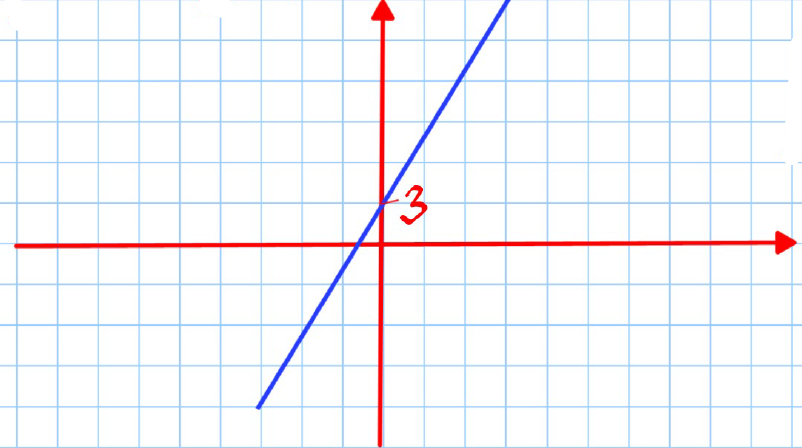
-
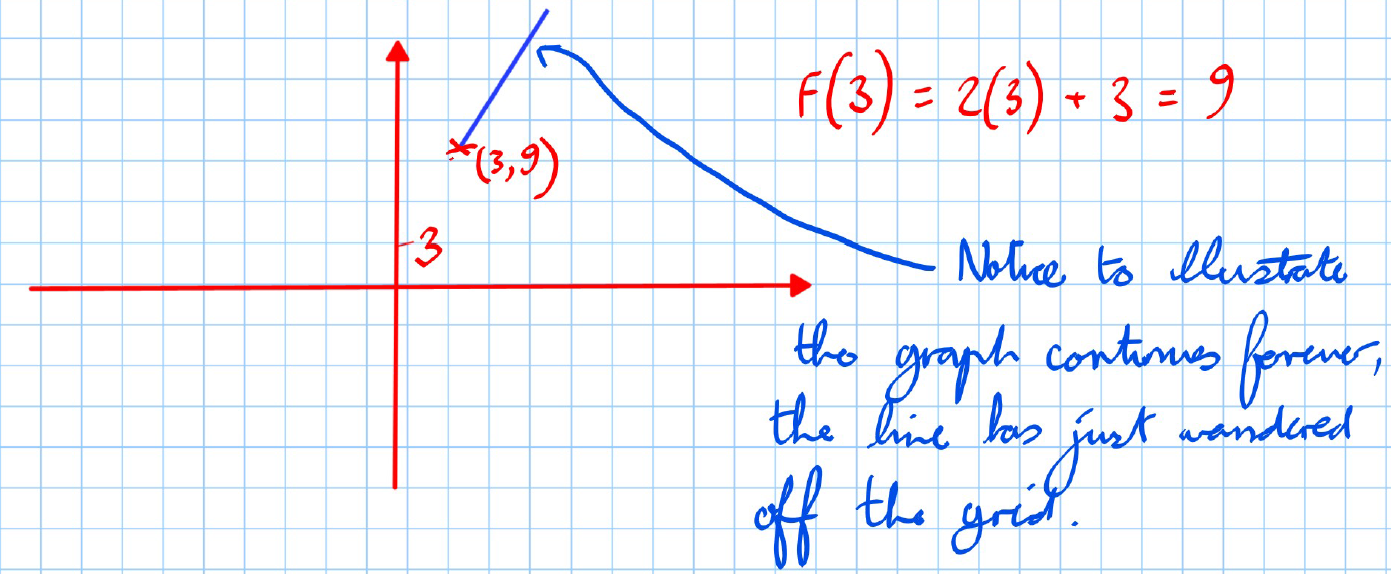
(Note: Point at is marked, illustrating that the function starts from this point.)
-
Notice, to illustrate the graph continues forever, the line has just vanished off the grid.
Note
Example of an Incorrect Domain for a Real Function:
- This cannot be correct as the function is undefined for .
Range of a Function
- The range of a function is the set of y values can take, given a particular domain.
Note
Example 1:
-
Sketch: for and state its range.
-
The sketch shows a parabola opening upwards with its vertex at . This helps in determining the range.
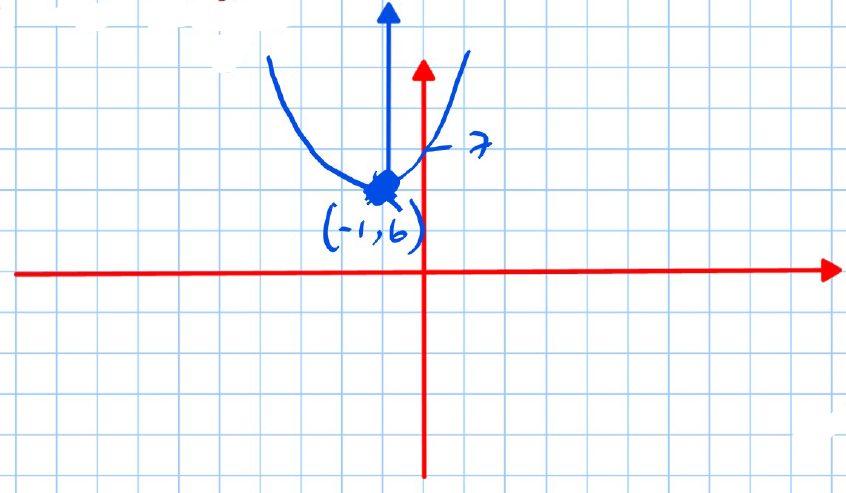
-
Calculator Steps:
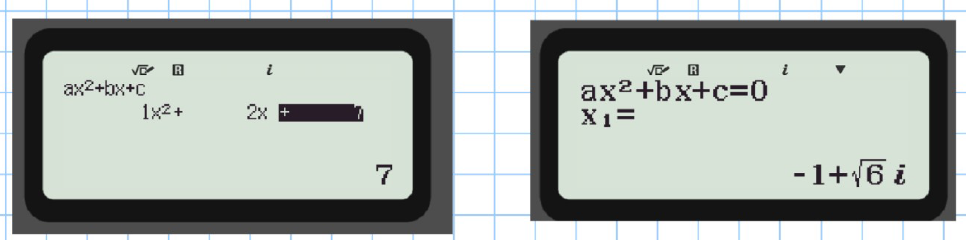
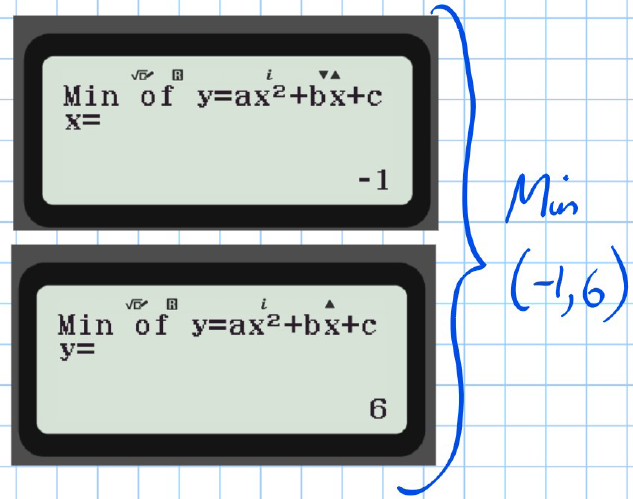
- Input the quadratic formula.
- The discriminant shows no real roots, indicating the vertex is the minimum point.
- Minimum point calculation gives: and .
- Thus, the range is or .
Note
Example 2:
-
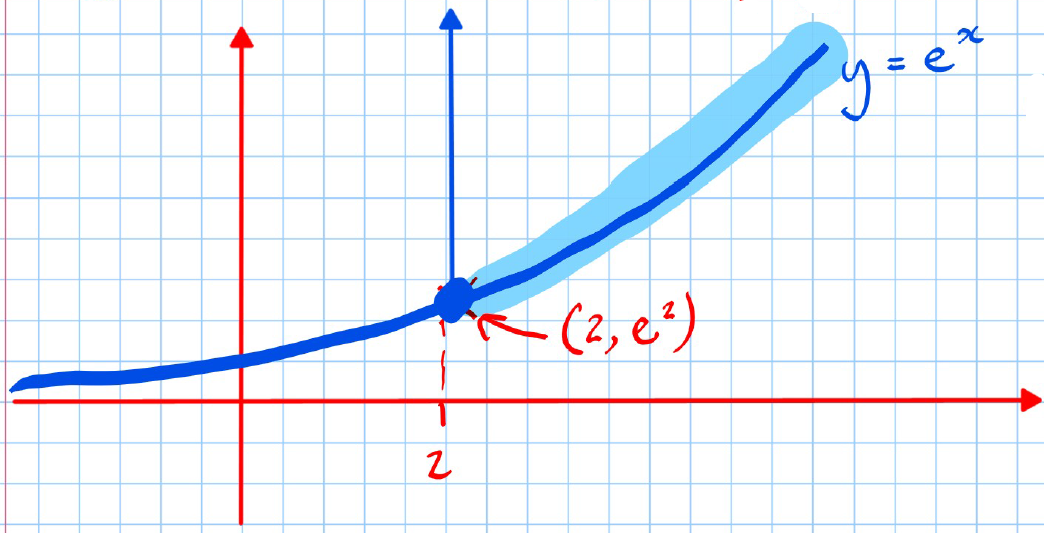
Find the range of .
-
Sketch shows the exponential function starting from .
-
The blue highlight indicates the part of the function of interest.
-
, indicating that for .
-
The range is the set of all values such that .
Note
The function is defined by for . The graph of is shown above.
- State the range of .
- At :
Thus, . The range of f is .
- Find the value of .
- First, calculate :
- Then, calculate :
Mapping
A function maps one set of numbers to another. The input is called the domain, the output set is called the range.
Note
Example:
- Domain:
- Range:
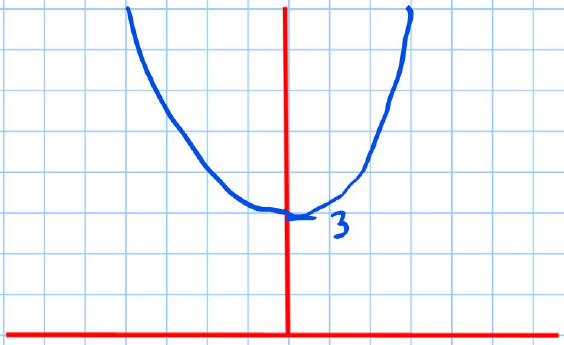
From the above, we can construct the statement:
(beyond the space)
maps real numbers to real numbers greater than or equal to .
Taking some specific values of mapping:
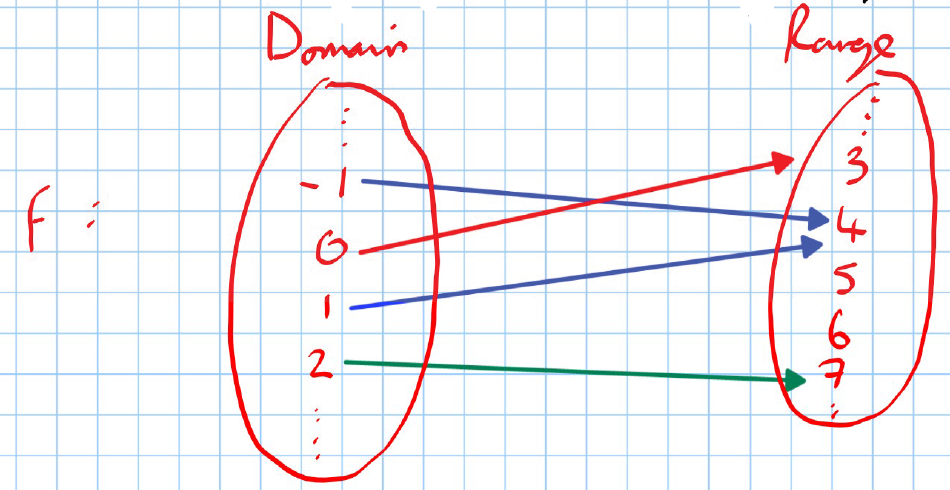
Domain:
Range:
For :
- Notice that for each element of the range, there are two elements (i.e., many) that map to one element of the range.
For example, .
Thus, the function is MANY-TO-ONE or MANY-ONE.
You can classify a function as many-to-one by drawing the function and drawing a horizontal line through the function.
Note
Example:
- Domain:
- Range:
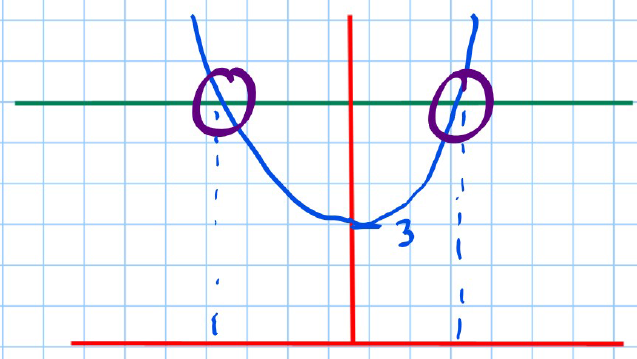
Since the line intersects the curve twice, we can see graphically that one y value is obtained from many values.
Note
Example of one-to-many:
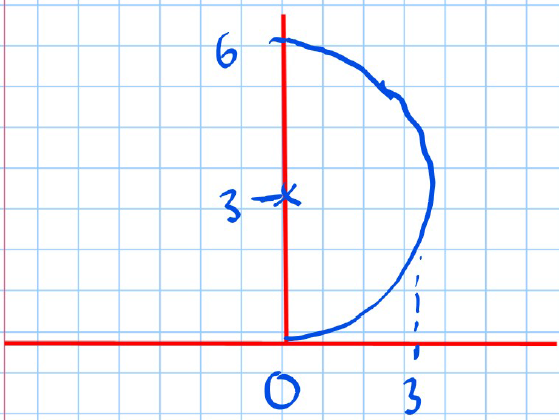
One -value, e.g., , gives many -values (i.e., ).
Draw a vertical line to test for this. If the line cuts in more than one place at any point, the function is ONE-TO-MANY.
What type of function is the following:
Conclusion: This function is Many-to-Many.
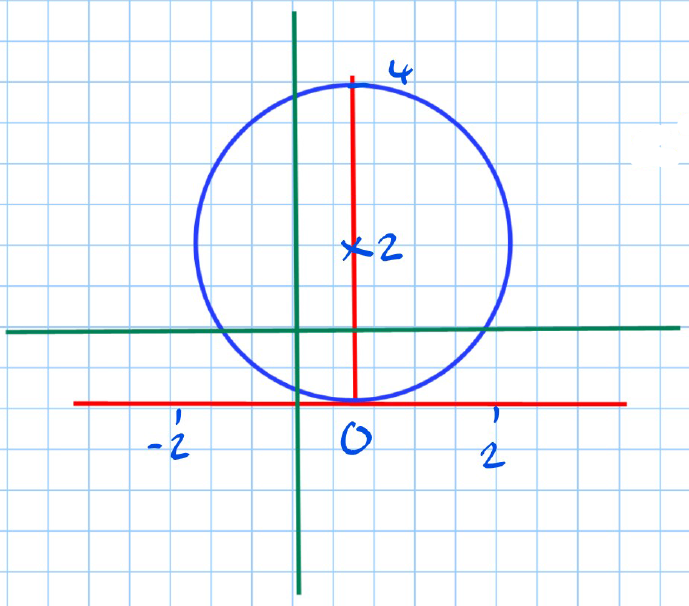
Explanation:
The significance of this is that a function that is Many-to-Many has no inverse. We cannot deduce a unique input from a given output.
Something is only strictly a function if it does not end "many," i.e., does end "one."