The role and composition of the Supreme Court. (Edexcel A-Level Politics): Revision Notes
📚Revision Notes
11.1.1 The role and composition of the Supreme Court.
Role of the UK Supreme Court
Final Court of Appeal:
Note
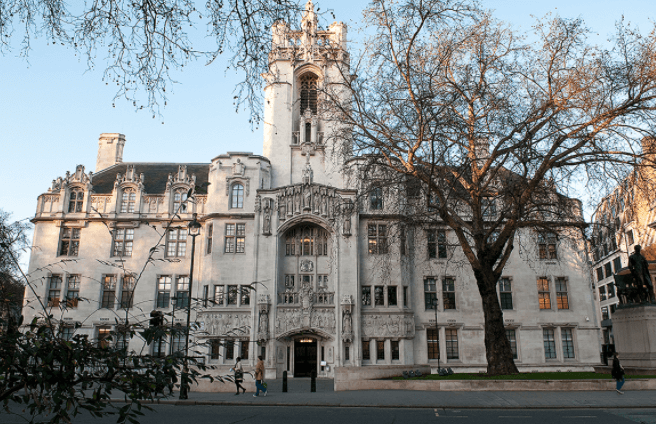
- The UK Supreme Court is the highest court in the United Kingdom, serving as the final court of appeal for both criminal and civil cases. It hears appeals from lower courts in England, Wales, Scotland, and Northern Ireland. The Supreme Court only hears cases of the greatest public or constitutional importance.
Interpretation of the Law:
- One of the key roles of the UK Supreme Court is to interpret and clarify the law. Its judgments help to ensure that the law is applied consistently across the country. The Court provides authoritative interpretations of statutes and common law, which lower courts are then bound to follow.
Judicial Review:
- The UK Supreme Court plays a crucial role in judicial review, where it examines the actions of public bodies to ensure they comply with the law. This includes reviewing the legality of decisions made by the government, ensuring that these decisions do not exceed the powers granted by Parliament (ultra vires).
Protection of Rights:
- The Supreme Court has an important role in protecting human rights, particularly through its interpretation and application of the Human Rights Act 1998. It ensures that laws and government actions comply with the European Convention on Human Rights (ECHR).
Constitutional Role:
- While the UK does not have a codified constitution, the Supreme Court plays a critical role in interpreting constitutional principles. It has the power to rule on matters relating to the devolution settlements in Scotland, Wales, and Northern Ireland, and can also determine the limits of parliamentary sovereignty and the rule of law.
Precedent Setting:
- The decisions made by the UK Supreme Court set precedents that lower courts must follow. This ensures consistency and stability in the application of the law, contributing to the development of the legal system over time.
Composition of the UK Supreme Court
Number of Justices:
Note
- The UK Supreme Court is composed of 12 Justices, including the President and Deputy President of the Court. The number of Justices can vary depending on retirements and appointments, but it usually remains around 12.
Appointment Process:
- Justices of the Supreme Court are appointed by the monarch on the advice of the Prime Minister, who receives recommendations from a special independent selection commission. The selection process is merit-based, and candidates must have extensive legal experience, either as senior judges or as highly qualified legal professionals.
Diversity and Representation:
- The composition of the UK Supreme Court has been criticized for its lack of diversity, with concerns about representation in terms of gender, ethnicity, and socio-economic background. Efforts have been made to increase diversity, but the Court still largely consists of individuals with similar educational and professional backgrounds, typically from elite institutions.
Independence:
- The UK Supreme Court operates independently of the executive and legislative branches of government. Justices have security of tenure, meaning they cannot be removed from office except in very specific circumstances, such as proven misconduct. This independence is crucial for maintaining the integrity and impartiality of the judiciary.
Roles of Justices:
Note
- Each Justice of the Supreme Court contributes to the Court's decisions. When hearing cases, the **Court typically sits in panels of five, seven, or nine Justices, depending on the complexity and importance of the case. The Justices engage in detailed legal analysis and debate before issuing a majority judgement, with dissenting opinions sometimes also being published.
President and Deputy President:
- The President of the UK Supreme Court is responsible for representing the Court and ensuring its effective operation. The Deputy President assists in these duties and may step in when the President is unavailable. Both roles involve leadership within the Court and a significant influence on its functioning.
"Evaluate the view that the Supreme Court is effective at checking the power of the government"
Note
- R(Factortame) v Secretary of State for Transport
- Factortame is a shipping company with majority Spanish shareholders
- This is due to the Common Fisheries Policy 1970
- The 1988 Merchant Shipping Act prevented foreign ships into the British waters
- Spain went to the ECJ
- The decision was that the 1988 Merchant Shipping Act was incompatible with EU law and EU law takes precedence over UK Law
EVALUATION 1:
Note
- Parliament is sovereign-so can ignore SC
- SC owes its existence to Parliament
- Parliament can remove the SC with a Parliament Act
- SC Is effective
- EG 2010 Ahmed v HM Treasury parliament tried to freeze suspected terrorist bank accounts but unable to do so as there were not sufficient statutes
- The SC ruled that the general wording of section 1 in the 1946 United Nations Act did not empower the government to pass the order
EVALUATION 2:
Note
- Govt put through Terrorist Freezing Act 2010 which allowed them to freeze terrorist bank accounts
- Shows sovereignty lies with parliament as the govt is able to pass laws if a majority is reached
- Due to the uncodified constitution of the UK, PM can pass laws if there is a majority
- Synoptic link-Passed with a strong majority produced by FPTP by the Labour Government
- R (Miller) v Secretary of State for exiting the European Union 2017
- She argued that individual cabinet members had no legal power to trigger Article 50 of the EU which states that member states can withdraw from the EU with its own constitutional arrangements
- The govt originally planned to bypass Parliament using prerogative powers
- As a result, Miller won the case as the PM must secure parliamentary approval if they want to trigger Article 50. Shows SC checking power over the executive
EVALUATION 3:
Note
- Rwanda bill deemed unlawful by the SC and violated human rights as asylum seekers will have ill-treatment if they go to Rwanda
- Ultimately, Parliament is sovereign and FPTP allowed for a majority and passed Rwanda bill