Reducing Water Loss (OCR A-Level Biology A): Revision Notes
📚Revision Notes
Reducing Water Loss
Why plants need to conserve water
Water is essential for life, and excessive water loss poses a significant threat to plant survival. While transpiration is necessary for mineral transport and temperature regulation, plants must balance this process with water conservation. This is particularly challenging for plants in environments where water replacement is difficult or impossible.
Leaves have evolved multiple structural and physiological features to minimize water loss while maintaining sufficient gas exchange for photosynthesis. The extent of these adaptations varies depending on the plant's habitat, with species in arid environments showing the most pronounced modifications.
Note
The degree of water-conserving adaptations in plants directly correlates with their habitat. Plants in water-scarce environments exhibit far more extensive modifications than those in water-rich environments.
General adaptations in land plants
Most terrestrial plants possess basic structural features that restrict water vapour loss from their leaves:
Waxy waterproof cuticle: A layer of waxy material covers the leaf surface, creating a waterproof barrier that prevents water vapour escaping from the epidermis. This limits evaporation to the stomata only, giving the plant control over where water loss occurs.
Stomatal positioning: The majority of stomata are located on the lower (abaxial) surface of the leaf rather than the upper surface. This positioning is advantageous because the lower surface typically faces away from direct sunlight, making it cooler. Lower temperatures reduce the kinetic energy of water molecules, thereby decreasing the rate of diffusion and evaporation.
Note
In aquatic plants with floating leaves, this pattern reverses—stomata appear on the upper surface. This occurs because water vapour loss is not problematic in these environments, and the atmosphere above the water provides a richer source of gases for photosynthesis than the water below.
Stomatal closure in darkness: During night-time, when photosynthesis cannot occur due to the absence of light, stomata close. This prevents unnecessary water loss while carbon dioxide uptake is not required. The closure is controlled by changes in the turgor pressure of guard cells surrounding each stoma.
Xerophytes and extreme water conservation
Xerophytes are plants specifically adapted to survive in environments where water availability is severely limited. These plants possess additional structural modifications beyond the standard features of land plants. The term derives from the Greek words meaning "dry plants."
Important
Xerophytic adaptations work primarily by reducing the water vapour concentration gradient between the leaf interior and the external atmosphere, or by minimizing the surface area available for water loss.
Structural adaptations of xerophytes
Reduced stomatal density: The total number of stomata per unit leaf area may be lower than in non-xerophytic species. Fewer stomata means fewer pores through which water vapour can escape, though this must be balanced against the need for adequate carbon dioxide uptake.
Sunken stomata: Rather than sitting flush with the leaf surface, stomata may be located in pits or grooves below the epidermis. This creates a sheltered microenvironment around each stoma where water vapour accumulates. The trapped moist air raises the humidity in the pit, which reduces the concentration gradient between the saturated air inside the leaf and the external environment. A smaller gradient means slower diffusion of water vapour out of the leaf.
Stomatal hairs: Many xerophytes develop hair-like structures (trichomes) surrounding their stomata. These hairs trap water vapour as it leaves the stoma, creating a layer of still, humid air around the opening. Like sunken stomata, this reduces the diffusion gradient by increasing local humidity. The hairs also reduce air movement across the stomatal surface, further limiting water loss.
Thickened waxy cuticle: Xerophytes typically have a much thicker cuticle than plants from less challenging environments. This provides additional waterproofing and further restricts any water loss occurring through the leaf surface itself, ensuring that water loss remains limited to stomatal transpiration that the plant can regulate.
Rolled leaves: Some xerophytes can roll their leaves so that the lower surface (where most stomata are located) faces inward, creating a tube or cylinder. This traps humid air within the rolled structure, maintaining high humidity around the stomata. The reduced diffusion gradient significantly slows transpiration. Marram grass demonstrates this adaptation particularly well.
Reduced leaf area: The most extreme xerophytic adaptation involves reducing or eliminating leaves entirely. Smaller leaves provide less surface area for water loss. In cacti, leaves have evolved into spines—structures that drastically reduce surface area while also providing protection from herbivores. The photosynthetic function transfers to the stem, which has its own water-conserving adaptations.
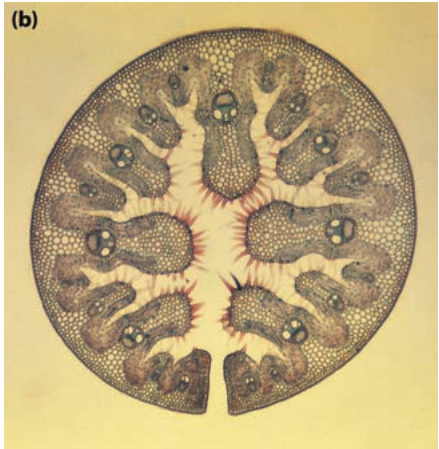
The cross-section above shows the internal structure of marram grass, revealing multiple xerophytic features including rolled leaf structure and sunken stomata.
Example: Marram grass (Ammophila arenaria)
Example
Worked Example: Marram Grass Adaptations
Marram grass colonizes sand dunes—environments where water drains rapidly through the sandy substrate, making water availability unpredictable despite proximity to the ocean. This species exhibits many of the xerophytic modifications described above:
- Stomata positioned in deep grooves on the inner surface of rolled leaves
- Numerous hairs that trap moisture
- Thick cuticle providing waterproofing
- Ability to roll leaves tightly during dry conditions
These combined adaptations allow marram grass to thrive in an environment that would be inhospitable to most plant species.
Example: Cacti
Example
Worked Example: Cactus Adaptations
Cacti represent an extreme example of xerophytic adaptation, native to desert environments where water is scarce and evaporation rates are very high.
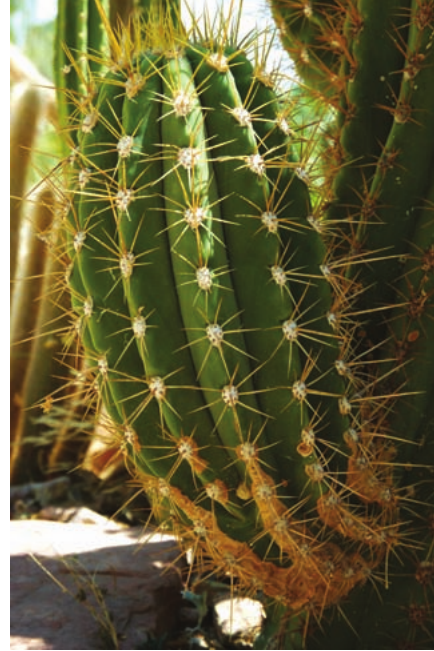
The cactus in the image shows the characteristic spine structure. These spines are modified leaves with minimal surface area, drastically reducing potential water loss. The green stem has taken over the photosynthetic role and possesses:
- A very thick cuticle
- Few stomata (which may open only at night)
- Specialized tissue for water storage
Hydrophytes: A contrasting adaptation strategy
For context, it is worth noting that plants living in aquatic environments face the opposite challenge. Hydrophytes are plants adapted to freshwater habitats where water conservation is not a concern.
Note
Key Contrasting Features
Key differences in hydrophyte structure include:
- Stomata predominantly or exclusively on the upper leaf surface (for floating leaves), allowing gas exchange with the atmosphere rather than with water
- Very large air spaces within tissues, providing buoyancy
- Thin, flat leaves that float easily
- Thin or reduced waxy cuticle
- Greatly reduced vascular tissue, particularly xylem
- Minimal root systems
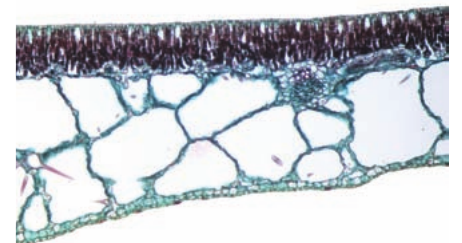
The water lily leaf section above demonstrates hydrophytic features, including large air spaces and thin structure, contrasting sharply with xerophytic adaptations.
Summary
Key Points to Remember:
- Xerophytes are plants with specialized adaptations for surviving in dry environments where water is limited
- All land plants possess basic water-conserving features: waxy cuticles, stomata mainly on lower leaf surfaces, and stomatal closure at night
- Xerophytic adaptations work by reducing the water vapour concentration gradient (through increasing local humidity) or by reducing surface area for water loss
- Key xerophytic features include: sunken stomata in pits, stomatal hairs, thickened cuticles, rolled leaves, and reduced leaf size
- Examples like marram grass and cacti show how multiple adaptations work together to minimize water loss in challenging environments