Transpiration (OCR A-Level Biology A): Revision Notes
📚Revision Notes
Transpiration
What is transpiration?
Transpiration is the loss of water vapour from plant leaves through stomata (small pores). It occurs as an unavoidable consequence of gas exchange for photosynthesis.
Plants need to exchange gases - taking in carbon dioxide and releasing oxygen during photosynthesis. This exchange happens through stomata, which are pores in the leaf epidermis surrounded by pairs of guard cells. However, when stomata open to allow gas exchange, water loss becomes inevitable.
Note
Stoma (plural: stomata) - A pore in the leaf epidermis, surrounded by a pair of guard cells that control its opening and closing.
The transpiration process
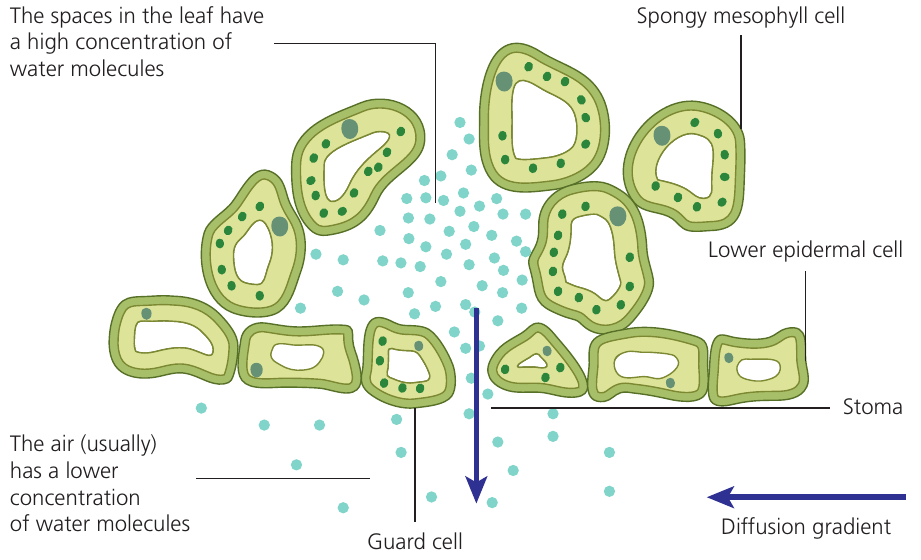
Water evaporates from the moist surfaces of mesophyll cells inside the leaf. The leaf interior has a high concentration of water molecules in the air spaces, whilst the external air typically has a lower concentration. This creates a diffusion gradient, causing water vapour to diffuse from the high water potential inside the leaf through the stomata to the lower water potential outside.
The internal surface area of a leaf is considerable, so large amounts of water can be lost through transpiration. Most water vapour loss occurs when stomata are open during daylight for photosynthesis. During darkness, when carbon dioxide is not needed for photosynthesis, stomata close to reduce water loss.
Important
Important distinction: Transpiration refers specifically to the evaporation of water from leaves, not the movement of water up the plant stem. Although transpiration is the main driving force for water movement up the stem, the term itself is restricted to the evaporation process only.
Factors affecting transpiration
The rate of transpiration depends on the diffusion gradient of water vapour between the inside of the leaf and the surrounding air. A larger gradient results in a faster rate of diffusion.
Several environmental factors affect this diffusion gradient and therefore influence transpiration rate:
Temperature
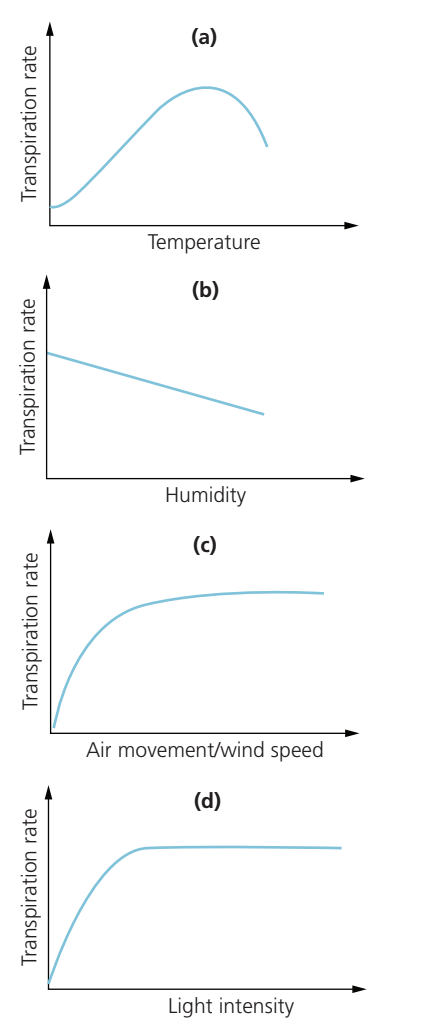
Increasing temperature raises the kinetic energy of all molecules, including water molecules. This increased molecular movement enhances the rate of evaporation and diffusion, so transpiration rate increases with temperature (assuming the concentration of water molecules in the air remains lower than inside the leaf).
Important
However, very high temperatures cause stomata to close as a protective mechanism. When this happens, transpiration rate decreases sharply despite the high temperature.
Humidity
As the humidity of the surrounding air increases, the concentration of water molecules in the external air rises. This reduces the diffusion gradient between the inside of the leaf and the surrounding air, causing transpiration rate to decrease.
Note
Eventually, when the external humidity becomes equal to the internal water vapour concentration, equilibrium is reached and there is no net water vapour loss from the leaf.
Air movement
In still air, water molecules that evaporate from the leaf are not carried away by wind. Instead, they accumulate close to the leaf surface, creating an area of high humidity around the leaf. This reduces or eliminates the concentration gradient, slowing transpiration.
Air currents (wind) move water molecules away from the leaf surface, maintaining the concentration gradient. Therefore, air movement increases transpiration rate up to a maximum level, beyond which further increases in wind speed have little additional effect.
Light intensity
In darkness, stomata close and the transpiration rate decreases drastically. Once light intensity reaches the threshold needed to trigger stomatal opening, further increases in light intensity have no additional effect on transpiration rate.
Note
The light intensity required for stomata to open is quite low - stomata remain open even on cloudy days, so light is rarely a limiting factor once the minimum threshold is exceeded.
Measuring transpiration
Transpiration is difficult to measure directly because it involves the loss of water vapour into the air. However, water uptake can be measured using a device called a potometer. The assumption is made that water uptake is directly proportional to water vapour loss by transpiration.
Note
Potometer - An apparatus used to measure the rate of water uptake by a plant shoot, which approximates the rate of transpiration.
Potometer design and operation
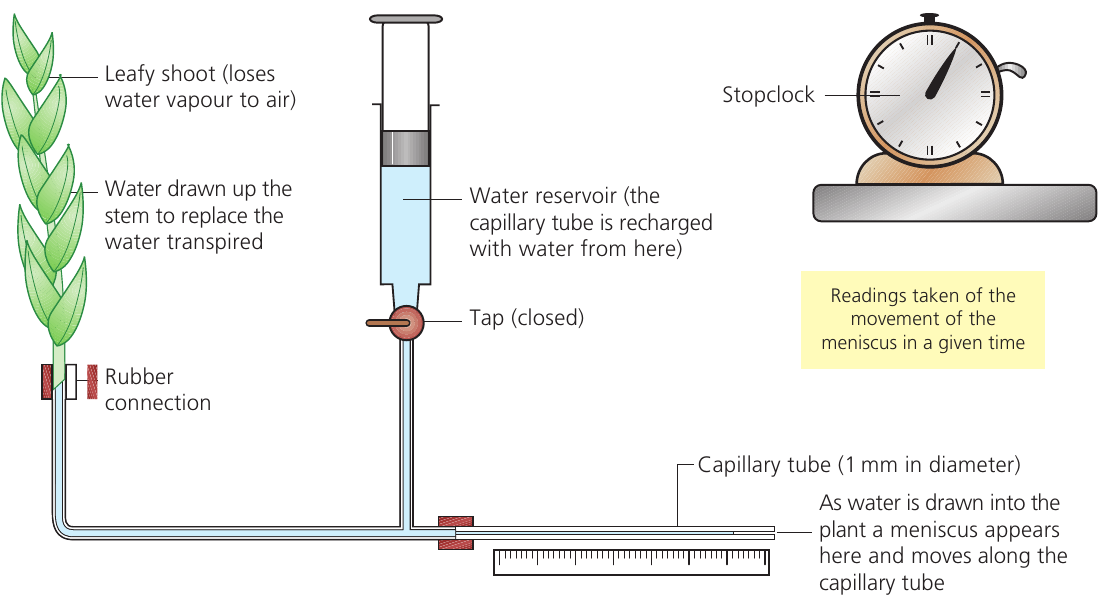
A potometer consists of:
- A leafy plant shoot connected to the apparatus
- A horizontal capillary tube (typically in diameter) with calibrated markings
- A water reservoir with a tap for refilling
- A rubber connection joining the shoot to the tubing
- A stopcock or timer for recording measurements
As water is transpired from the leaves, more water is drawn up the stem to replace it. This creates a visible air bubble (meniscus) in the capillary tube that moves along the tube. The distance the meniscus travels in a given time can be measured and used to calculate the rate of water uptake.
Setting up a potometer correctly
Proper setup is essential to obtain reliable results. The following precautions must be taken:
Important
Preventing airlocks:
Air bubbles are the main cause of experimental failure when using a potometer. To prevent airlocks:
- The plant stem must be cut underwater to prevent air entering the xylem vessels
- The transpiration stream naturally pulls water upwards, which would suck air into cut xylem if the stem is not submerged
- The entire apparatus must be assembled underwater
- All joints must be airtight to prevent air bubbles entering the system
- Air bubbles create airlocks that stop water movement and invalidate results
Other important considerations:
- If leaves get wet during setup, they should be dried before taking readings
- Wet leaves create a humid atmosphere around the leaf surface, reducing transpiration and affecting results
- Allow the apparatus to stabilize until the bubble movement rate becomes constant before starting measurements
- This ensures the plant has adjusted to the new conditions
Investigating environmental factors
Potometers can be used to investigate how environmental factors affect transpiration rate. For example, to study the effect of air movement:
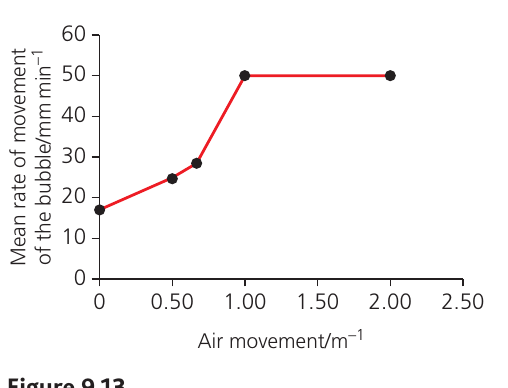
The graph shows experimental results where a fan was placed at different distances from the plant. Air movement was calculated as (measured in ).
Example
Worked Example: Interpreting Air Movement Results
The results demonstrate that:
- Between and : transpiration rate increases steeply as air movement increases
- Between and : transpiration rate plateaus at approximately , showing little further increase
Explanation: This pattern occurs because initially, increased air movement removes the humid air layer around leaves, steepening the diffusion gradient. Beyond a certain point, the diffusion gradient is already maximal, so additional air movement provides no further benefit.
Variables that should be controlled in such experiments:
- Temperature
- Humidity
- Light intensity
- Plant species and size
- Number and size of leaves
Note
Limitations of the method:
The assumption that water uptake equals transpiration may not be completely valid because:
- Some absorbed water is used in photosynthesis
- Some water is used for cell growth and maintaining turgidity
- Some water may be used in other metabolic processes
- However, these amounts are typically small compared to transpiration losses
Calculating water uptake rates
To convert bubble movement into an actual rate of water uptake, you need:
- The capillary tubing calibrated in standard units (usually millimetres)
- The cross-sectional area of the bore of the tubing (determined from the radius)
Formulas
Volume of water absorbed:
where
Rate of water uptake:
Example calculation
A different potometer design uses a graduated tube and balance to measure both water uptake and mass loss:
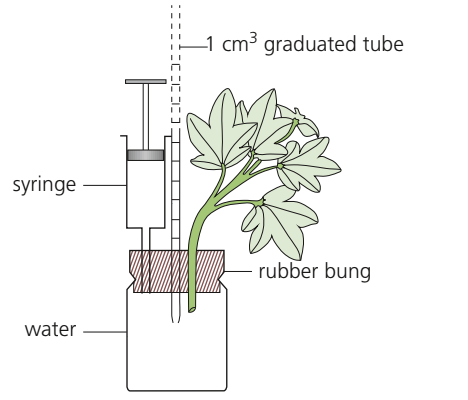
Example
Worked Example: Calculating Water Uptake and Loss Rates
Consider an experiment with the following data collected over minutes:
| Time (min) | Volume of water in tube (cm³) | Mass of potometer and shoot (g) |
|---|---|---|
Step 1: Calculating rate of water vapour loss
Decrease in mass
Rate of water vapour loss
Step 2: Calculating rate of water uptake
Water uptake (note: water )
Rate of water uptake
Step 3: Analysis
The difference between water uptake () and water vapour loss () represents water retained by the plant for other processes such as:
- Photosynthesis
- Maintaining cell turgidity
- Cell growth
- Other metabolic processes
Note
The assumption when using mass loss to measure transpiration is that mass changes due to other processes (such as respiration or photosynthesis) are too small to significantly affect the measurements.
Note: If the rates were not constant (non-linear relationship), you would need to plot a graph and calculate the gradient (slope) to determine the rate.
Remember!
Summary
Key Points to Remember:
- Transpiration is the evaporation of water vapour through stomata - it is NOT the movement of water up the plant
- Transpiration is an inevitable consequence of opening stomata for gas exchange during photosynthesis
- Four main factors affect transpiration rate:
- Temperature (increases rate until stomata close)
- Humidity (decreases rate)
- Air movement (increases rate up to maximum)
- Light (required for stomatal opening)
- A potometer measures water uptake as an approximation of transpiration rate
- When setting up a potometer, always cut the stem underwater and assemble the apparatus underwater to prevent airlocks
- Water uptake rate can be calculated using: volume distance moved, then rate