Cell Signalling (OCR A-Level Biology A): Revision Notes
📚Revision Notes
Cell Signalling
Introduction to cell signalling
In multicellular organisms, cells work cooperatively rather than independently. Communication between cells occurs via chemical messenger molecules, which are synthesized in one cell and transported to others. Not all cells respond to every messenger molecule — only those possessing the appropriate receptors can detect and respond to specific messengers.
Note
Cell signalling describes this process of information transfer between cells through chemical messengers. When a messenger molecule binds to a compatible receptor on the plasma membrane, it triggers changes within that cell.
Plasma membrane receptors
Structure and function
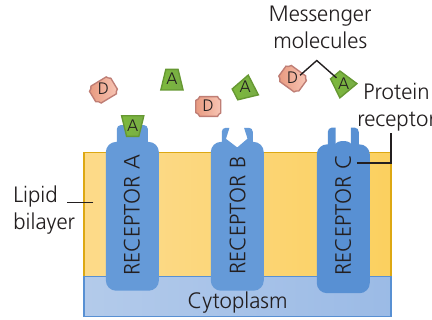
The plasma membrane contains specialized receptor molecules that detect chemical messengers. Glycoproteins serve as the primary receptors for cell signalling, though evidence suggests that glycolipids may also contribute to this function.
Each cell possesses hundreds of different receptor types embedded in its membrane. The specific population of receptors varies between cell types, which explains why different cells respond differently to the same messenger molecules.
Receptor specificity
Important
Every receptor type recognizes and binds to only one type of messenger molecule. This specificity depends on complementary molecular shapes — the messenger must fit precisely into the receptor's binding site, similar to a lock and key mechanism.
Target cells
A target cell is defined as a cell that responds to a particular messenger molecule because it possesses the appropriate receptors. Cells lacking the necessary receptors remain unaffected by that messenger, even when exposed to it.
Example
Worked Example: Glucagon and Target Cells
Liver cells possess receptors for the hormone glucagon. When glucagon binds to these receptors, liver cells release glucose from stored glycogen.
Although skeletal muscle cells encounter glucagon circulating in the blood, they do not respond because they lack the complementary glucagon receptors.
This demonstrates that the presence of specific receptors determines whether a cell is a target cell for a particular messenger.
Mechanisms of receptor action
When a messenger molecule binds to its receptor, the resulting conformational change in the receptor protein can trigger cellular responses through three main mechanisms:
Important
Three Key Mechanisms of Receptor Action:
-
Release of second messengers — The receptor change may initiate the release of a second messenger inside the cell. This internal signalling molecule can trigger various downstream effects within the cytoplasm.
-
Regulation of ion channels — The receptor activation may open a previously closed protein channel, or close one that was open. This controls the movement of specific ions or molecules across the membrane.
-
Enzyme activation — The receptor change may activate an enzyme already present within the cell. Alternatively, the membrane receptor protein itself may function as an enzyme that becomes active upon messenger binding.
Membrane receptors and drugs
Drug targeting
Approximately half of all medicinal drugs target specific membrane receptors. This targeting allows drugs to affect only certain cell types and create (or block) particular cellular responses, improving therapeutic precision and reducing unwanted side effects.
Antihistamine mechanism
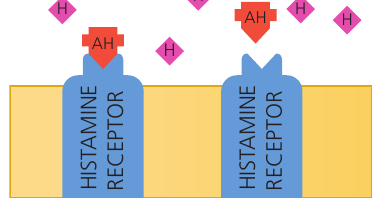
Histamine is a chemical messenger released by white blood cells in response to tissue damage. When histamine binds to membrane receptors on capillary cells, it increases their permeability to white blood cells, resulting in inflammation at the damaged site. This response is beneficial during genuine tissue damage.
However, white blood cells sometimes release histamine in response to harmless substances in individuals with allergies. This inappropriate histamine release triggers unnecessary inflammation.
Example
Worked Example: How Antihistamines Work
Antihistamine drugs work by blocking histamine receptors through competitive inhibition:
Step 1: The drug molecules possess a complementary shape to the histamine receptor
Step 2: Antihistamines compete with histamine for binding sites on the receptors
Step 3: When antihistamines occupy the receptors, histamine molecules cannot bind
Result: The inflammatory response is prevented because histamine cannot activate the receptors
Opioid receptors and pain management
Nerve cells in the brain, spinal cord, and alimentary canal contain opioid receptors that respond to natural signalling compounds called enkephalins.
Note
Morphine, a painkiller, interacts with opioid receptors because its molecular structure is complementary to the receptor's binding site, mimicking the effects of enkephalins. In contrast, aspirin (another painkiller) does not interact with opioid receptors because its molecular shape differs and is not complementary.
Morphine cannot cross the phospholipid bilayer because it is water-soluble rather than lipid-soluble. Therefore, it must bind to receptors on the plasma membrane surface.
Example
Case Study: Naloxone and Competitive Inhibition
Naloxone demonstrates competitive inhibition of morphine:
- When administered, naloxone binds to opioid receptors, blocking morphine from accessing them
- This explains why naloxone can reverse morphine's effects
- However, increasing the morphine concentration can overcome this inhibition by increasing the probability that morphine, rather than naloxone, will bind to available receptors
Important observation: Morphine and naloxone have no effect on heart and lung cells because these cells lack opioid receptors — they are not target cells for these compounds.
Remember!
Summary
Key Points to Remember:
- Cell signalling enables communication between cells through chemical messenger molecules that bind to specific membrane receptors
- Glycoproteins in the plasma membrane function as receptors, with each receptor type specific to one messenger molecule
- Only target cells (those possessing appropriate receptors) respond to particular messengers
- Receptor activation triggers changes through three mechanisms:
- Releasing second messengers
- Regulating ion channels
- Activating enzymes
- Approximately of medicinal drugs target membrane receptors, allowing precise therapeutic effects through competitive inhibition or receptor activation