Transport of Substances Into and Out of Cells (OCR A-Level Biology A): Revision Notes
📚Revision Notes
Transport of Substances Into and Out of Cells
Introduction to membrane transport
Cells continuously exchange materials with their surroundings through the plasma membrane. The direction and mechanism of transport depend on whether a concentration gradient exists and whether it favours the movement.
When substances move from higher to lower concentration (down a gradient), passive transport occurs without energy expenditure. Three types exist:
- Simple diffusion
- Facilitated diffusion
- Osmosis
When substances must move from lower to higher concentration (against a gradient), cells must expend energy through active transport. Additionally, cells use bulk transport mechanisms (endocytosis and exocytosis) to move large quantities of materials.
Note
The fundamental principle of membrane transport is that movement can occur passively down concentration gradients, but movement against gradients requires cellular energy investment. Understanding this distinction is essential for predicting how substances will move across membranes.
Diffusion
Diffusion describes the net movement of particles (atoms or molecules) down a concentration gradient, from regions where they are more concentrated to regions where they are less concentrated.
Mechanism of diffusion
Particles in liquids and gases move randomly and continuously. Although individual particles move in all directions, when more particles exist in one region than another, random movement results in net particle flow towards the less concentrated region. This occurs because:
- More particles move away from the concentrated region
- Fewer particles move towards the concentrated region
- The difference creates net movement down the gradient
No metabolic energy input is needed, making diffusion a passive process.
Important
Common Misconception: Students often think particles "know" where to go or are somehow attracted to areas of lower concentration. In reality, diffusion results purely from random particle movement - there is no directional force involved. The net movement emerges statistically from countless random collisions.
Diffusion rates in different states
- Solids: Particles vibrate but remain fixed in position, so very little diffusion occurs
- Liquids: Particles move freely, allowing diffusion to proceed readily
- Gases: Particles move most freely, enabling rapid diffusion
Diffusion and membranes
The plasma membrane forms a partially permeable barrier. Even with a favourable concentration gradient, some particles cannot cross the lipid bilayer. These molecules require facilitated diffusion.
Facilitated diffusion
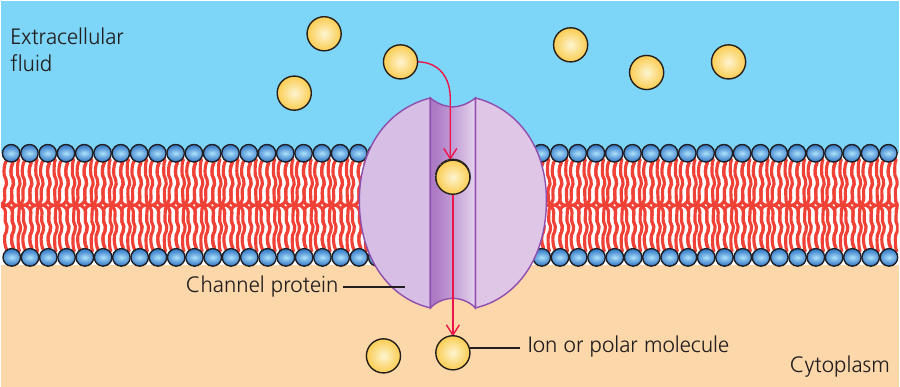
Facilitated diffusion enables larger molecules, polar molecules, and ions to cross the membrane using membrane proteins. Two protein types mediate this process:
Channel proteins
Channel proteins function as pores through the membrane, providing a hydrophilic pathway for ions and small polar molecules.
Key features:
- Different channels transport different substances
- Many channels can open and close to regulate flow
- Transport remains passive (no metabolic energy required)
- Movement still follows concentration gradients
Carrier proteins
Carrier proteins transport larger molecules through a conformational change mechanism:
- The specific molecule binds to the carrier protein
- The protein changes shape in response
- This shape change transfers the molecule across the membrane
- The protein returns to its original conformation
Key features:
- Each carrier shows specificity for particular substances
- Shape changes occur spontaneously (no metabolic energy needed)
- Process remains passive
- Movement follows concentration gradients
Note
Key Distinction: Both channel and carrier proteins enable facilitated diffusion, but they work differently. Channels provide a continuous pore through the membrane, while carriers undergo conformational changes to shuttle molecules across. This difference affects their transport rates and the types of molecules they can handle.
Comparison with simple diffusion
| Feature | Simple diffusion | Facilitated diffusion |
|---|---|---|
| Molecules transported | Small, non-polar molecules | Large molecules, polar molecules, ions |
| Membrane components | Lipid bilayer only | Channel or carrier proteins |
| Energy requirement | None (passive) | None (passive) |
| Specificity | Non-specific | Specific to transported substance |
| Regulation | Cannot be regulated | Can be regulated (especially channels) |
Active transport
Active transport moves substances against their concentration gradient, from regions of lower concentration to regions of higher concentration.
Energy requirement
Because particles cannot move against concentration gradients passively, cells must provide energy:
- Adenosine triphosphate (ATP) provides this energy directly
- The process is therefore active (energy-dependent)
- Respiratory inhibitors (e.g., cyanide) stop active transport by preventing ATP formation
Important
Critical Concept: Active transport is the only way particles can move up their concentration gradient. Without ATP, cells cannot perform active transport, which is why respiratory poisons that block ATP production are so lethal - they prevent essential ion pumping and other vital transport processes.
Mechanism of active transport
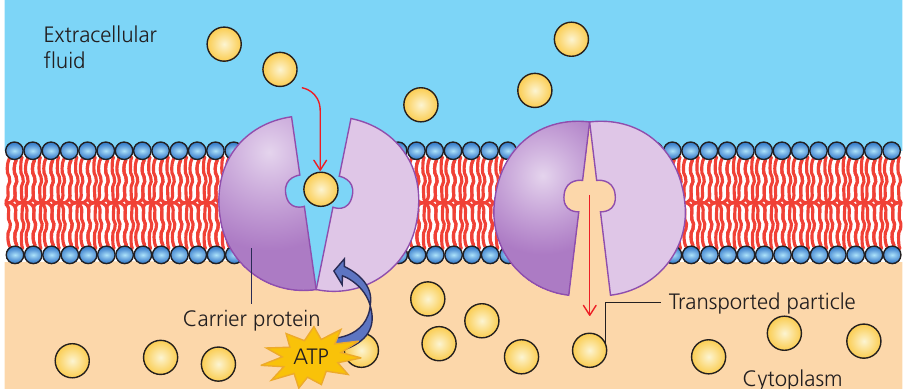
Active transport uses carrier proteins but not channel proteins:
- The transported particle binds to a specific carrier protein
- ATP provides energy for the carrier to change shape
- The shape change moves the particle across the membrane against its gradient
- The protein returns to its original conformation
Characteristics of active transport
- Each carrier protein is specific to one substance or a restricted range of substances
- Some carriers perform two-way active transport, simultaneously pumping one substance in and another out
- Active transport can accumulate substances to high concentrations inside cells
- The process continues regardless of concentration gradient direction
Evidence for active transport
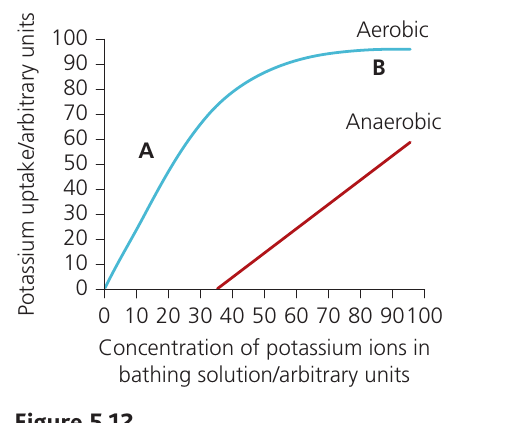
Experiments comparing aerobic and anaerobic conditions demonstrate active transport:
Example
Worked Example: Interpreting Active Transport Evidence
In aerobic conditions:
- Cells can produce ATP through respiration
- Ion uptake shows a saturation curve (reaching a maximum rate)
- Uptake exceeds that possible by diffusion alone
- This indicates carrier proteins become saturated at high ion concentrations
In anaerobic conditions:
- ATP production is severely limited
- Ion uptake occurs only by diffusion (linear relationship)
- Much lower uptake rates observed
- The dramatic difference proves that ATP-dependent active transport is responsible for the majority of ion uptake under normal conditions
Osmosis
Osmosis is the net movement of water molecules from a more dilute solution to a more concentrated solution across a partially permeable membrane.
Defining characteristics
Two factors define osmosis specifically:
- It involves only water molecules (not other substances)
- Movement occurs through a partially permeable membrane
Important
Precise Definition Matters: Water diffusion through cytoplasm or other substance diffusion through membranes should not be called osmosis. Osmosis requires both criteria: water molecules AND a partially permeable membrane. This is a common examination error.
Water potential
Scientists describe the concentration of water in solutions using water potential (symbol: , unit: kPa):
Water potential measures the relative tendency of water to move from one area to another. Water always moves from regions of higher water potential to regions of lower water potential.
Key points:
- Pure water has the highest water potential (defined as kPa)
- Adding solutes lowers water potential (values become negative)
- The more concentrated a solution, the lower (more negative) its water potential
- Lower water potential = greater tendency for water to move to that region
Note
Understanding Water Potential Values: Think of water potential like a number line extending into negative numbers. Pure water sits at zero. As you add solutes, you move further into negative territory. Water "wants" to move toward more negative values (lower water potential), which might seem counterintuitive at first. Remember: more negative = less water = water moves toward it.
Mechanism of osmosis
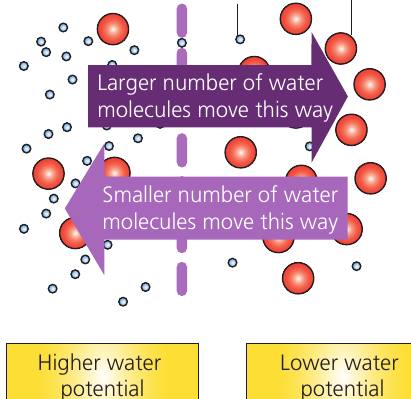
Osmosis operates as a two-way process:
- Water molecules move in both directions through the membrane
- More water molecules move from higher to lower water potential
- Fewer water molecules move in the opposite direction
- The difference creates net movement from higher to lower water potential
The process never stops (while water molecules remain on both sides), but may reach equilibrium when water movement in each direction becomes equal.
Effects of osmosis on cells
Different cell types respond differently to osmotic changes because of structural differences.
Effects on animal cells
Animal cells lack rigid cell walls, making them vulnerable to osmotic damage:
| Water potential of surrounding solution | Effect on cell | Term |
|---|---|---|
| Higher than cell (hypotonic) | Net water entry causes swelling and bursting | Lysis |
| Equal to cell (isotonic) | No net water movement | Equilibrium |
| Lower than cell (hypertonic) | Net water loss causes shrivelling | Crenation |
Both bursting and crenation are typically fatal to animal cells.
Note
Animal Cell Vulnerability: Without a rigid cell wall, animal cells are extremely sensitive to osmotic changes. This is why maintaining isotonic conditions is crucial for animal cells - both in the body (through homeostatic mechanisms) and in laboratory settings. Red blood cells placed in pure water will rapidly burst due to water influx.
Effects on plant cells
Plant cells possess rigid cell walls, which modify osmotic effects:
| Water potential of surrounding solution | Effect on cell | Term |
|---|---|---|
| Higher than cell (hypotonic) | Net water entry; cell becomes rigid | Turgid |
| Equal to cell (isotonic) | No net water movement; cell loses rigidity | Flaccid |
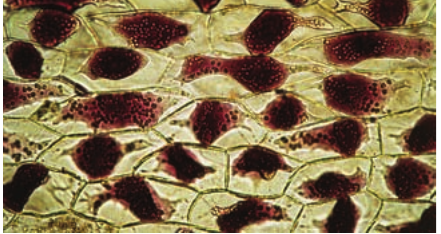
| Lower to cell (hypertonic) | Net water loss; cytoplasm pulls away from cell wall | Plasmolysed |
Turgid cells provide essential support in non-woody plants, preventing wilting. The rigid cell wall prevents bursting even when considerable water enters.
Plasmolysis can lead to cell death as the cytoplasm separates from the cell wall, creating gaps between the membrane and wall.
Important
Plant Cell Protection: The cellulose cell wall is what protects plant cells from bursting in hypotonic solutions. As water enters, the cell becomes turgid and the wall resists further expansion. This turgor pressure is essential for plant support - when plants wilt, it's because their cells have lost turgor and become flaccid.
Important terminology
When using osmotic terms, always define them using water potential:
- Hypotonic = higher water potential than the cell
- Isotonic = equal water potential to the cell
- Hypertonic = lower water potential than the cell
Note
Terminology Precision: Note that turgid, flaccid, and plasmolysed apply only to plant cells. Crenation applies only to animal cells. Using these terms incorrectly is a common examination mistake - always match the term to the correct cell type.
Investigating osmosis
Plasmolysis in plant tissue
Plasmolysis can be observed microscopically in plant epidermal cells:
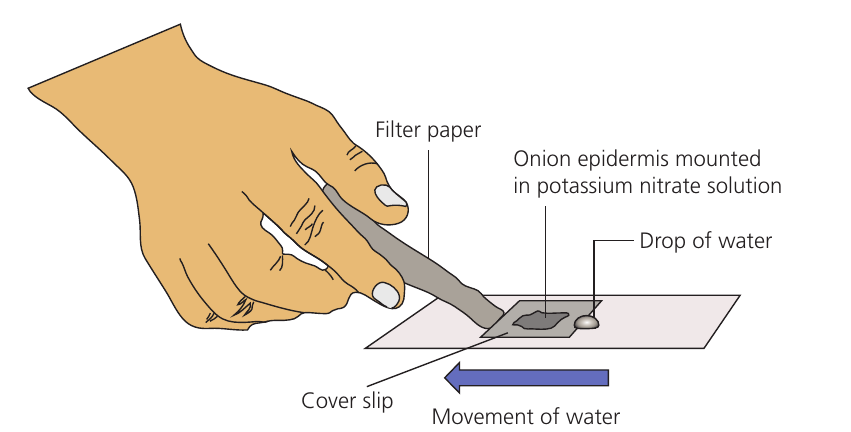
Experimental approach:
- Plant tissue is mounted in solutions of known water potential
- Cells are observed for plasmolysis (cytoplasm pulling away from cell wall)
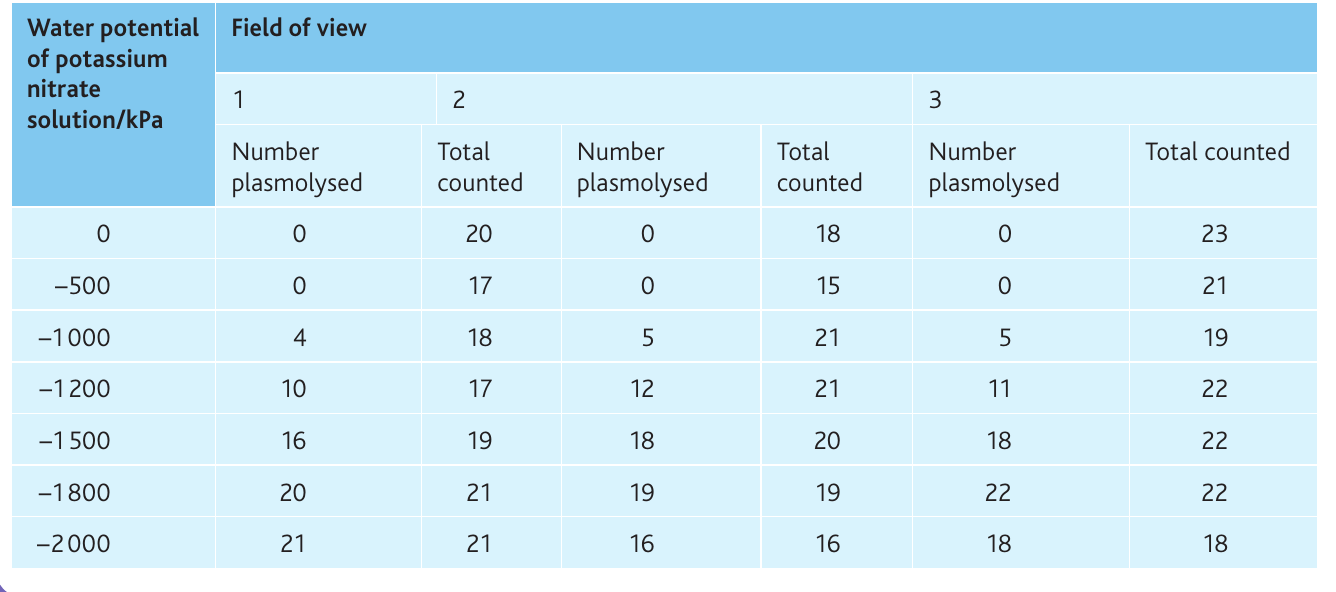
- The percentage of plasmolysed cells is counted at each water potential
- Results show the relationship between external water potential and plasmolysis
Example
Worked Example: Interpreting Plasmolysis Data
Key findings from the investigation:
- At high water potentials ( to kPa), no plasmolysis occurs (cells remain turgid)
- As water potential decreases, an increasing percentage of cells plasmolyse
- At very low water potentials ( to kPa), nearly all cells are plasmolysed
- Multiple fields of view should be counted to ensure reliability
- Percentage plasmolysis is more meaningful than total cell counts (accounts for varying cell numbers)
Interpreting the 50% point: The water potential at which 50% of cells are plasmolysed approximates the water potential of the cell sap. This represents the point where the external solution matches the internal water potential of an average cell.
Endocytosis and exocytosis
For large molecules or bulk quantities of materials, cells use membrane-based mechanisms that engulf or expel substances.
Endocytosis
Endocytosis is the process by which cells absorb molecules or particles by engulfing them. Two forms exist:
Pinocytosis
Pinocytosis (cell drinking) takes in small particles and fluid:
- The plasma membrane invaginates (folds inward)
- The invagination deepens to form a pocket
- Membranes fuse around the fluid, forming a small vesicle
- The vesicle separates into the cytoplasm
Phagocytosis
Phagocytosis (cell eating) takes in larger particles such as bacteria:
- Membrane extensions called pseudopodia (singular: pseudopodium) extend from the cell
- Pseudopodia wrap around the particle
- Membranes fuse to seal the particle in a vesicle
- The vesicle separates into the cytoplasm
In both processes, engulfed materials remain inside a membrane-bound vesicle, not free in the cytoplasm.
Note
Remembering the Difference: The terms derive from Greek - "phago" means eating and "pino" means drinking. Think of phagocytosis for large particles (like eating solid food) and pinocytosis for small particles and fluids (like drinking liquids). Both are forms of endocytosis ("endo" = into).
Exocytosis
Exocytosis secretes or expels substances from cells, essentially reversing pinocytosis:
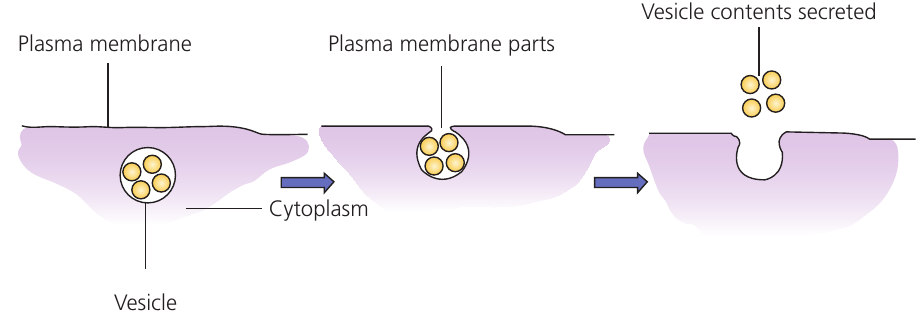
- A vesicle containing materials to be secreted moves to the plasma membrane
- The vesicle membrane fuses with the plasma membrane
- The vesicle opens to the cell exterior
- Contents are released outside the cell
Energy requirements
Both endocytosis and exocytosis are active processes requiring ATP as an energy source. Membrane fusion and vesicle formation demand energy input.
Important
ATP Requirement for Bulk Transport: Although endocytosis and exocytosis don't work against concentration gradients like active transport does, they still require ATP energy for the mechanical work of membrane fusion and vesicle formation. This makes them active (not passive) processes. Without ATP, cells cannot perform these essential bulk transport functions.
Summary
Key Points to Remember:
Passive Transport (No ATP Required):
- Diffusion moves particles down concentration gradients through random movement
- Facilitated diffusion uses channel or carrier proteins to move larger molecules, ions, and polar molecules down gradients
- Osmosis specifically describes net water movement across partially permeable membranes from higher to lower water potential
Active Transport (ATP Required):
- Active transport pumps substances against concentration gradients using carrier proteins and ATP energy
- Endocytosis (phagocytosis and pinocytosis) and exocytosis enable bulk transport using membrane vesicles
Water Potential Concepts:
- Water potential measures water's tendency to move; pure water = kPa, solutions have negative values
- Water moves from higher to lower water potential (more negative)
Cell Responses to Osmosis:
- Plant cells: turgid (rigid), flaccid (limp), or plasmolysed (cytoplasm pulled from wall)
- Animal cells: may burst in hypotonic solutions or become crenated (shrivelled) in hypertonic solutions
Solution Terminology:
- Hypotonic = higher water potential than the cell (water enters)
- Isotonic = equal water potential to the cell (no net movement)
- Hypertonic = lower water potential than the cell (water leaves)