Independent Assortment, Crossing Over, and Genetic Variation (OCR A-Level Biology A): Revision Notes
📚Revision Notes
Independent Assortment, Crossing Over, and Genetic Variation
Introduction to genetic variation in sexual reproduction
Sexual reproduction using gametes formed through meiosis generates offspring with significant genetic variation. This variation arises from two key mechanisms operating during meiosis: independent assortment and crossing over. Both processes ensure that each gamete produced is genetically unique, contributing to the genetic diversity observed in sexually reproducing populations.
Note
Genetic variation is essential for the survival and evolution of species. It provides the raw material for natural selection, allowing populations to adapt to changing environmental conditions and challenges.
Independent assortment
Independent assortment describes the random distribution of chromosomes from each homologous pair into daughter cells during meiosis. This mechanism operates during the first meiotic division and represents a major source of genetic variation.
Mechanism of independent assortment
During meiosis, homologous chromosomes enable cells to pass a complete set of chromosomes to gametes whilst maintaining all genes in the new individual. When meiosis I occurs, one chromosome from each homologous pair transfers to the newly formed gamete. Crucially, which chromosome from any homologous pair enters a particular gamete occurs entirely randomly.
When fertilisation takes place, the diploid number restores and homologous pairs reinstate. Since homologous pairs carry the same genes but potentially different alleles (gene variants), each gamete receives a unique genetic composition depending on which chromosome from each pair passes forward.
Important
The randomness of chromosome distribution is the key factor that generates variation. There is no predetermined pattern - each chromosome from a homologous pair has an equal chance of entering either daughter cell.
Calculating possible combinations
The number of possible chromosome combinations depends on the number of homologous pairs present. With pairs of chromosomes, the number of possible combinations equals .
Example
Worked Example: Calculating Combinations in Humans
For humans, with pairs of chromosomes:
Step 1: Apply the formula Number of combinations =
Step 2: Substitute the value Number of combinations =
Step 3: Calculate the result (over 8 million different possible combinations)
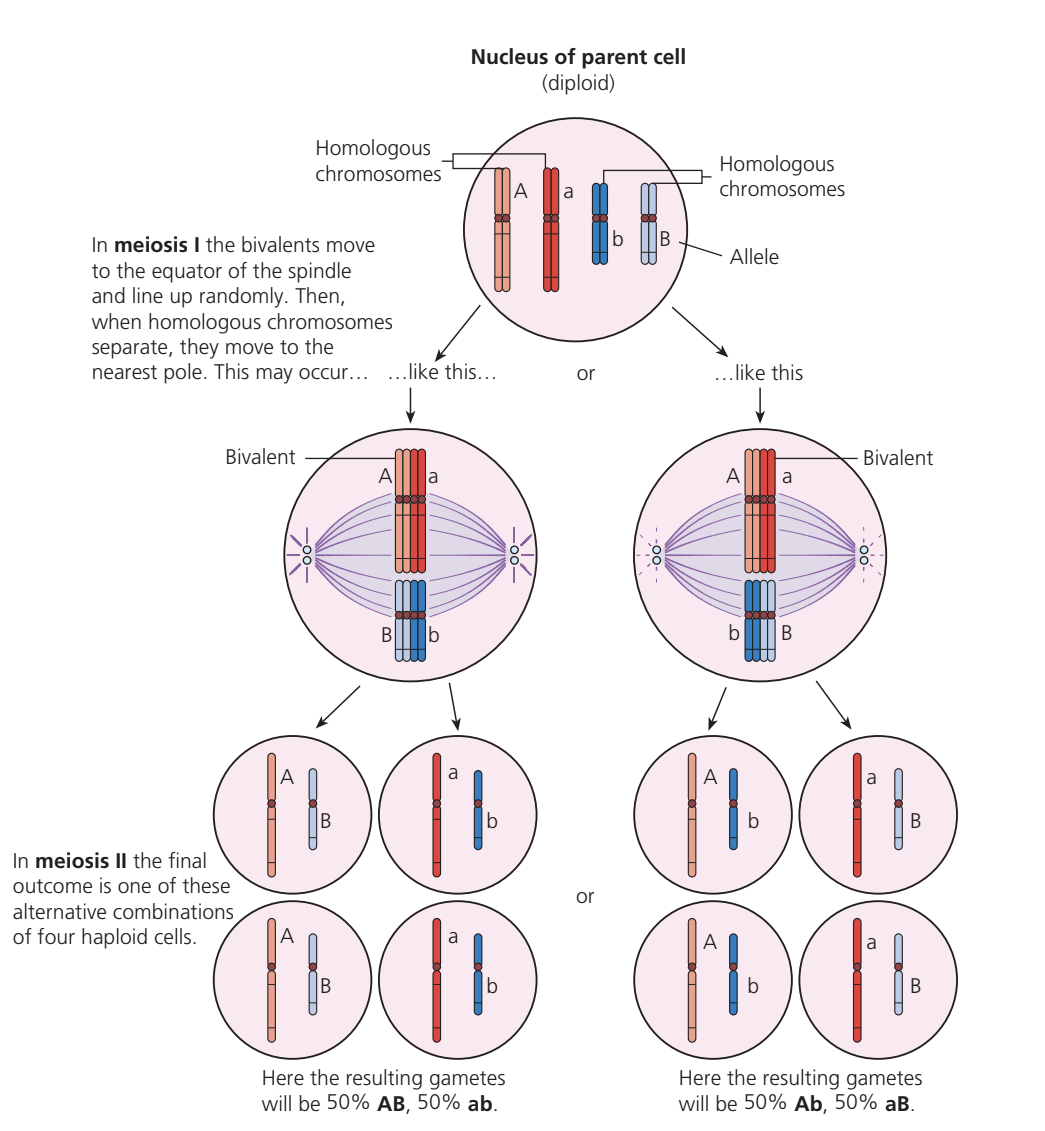
The diagram above illustrates independent assortment in a parent cell containing two pairs of homologous chromosomes (forming two bivalents - paired homologous chromosomes). The letters A/a and B/b represent different alleles of two distinct genes located on separate chromosomes. During metaphase I, bivalents align randomly at the cell equator. This random alignment produces two alternative separation patterns:
- Pattern 1: Results in AB gametes and ab gametes
- Pattern 2: Results in Ab gametes and aB gametes
Note
The greater the number of bivalents, the more variation becomes possible. This exponential relationship () means that even small increases in chromosome number dramatically increase genetic diversity.
Crossing over
Crossing over provides an additional mechanism for generating genetic variation during meiosis. This process involves the physical exchange of genetic material between homologous chromosomes.
Process of crossing over
Crossing over occurs during prophase I of meiosis. The homologous chromosome pair undergoes synapsis (pairing together), forming a bivalent structure. At specific points where chromatids cross, called chiasmata (singular: chiasma), breaks appear at equivalent locations on two non-sister chromatids. The broken sections then exchange between the chromatids.
Because homologous chromosomes possess identical gene sequences, exchanging broken sections does not disrupt genetic information. However, the exchange does rearrange alleles from the original paternal and maternal chromosomes, creating new allele combinations.
Important
Typically, two, three, or more chiasmata form between chromatids of each bivalent during prophase I, substantially increasing potential genetic variation. The formation of multiple chiasmata per bivalent multiplies the number of possible recombinant chromosomes that can be produced.
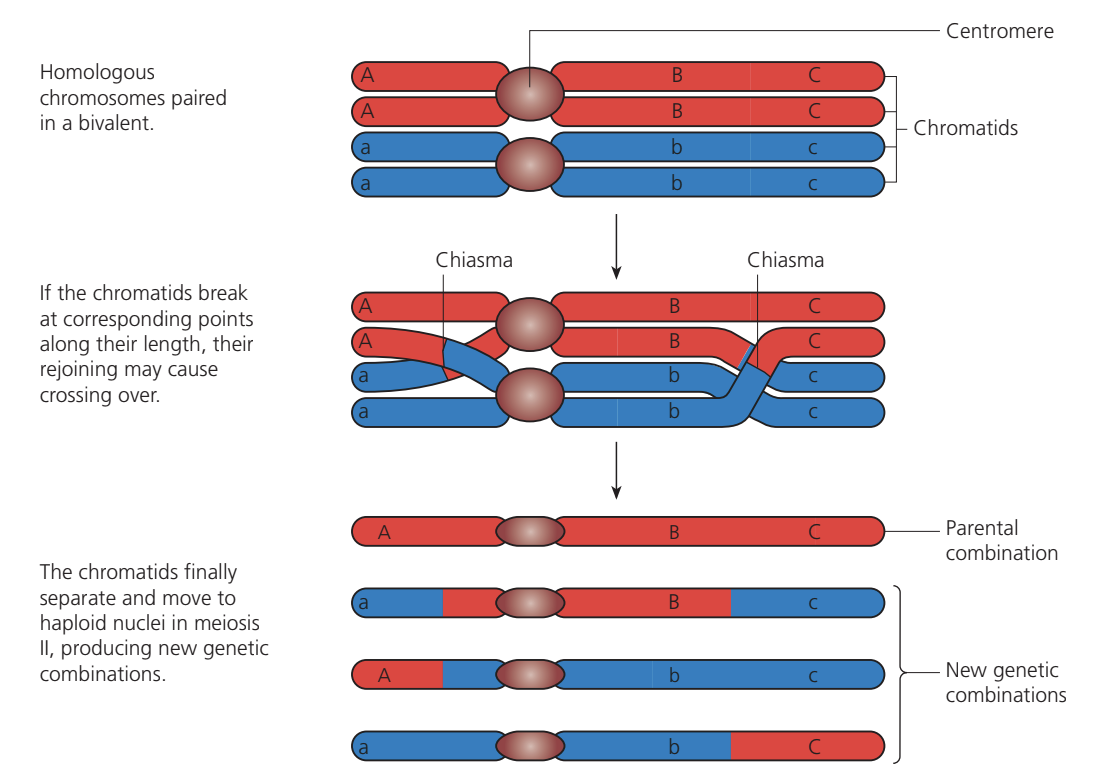
The diagram above demonstrates crossing over between a pair of homologous chromosomes. The process follows these stages:
Example
Demonstration: Stages of Crossing Over
Stage 1 - Initial pairing: Homologous chromosomes pair as a bivalent, each consisting of two sister chromatids joined at the centromere
Stage 2 - Chiasma formation: Chromatids break at corresponding points along their length where they cross over
Stage 3 - Genetic exchange: Broken segments rejoin, causing segments to swap between non-sister chromatids
Stage 4 - Separation: Following meiosis II, chromatids separate and move to haploid nuclei, producing new genetic combinations
The chromosomes labelled with alleles A-B-C (red) and a-b-c (blue) demonstrate how crossing over creates recombinant chromosomes with new allele combinations (e.g., A-b-c, a-B-c) alongside parental combinations (A-B-C, a-b-c).
Combined effect on genetic variation
Independent assortment and crossing over work together to ensure nearly all gametes produced are genetically unique. The scale of variation these mechanisms generate in humans is remarkable.
Quantitative analysis in humans
In humans, with chromosome pairs:
- The probability of producing genetically identical gametes from independent assortment alone equals approximately 1 in 20 million
- Males produce over 400 billion sperm cells during their lifetime, meaning some genetically identical sperm cells will occur
- Females release approximately 450 eggs total across their reproductive lifetime, making each egg cell almost certain to be genetically unique
- The probability of two fertilisations involving both genetically identical sperm and genetically identical eggs equals approximately 1 in 400,000 billion ()
Important
This extraordinarily low probability explains why all humans, apart from identical twins who originate from the same fertilised egg, possess unique genetic compositions. Even siblings (except identical twins) are genetically distinct because they result from different combinations of parental chromosomes and different crossing over events.
Explaining human genetic uniqueness
The combination of independent assortment creating millions of possible chromosome arrangements, plus crossing over generating countless new allele combinations within chromosomes, ensures that genetic variation remains extremely high in sexually reproducing populations.
The maintenance of genetic variation through these mechanisms provides the raw material for natural selection and evolution, allowing populations to adapt to changing environmental conditions.
Summary
Key Points to Remember:
-
Independent assortment randomly distributes chromosomes from homologous pairs into gametes during meiosis I, with possible combinations where equals the number of chromosome pairs
-
Crossing over exchanges genetic material between non-sister chromatids at chiasmata during prophase I, creating new allele combinations on individual chromosomes
-
In humans ( chromosome pairs), independent assortment alone generates over 8 million possible gamete combinations
-
The combined effects of independent assortment and crossing over make the probability of two genetically identical fertilisations approximately 1 in 400,000 billion, explaining genetic uniqueness in humans (except identical twins)
-
Multiple chiasmata typically form per bivalent, substantially amplifying the genetic variation produced through crossing over
-
These mechanisms together provide the essential genetic variation needed for natural selection and evolutionary adaptation