Inorganic Ions in Biological Processes (OCR A-Level Biology A): Revision Notes
📚Revision Notes
Inorganic Ions in Biological Processes
Introduction to inorganic ions
Biological processes require enzymes and substrates, but they also depend on various inorganic ions. These ions are essential for vital cellular activity in both animals and plants. They serve multiple functions: contributing to the osmotic pressure of body fluids, acting as cofactors for enzyme activity, and participating in numerous other critical processes.
Note
A cofactor is a non-protein chemical compound required for a protein's biological activity. Many enzymes cannot function without their specific cofactors, which may be metal ions or other inorganic molecules. Without these cofactors, the enzyme's tertiary structure may not be maintained, or the active site may not function properly.
Inorganic ions can be classified into two main categories: cations (positively charged ions) and anions (negatively charged ions). Each type of ion has specific roles in maintaining cellular function and supporting life processes.
Cations in biological processes
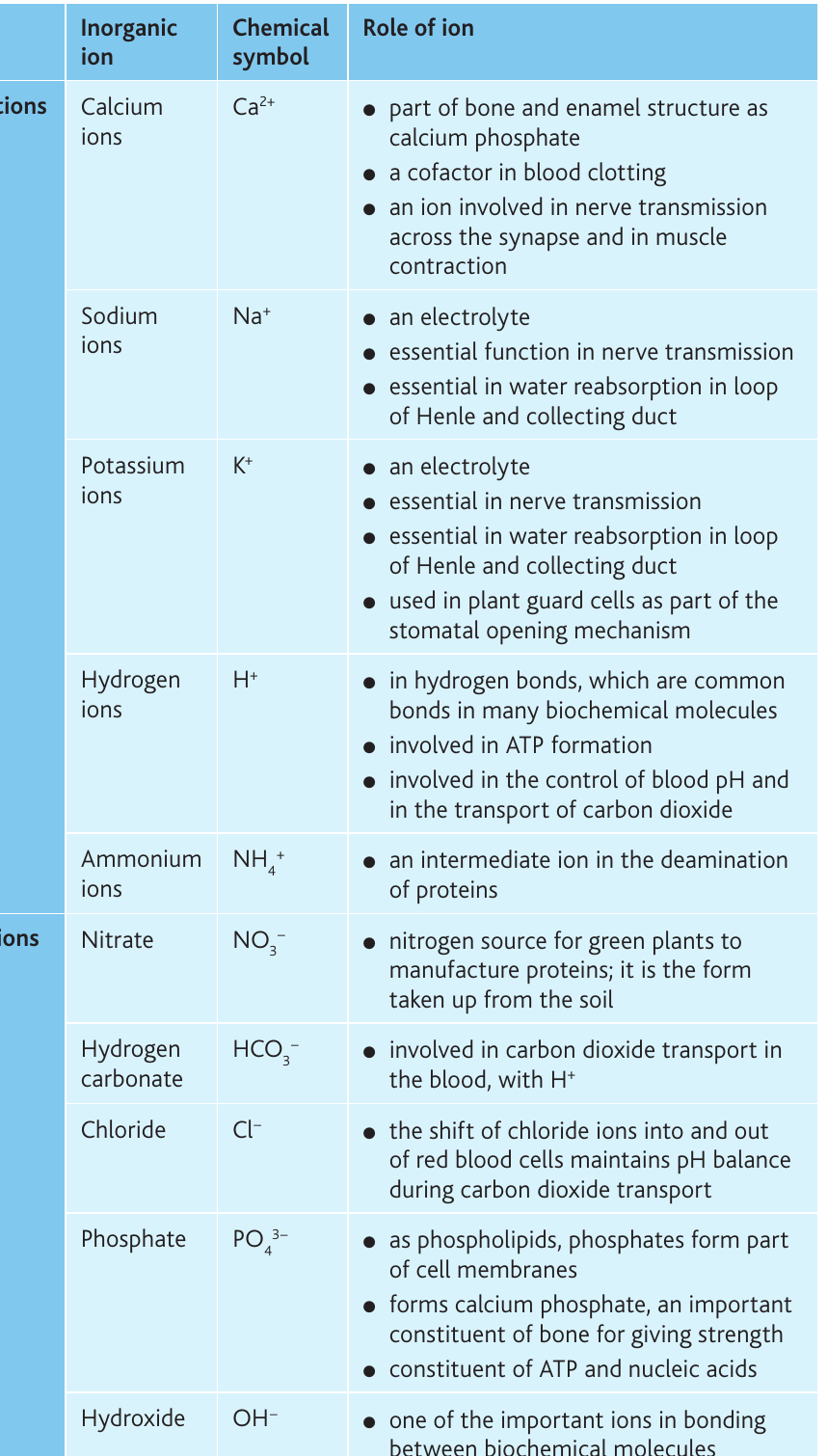
Calcium ions (Ca²⁺)
Calcium ions have structural and regulatory functions in organisms. They form calcium phosphate, which is a key component of bone and tooth enamel, providing mechanical strength and rigidity to these structures. In blood clotting, calcium ions act as a cofactor for several enzymes in the clotting cascade, enabling the formation of fibrin clots.
Calcium ions also play a vital role in cell signalling. During nerve transmission, they are involved in the release of neurotransmitters across synapses. Similarly, in muscle contraction, calcium ions interact with troponin proteins to expose binding sites on actin filaments, allowing myosin to bind and initiate contraction.
Note
Calcium ions demonstrate remarkable versatility in biological systems - they provide both structural support (in bones and teeth) and dynamic regulatory functions (in signalling, nerve transmission, and muscle contraction).
Sodium ions (Na⁺)
Sodium ions function primarily as an electrolyte, helping to maintain the electrical balance across cell membranes. They are essential for nerve transmission, where they move across the axon membrane during the generation and propagation of action potentials.
In the kidneys, sodium ions are critical for water reabsorption in the loop of Henle and the collecting duct. The active transport of sodium ions creates an osmotic gradient that drives the reabsorption of water, helping to regulate blood volume and concentration.
Potassium ions (K⁺)
Like sodium, potassium ions serve as an electrolyte and are essential for nerve transmission. They work in partnership with sodium ions to establish and maintain the resting potential of neurons and to repolarise the membrane after an action potential.
Potassium ions also play a role in kidney function, being essential for water reabsorption in the loop of Henle and collecting duct. In plants, potassium ions accumulate in guard cells to increase their water potential, causing water to enter by osmosis. This makes the guard cells turgid and opens the stomata, allowing gas exchange.
Hydrogen ions (H⁺)
Hydrogen ions participate in hydrogen bonding, which is common in many biochemical molecules including proteins and nucleic acids. These bonds help stabilise the secondary and tertiary structures of proteins.
Important
Hydrogen ions are directly involved in ATP formation during chemiosmosis in respiration and photosynthesis. The movement of hydrogen ions down their concentration gradient through ATP synthase provides the energy to phosphorylate ADP to ATP. This process is fundamental to cellular energy production.
Additionally, hydrogen ions help control blood pH and play a role in carbon dioxide transport. In red blood cells, carbon dioxide combines with water to form carbonic acid, which dissociates into hydrogen carbonate ions and hydrogen ions.
Ammonium ions (NH₄⁺)
Ammonium ions are formed as an intermediate product during the deamination of proteins. When amino acids are broken down, the amino group is removed and converted to ammonia, which then forms ammonium ions. These are typically converted to urea in the liver for excretion.
Anions in biological processes
Nitrate ions (NO₃⁻)
Nitrate ions serve as the nitrogen source for green plants. Plants absorb nitrate from the soil through their root systems and use it to manufacture amino acids and proteins. Nitrate is the form of nitrogen most readily available for uptake by plant roots.
Hydrogen carbonate ions (HCO₃⁻)
Hydrogen carbonate ions are essential for carbon dioxide transport in the blood. When carbon dioxide diffuses into red blood cells, it combines with water in a reaction catalysed by carbonic anhydrase. This forms carbonic acid, which dissociates into hydrogen carbonate ions and hydrogen ions. The hydrogen carbonate ions then diffuse out of the red blood cells into the blood plasma, where they are transported to the lungs.
Chloride ions (Cl⁻)
The movement of chloride ions into and out of red blood cells maintains pH balance during carbon dioxide transport. This process, known as the chloride shift, occurs when hydrogen carbonate ions diffuse out of red blood cells. To maintain electrical neutrality, chloride ions move in the opposite direction, entering the cells from the plasma.
Note
The chloride shift is a crucial mechanism for maintaining electrical balance across cell membranes. Without this compensatory movement of chloride ions, the loss of negatively charged hydrogen carbonate ions would create an electrical imbalance in red blood cells.
Phosphate ions (PO₄³⁻)
Phosphate ions have several critical roles in cells. As phospholipids, they form part of cell membranes, with the phosphate group forming the hydrophilic head of the molecule. Phosphate combines with calcium to form calcium phosphate, which provides strength to bones and teeth.
Phosphate is also a constituent of ATP (adenosine triphosphate), the universal energy currency of cells. Additionally, phosphate groups form part of the sugar-phosphate backbone in nucleic acids (DNA and RNA), linking nucleotides together in polynucleotide chains.
Important
Phosphate ions are among the most versatile inorganic ions in biology. They play essential roles in:
- Energy transfer (as part of ATP)
- Genetic information storage (in DNA and RNA backbones)
- Cell membrane structure (in phospholipids)
- Skeletal support (in bones and teeth)
Hydroxide ions (OH⁻)
Hydroxide ions are important in bonding between biochemical molecules. They participate in the formation of ester bonds and other chemical linkages in biological polymers.
Practical: Biuret test for proteins
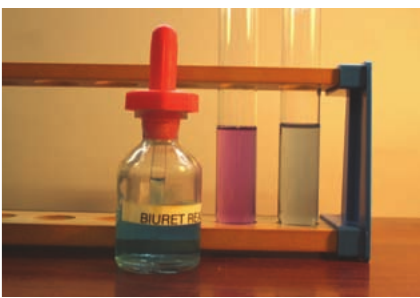
The biuret test is a qualitative biochemical test used to detect the presence of proteins. Although this test detects proteins rather than inorganic ions directly, it demonstrates important laboratory techniques for biological analysis.
Example
Worked Example: Performing the Biuret Test
Step 1: Mix equal volumes of protein suspension and sodium hydroxide solution by shaking
Step 2: Add copper sulfate solution drop by drop, shaking between each addition
Step 3: Observe the colour change
Expected Result: A mauve or purple colour indicates the presence of proteins. This occurs because the peptide bonds in proteins form a complex with copper ions in alkaline conditions.
Control: A solution without protein remains the original blue colour of copper sulfate.

Note
The protein sample appears as a cloudy suspension rather than a clear solution because protein molecules are large and do not fully dissolve. Instead, they remain dispersed as small particles throughout the liquid, causing light to scatter and creating a cloudy appearance.
The biuret test is qualitative because it only indicates whether protein is present or absent based on a colour change. It does not provide precise numerical data about protein concentration. To make this a quantitative test, a colorimeter would be needed to measure the intensity of the purple colour, which is proportional to protein concentration.
ATP and the role of phosphate
Adenosine triphosphate (ATP) is the universal energy currency of cells, transferring energy for cellular processes. The structure of ATP demonstrates the importance of phosphate groups in biological molecules.
ATP consists of three main components joined by covalent bonds:
- The nitrogenous base adenine
- The pentose sugar ribose (a 5-carbon sugar)
- Three phosphate groups linked in a chain
Note
The combination of adenine and ribose forms adenosine. When one phosphate group is attached, this creates adenosine monophosphate (AMP). Two phosphate groups form adenosine diphosphate (ADP), and three phosphate groups form adenosine triphosphate (ATP).
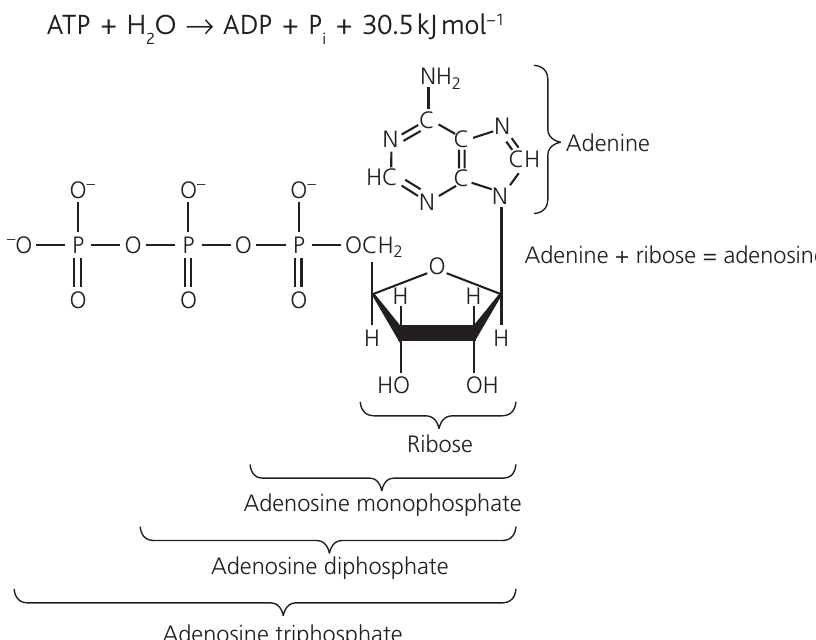
During energy transfer, ATP undergoes hydrolysis when water is added. The terminal (outermost) phosphate group is removed, releasing energy and inorganic phosphate (). This reaction can be represented as:
The energy released () is available for cellular processes such as active transport, muscle contraction, protein synthesis, and DNA replication. This demonstrates the crucial role of phosphate ions in energy metabolism.
Important
The presence of three negatively charged phosphate groups creates instability in the ATP molecule due to electrostatic repulsion. When the terminal phosphate bond is broken, this releases the stored energy. The ADP produced can be re-phosphorylated to ATP during respiration or photosynthesis, allowing the continuous cycling of energy in cells.
Remember!
Summary
Key Points to Remember:
-
Inorganic ions are essential for vital cellular processes and can act as cofactors for enzymes
-
Cations (Ca²⁺, Na⁺, K⁺, H⁺, NH₄⁺) have roles in structure, nerve transmission, muscle contraction, pH control, and kidney function
-
Anions (NO₃⁻, HCO₃⁻, Cl⁻, PO₄³⁻, OH⁻) are involved in nutrition, gas transport, pH balance, membrane structure, and energy transfer
-
Phosphate ions are particularly important as components of ATP, nucleic acids, phospholipids, and bone structure
-
ATP releases when hydrolysed to ADP and inorganic phosphate, providing energy for cellular processes